Victor Vasarely: Pioneer of Op Art and Democratizing Visual Experience
Victor Vasarely (1906-1997) stands as a monumental figure in the history of modern art, recognized globally for his groundbreaking contribution to Op Art – Optical Art. Born Károly Vaszary in Pécs, Croatia, he embarked on an artistic journey that defied conventional expectations, initially pursuing medical studies before discovering his true vocation within the realm of visual expression.
- Early Influences: Vasarely’s formative years were marked by exposure to Bauhaus principles and Sándor Bortnyik’s workshop, fostering a deep appreciation for functional design and geometric abstraction. These influences would irrevocably shape his artistic vision.
- The Birth of Geometric Abstraction: Abandoning medicine in 1927, he enrolled at the Podolini-Volkmann Academy, where he honed his skills in creating abstract compositions centered around fundamental geometric forms – circles, squares, triangles, and diamonds.
- Op Art’s Revolutionary Vision: Vasarely's pivotal breakthrough arrived with his embrace of Op Art, a movement that sought to challenge perceptions of reality through illusionistic visual effects achieved via precise geometric patterns. This approach aimed to stimulate the eye and provoke contemplation about how we perceive space and color.
MC-MC Pan: A Masterpiece of Geometric Illusion
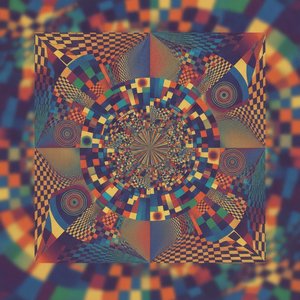
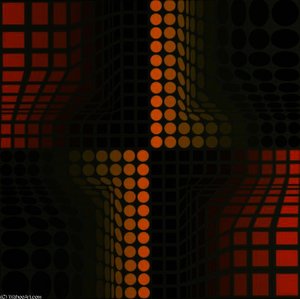
“MC-MC Pan” exemplifies Vasarely’s signature style—a vibrant collage of interlocking colored geometric shapes that create a mesmerizing optical illusion. The painting features at least 13 distinct shapes, each meticulously rendered in bold hues – reds, blues, yellows, and greens – contributing to the overall dynamism and complexity of the composition.
The artwork’s color palette is deliberately chosen to maximize visual impact, mirroring the principles of Op Art. The careful arrangement of shapes generates a sense of depth and movement, inviting viewers to actively engage with the piece and experience its perceptual distortions firsthand. It's remarkable how Vasarely manages to convey emotion through purely geometric forms.
Technique and Material Considerations
Executed in color screenprint on wove paper, “MC-MC Pan” showcases Vasarely’s mastery of printmaking techniques. The meticulous application of pigment ensures exceptional color fidelity and textural detail, preserving the artist's vision with remarkable accuracy. The wide margins surrounding the image further enhance its aesthetic appeal.
Vasarely’s systematic approach to art creation—characterized by mathematical precision and rigorous experimentation—is evident in every aspect of this artwork. He meticulously calculated the placement and size of each shape, striving for optimal visual harmony and maximizing the illusionistic effect.
Symbolism and Legacy
"MC-MC Pan" transcends mere decorative beauty; it embodies Vasarely’s philosophical exploration into the nature of perception and consciousness. The geometric forms themselves represent a deliberate rejection of representational art, prioritizing abstraction as a means of conveying universal ideas about order, rhythm, and dynamism.
Vasarely's influence extends far beyond the confines of Op Art, impacting fields such as architecture, design, and even music. His pioneering work continues to inspire artists and designers worldwide, demonstrating the enduring power of geometric abstraction to provoke thought and stimulate creativity. Reproductions of “MC-MC Pan” offer a captivating glimpse into Vasarely’s artistic universe—a testament to his unwavering commitment to pushing boundaries and redefining visual experience.
Pitanja i odgovori
Koja je dominantna nijansa dela „MC-MC пан”, Viktor Vasereli?
Dominantna nijansa dela „MC-MC пан”, Viktor Vasereli je Spektar od zelene do ljubičaste. Ova nijansa predstavlja osnovni ton palete.
Kako mogu da nabavim digitalni fajl dela „MC-MC пан”, Viktor Vasereli?
Da biste dobili digitalni fajl dela „MC-MC пан”, Viktor Vasereli, poručite preuzimanje digitalne slike visoke rezolucije na njegovoj stranici Digitalna slika.
Kakvu bojnu harmoniju prikazuje „MC-MC пан”, Viktor Vasereli?
Harmonija boja dela "MC-MC пан" zabeležena je kao Neskladna paleta boja.



 Pregledaj u prostoru
 Naručite ručno oslikano reprodukciju
 Podeli
 Podeli
 Detalji
 Vodič
Vodič

 Preuzmi sliku
 Slični predmeti
 Rendgenski snimak
 Automatska prezentacija
 Statistika
 Pročitaj više






































 Opcija sa staklom dostupna je samo za dimenzije manje od 110 cm