Giclée štampa ili print na platnu muzejskog kvaliteta uz brzu izradu i raznovrsne opcije završne obrade. ( Kupite ručno oslikano delo Pređi na digitalnu sliku)





























Izaberite jednu od naših unapred definisanih veličina koje odgovaraju originalnim proporcijama umetničkog dela.

Unesite željenu širinu i visinu kako bi se štampa uklopila u vaš ram ili zid. Štampu je moguće samo iseći, ali nikada povećati iznad dimenzija originalne slike, stoga format sa drugačijim proporcijama uzrokuje gubitak dela slike. Pre početka štampe, poslaćemo vam digitalni prikaz radi potvrde. Slika prikazana na ovoj stranici ne predstavlja stvarni isrez — to pokazuje samo digitalni prikaz.
Dostava širom sveta () za 2 nedelje umesto uobičajenih 4/5 nedelja. (13 новембар)
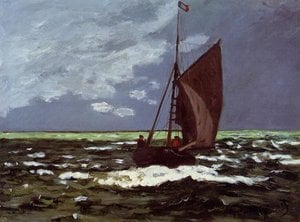
Seascape
Dimenzije reprodukcije
A heavy, dark indigo water rises in diagonal lines across the canvas. Large, cresting waves move with a raw, turbulent energy, pushing toward the viewer from a low vantage point within the sea itself. Deep charcoal grays and blacks dominate the depths of the ocean, while muted whites mark the churning foam at the peaks. The ships appear as dark silhouettes, their sharp, angular masts providing a structural contrast to the organic, undulating shapes of the waves. Light breaks through thick, overcast clouds in a chiaroscuro effect, catching only the highest points of the spray and the edges of the vessels.
The year 1627 marks this moment of maritime peril. The painting utilizes oil on canvas to achieve atmospheric depth and realistic light effects characteristic of Baroque maritime painting. Through delicate brushwork, a sense of mist and salt spray settles over the scene. The composition captures multiple sailing vessels struggling against massive swells, creating a feeling of isolation and the immense power of nature. A pale ochre tint touches the heavy clouds above the dark water.
The sea remains restless.
„Seascape”, autor Claes Claesz. Wou prikazuje: waves, ships, sea, clouds, dark blue, white foam, ocean.
Što se tiče autorskih prava, delo "Seascape" je u javnom vlasništvu – autorska prava su istekla.
Delo "Seascape" možete istraživati sloj po sloj na stranici Rentgensko posmatranje, koja predstavlja interaktivni pregledač inspirisan konzervatorskim svetlosnim stolom, sa jedanaest optičkih prikaza slike.

In the narrow streets of Amsterdam, where the water meets the stone, Claes Claesz. Wou lived a life tied to the movement of the tides. Born in 1592, he was a man of the city, moving from the quiet outskirts of Buitenveldert to the bustling Prinsengracht near the Laurierstraat. He was more than a painter; he held the position of a waard in 't Groene Woudt, a role that suggests a life deeply embedded in the local community. There was a certain social weight to his presence, though perhaps not a financial one. At the time of his death in 1665, he left behind many debts owed by his fellow artists, a detail that hints at a man who lived closely among his peers, perhaps spending as much time in their company as he did at his easel.
His hands were accustomed to the brush, but his eyes were fixed on the horizon. He did not seek the bright, clear skies of the Mediterranean. Instead, he found his subject in the heavy, churning waters of the North Sea. His work focused on the struggle of ships against the elements, capturing the weight of a storm and the spray of salt against wood.
Wou’s technique was one of restraint and atmosphere. He did not rely on a wide palette to tell his story. Instead, he worked within a restricted range, often using a monochrome grey to build the depth of a storm. He understood how light breaks through a heavy sky to hit the crest of a wave. His compositions were defined by a low horizon, a choice that forces the viewer to look up at the vastness of the sky and the chaos of the water, making the ships appear small and vulnerable against the immense scale of the ocean.
His approach to the sea was shaped by specific technical choices:
The influence of Wou can be seen in the way he translated the movement of water onto a flat surface. He was not a solitary figure in the art world, but one who sat at the center of a circle of makers. It is believed that he may have been the teacher of Jan Abrahamsz. van Beerstraten, another painter who dedicated his life to the same maritime subjects. This connection suggests a continuity of style and a passing down of the specific way to capture a storm. He remained active in his craft from 1612 until his death in 1665, a long life spent observing the way the light changes over the water.

1592 - 1665 , Netherlands

Discover the profound beauty of maritime art with our expert guide. From Impressionist waves to bespoke impasto commissions, explore how premium seascape paintings elevate luxury interiors and professional collections through timeless craftsmanship.

Discover the profound beauty of maritime masterpieces. From historical seascapes to bespoke oil reproductions, explore the artistry, emotion, and timeless elegance of the sea through our curated collection of premium fine art.
Immerse yourself in the profound beauty of marine art. From 17th-century maritime masterpieces to bespoke hand-painted oil reproductions, discover a curated collection of exquisite seascapes designed for the discerning collector and luxury interior professional. Experience timeless elegance.

Discover the profound beauty of seascape art with our expert guide for collectors. Explore premium hand-painted maritime reproductions, from Impressionist light to classical masters, and learn how bespoke coastal commissions can transform luxury interiors with timeless elegance.

Discover the profound allure of maritime art through our curated collection of exquisite nautical masterpieces. From hand-painted oil reproductions to bespoke commissions, we provide museum-quality seascapes for elite collectors and luxury hospitality design worldwide.
 Pregledaj u prostoru
 Pošalji
 Podeli
 Detalji o delu
 Vodič
Vodič

 Preuzmi
 Slični predmeti
 Rendgenski snimak
 Automatska prezentacija
 Pitanja i odgovori
 Statistika

 Pročitaj više









 Opcija sa staklom dostupna je samo za dimenzije manje od 110 cm