Robert Henri’s “Paris Night”: A Glimpse of Urban Life in 1898
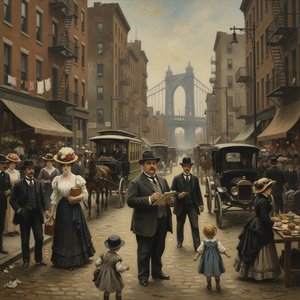
Robert Henri's "Paris Night," painted in 1898, isn’t merely a depiction of a Parisian street scene; it’s a vibrant snapshot of a city teeming with life and subtly hinting at the social currents simmering beneath its romantic facade. Born amidst turmoil – his father’s gambling debts and subsequent flight from Cincinnati casting a long shadow over his early years – Henri channeled this inherent restlessness into an artistic vision that fiercely rejected the rigid conventions of academic art. This painting, created during a pivotal period in his career, exemplifies his commitment to capturing the raw, unvarnished reality of American life, particularly as observed through the lens of urban experience.
The scene unfolds with remarkable immediacy. A black and white palette dominates, lending the image an almost photographic quality reminiscent of late 19th-century photography – a deliberate choice by Henri to ground his work in the tangible world. Figures populate the street, not as idealized subjects but as individuals going about their daily routines: men in hats hurrying along, women carrying baskets, and horses pulling carriages through the dimly lit thoroughfare. Henri masterfully employs perspective to create depth, drawing the viewer’s eye from the foreground figures – rendered with a slightly rougher, more immediate brushstroke – towards the receding forms of the buildings and the distant glow of gaslights. The two horses, prominently featured near the center, add to the sense of movement and bustle, while the carriage on the right reinforces the image's narrative of urban commerce.
The Ashcan School and Henri’s Realist Vision
“Paris Night” firmly situates itself within the burgeoning Ashcan School movement, a group of American artists who rejected the polished realism favored by the established art academies. Influenced by Impressionism but rejecting its emphasis on fleeting light and delicate brushwork, the Ashcan School sought to depict the gritty realities of urban life – poverty, overcrowding, and social inequality – with unflinching honesty. Henri, along with artists like John Sloan and George Luks, aimed to create a distinctly American art that reflected the experiences of ordinary people. This wasn’t about romanticizing or glorifying; it was about presenting a truthful, often uncomfortable, portrait of modern America.
Henri's technique in “Paris Night” is characterized by loose brushwork and a deliberate lack of detail. He prioritized capturing the *feeling* of the scene – the energy, the noise, the sense of anonymity – over meticulous representation. The figures are not sharply defined; they’re suggested rather than precisely rendered, contributing to the painting's overall atmosphere of immediacy and movement. Notice how he uses subtle variations in tone and texture to create a sense of depth and volume, particularly in the depiction of the buildings and the horses. This approach was revolutionary for its time, challenging the prevailing artistic norms and paving the way for future generations of American artists.
Symbolism and Emotional Resonance
Beyond its straightforward depiction of urban life, “Paris Night” carries a subtle layer of symbolism. The darkness of the scene – punctuated by the artificial glow of gaslights – evokes a sense of mystery and perhaps even unease. The crowded street, teeming with anonymous figures, speaks to the alienation and isolation that can be experienced in modern cities. Henri’s decision to portray these individuals without judgment or sentimentality forces the viewer to confront the complexities of urban existence.
Furthermore, considering Henri's own turbulent childhood – marked by instability and a dramatic family upheaval – one might interpret “Paris Night” as an exploration of themes related to displacement, anonymity, and the search for identity. The painting’s raw energy and unvarnished realism reflect his own personal journey of reinvention and his desire to find meaning in the everyday experiences of ordinary people. It's a powerful testament to the ability of art to capture not just what is seen but also what is felt – the anxieties, the hopes, and the struggles that shape our lives.
A Reproduction for Your Space
WahooArt offers meticulously hand-painted reproductions of Robert Henri’s “Paris Night,” capturing the essence of this iconic work with exceptional detail and fidelity. Our artists utilize archival-quality materials to ensure that your reproduction will endure for generations, faithfully preserving the painting's rich textures, subtle tonal variations, and evocative atmosphere. Whether you are an art collector, a design enthusiast, or simply seeking a stunning piece to adorn your walls, our “Paris Night” reproduction provides a beautiful and authentic representation of this significant work of American art. Available in various sizes, it’s the perfect way to bring a touch of Henri's urban realism into your home or office.
Pitanja i odgovori
Šta prikazuje „Paris Night”, Robert Henri?
„Paris Night”, Robert Henri prikazuje: paris, night, street scene, people, horses, carriage, urban, 1898.
Da li su boje dela „Paris Night”, Robert Henri živopisne ili prigušene?
„Paris Night”, Robert Henri je zabeležen sa Muted zasićenosti i Monochromatic intenzitetom.
Da li je „Paris Night”, Robert Henri slika, crtež ili grafika?
„Paris Night”, Robert Henri je klasifikovan/a kao WallArt. Ova kategorija opisuje vrstu umetničkog dela kojem original pripada.



 Pregledaj u prostoru
 Naručite ručno oslikano reprodukciju
 Podeli
 Podeli
 Detalji
 Vodič
Vodič

 Preuzmi sliku
 Slični predmeti
 Rendgenski snimak
 Automatska prezentacija
 Statistika


 Pročitaj više






































 Opcija sa staklom dostupna je samo za dimenzije manje od 110 cm