A Symphony of Human Endeavor
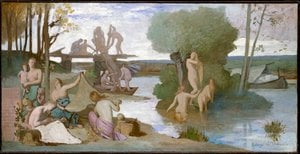
In the vast landscape of nineteenth-century French art, few works command the viewer's attention with such quiet, monumental authority as Pierre Cécile Puvis de Chavannes' “Le Travail.” Painted in 1863, this sweeping canvas serves as a profound meditation on the dignity of labor and the unbreakable bonds of communal spirit. As one gazes upon the scene, there is an immediate sense of being transported to a primordial woodland, where the dappled sunlight filters through a canopy of trees to illuminate a group of men engaged in the rhythmic, arduous task of felling timber. The composition is not merely a depiction of physical toil; it is a carefully orchestrated ballet of effort, where the glistening water nearby and the distant, hazy mountains provide a serene backdrop to the raw, muscular energy of the figures.
The painting captures a moment of intense collaboration. Rather than presenting isolated laborers, Puvis de Chavanness presents a unified front of humanity. We see men spread across the landscape, some wielding axes with focused precision, others transporting heavy logs, all part of a singular, collective purpose. This sense of shared destiny is palpable in the way the figures are positioned, creating a visual flow that guides the eye through the forest, mirroring the very movement of the work being performed. For the collector or interior designer, this piece offers a rare balance of dynamic energy and tranquil atmosphere, making it an ideal centerpiece for spaces that require both a sense of strength and a calming, classical elegance.
Symbolism and the Spirit of the Age
To understand “Le Travail,” one must look beyond the literal depiction of woodcutting and into the heart of the Symbolist movement. Puvis de Chavannes was a master at rejecting the stark, often gritty realism of his contemporaries in favor of an elevated, almost dreamlike abstraction. The choice to depict the men as nude figures is deeply intentional; by stripping away the artifice of clothing and social status, the artist presents humanity in its most fundamental state. These are not merely workers, but symbols of resilience, strength, and the noble pursuit of progress through honest effort.
The technique employed here is a masterclass in monumental simplicity. The artist utilizes a softened palette and simplified forms to transcend the specificities of time and place, aiming instead for universal truths. This stylistic choice allows the painting to resonate across generations, as it speaks to the eternal virtues of cooperation and the connection between human industry and the natural world. The way the light interacts with the skin of the figures and the textures of the bark creates a tactile experience that feels both ancient and immediate.
An Enduring Legacy for the Modern Collector
For those seeking to infuse a curated space with historical depth and emotional resonance, “Le Travail” offers unparalleled inspiration. It is a work that does not merely decorate a wall but tells a story of human potential. The painting’s ability to evoke a sense of peace through its pastoral setting, while simultaneously celebrating the grit of physical existence, makes it a versatile masterpiece for high-end residential or gallery settings.
Owning a high-quality reproduction of this work allows one to bring the spirit of the Musée de Picardie into the home. It serves as a constant reminder of the beauty found in persistence and the grace inherent in collective action. Whether placed in a sunlit study or a grand salon, the presence of Puvis de Chavannes’ vision invites contemplation, grounding the modern environment in the timeless values of dignity, strength, and the enduring majesty of the natural world.



 Pregledaj u prostoru
 Naručite ručno oslikano reprodukciju
 Podeli
 Podeli
 Detalji
 Vodič
Vodič

 Preuzmi sliku
 Slični predmeti
 Rendgenski snimak
 Automatska prezentacija
 Statistika


 Pročitaj više






































 Opcija sa staklom dostupna je samo za dimenzije manje od 110 cm