A Geometric Symphony in Provence
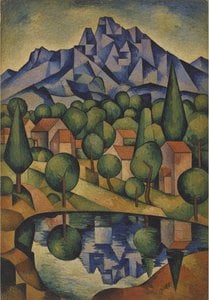
In the heart of the French landscape, where the sun-drenched hills of Aix-en-Provence meet the rugged spirit of the Mediterranean, Paul Cézanne captured more than just a view; he captured a revolution. His 1885 masterpiece, Gardanne, serves as a profound window into a moment when art began to shed its traditional skin. This is not merely a depiction of a hillside town, but an intentional dismantling and rebuilding of perception itself. As the eye wanders across the canvas, one does not find the fleeting, misty light of the Impressionists, but rather a deliberate search for permanence. Cézanne sought to render the world with a structural solidity that felt as eternal as the mountains themselves, turning a simple Provençal village into a monumental study of form and weight.
The composition is nothing short of architectural. Moving away from the vanishing points of classical perspective, Cézanne employs a technique that anticipates the fractured brilliance of Cubism. The buildings of Gardanne are rendered as a series of interlocking planes—cubes, pyramids, and facets that seem to emerge organically from the earth. The steeple of the local church punctuates the skyline with an assertive verticality, acting as an anchor for the swirling, rhythmic arrangement of red-roofed houses. This geometric dance creates a sense of rhythmic stability, where every stroke of the brush contributes to a larger, cohesive structure that feels both grounded and dynamic.
The Alchemy of Color and Light
To behold Gardanne is to experience the warmth of the South through a sophisticated, muted palette. Cézanne avoids the garish in favor of the harmonious, utilizing earthy ochres, deep reds, and soft terracottas that mirror the very soil of the region. These tones are not merely decorative; they are functional, used to build volume and create a sense of depth without relying on traditional shading. The way the light interacts with these faceted surfaces creates a subtle vibration, a visual pulse that breathes life into the inanimate stone and tile. For the discerning collector or interior designer, this palette offers an unparalleled versatility, providing a sophisticated focal point that brings a sense of organic warmth and historical depth to any curated space.
Beyond the technical mastery lies a deeper, more symbolic resonance. The painting captures a tension between the man-made and the natural world. While the village is built into the terrain, its sharp edges and structured forms stand in a quiet dialogue with the undulating hills. There is an emotional gravity here—a sense of stillness that invites contemplation. It is a piece that speaks to the concept of endurance. In an era of rapid change, Cézanne’s ability to find the immutable essence within a landscape offers a profound sense of peace and permanence.
An Essential Addition to the Modern Collection
For those looking to elevate an interior with art that possesses both intellectual rigor and aesthetic grace, a high-quality reproduction of Gardanne is an exquisite choice. It is a work that rewards repeated viewing, revealing new layers of geometric complexity and tonal nuance upon every encounter. Whether placed in a contemporary gallery setting or a classic study, the painting acts as a bridge between the historical weight of Post-Impressionism and the bold abstractions of the modern age.
Owning a piece of this caliber is an opportunity to surround oneself with the legacy of "the father of us all," as Picasso once called him. It is more than decoration; it is an invitation to see the world through the eyes of a master who believed that nature could be understood through the beautiful, analytical logic of art.
Pitanja i odgovori
Kome je „Gardanne”, Pol Sezan preporučeno kao poklon?
„Gardanne“ se predlaže kao poklon za Anniversary.
Da li se prikaz „Gardanne”, Pol Sezan može slobodno reprodukovati?
Status autorskih prava za „Gardanne”, Pol Sezan: delo je u javnom vlasništvu – autorska prava su istekla. Ovo određuje da li se reprodukcije slike mogu slobodno izrađivati.
Koji nacionalni poreklom stoji iza Cubist Exploration dela "Gardanne"?
Delo "Gardanne" delo je Pol Sezan, rođenog u Француска, u okviru pokreta Cubist Exploration. Poreklom umetnika, ovo delo se povezuje sa Cubist Exploration stilom kakav su zastupali umetnici iz Француска.



 Pregledaj u prostoru
 Naručite ručno oslikano reprodukciju
 Podeli
 Podeli
 Detalji
 Vodič
Vodič

 Preuzmi sliku
 Slični predmeti
 Rendgenski snimak
 Automatska prezentacija
 Statistika


 Pročitaj više






































 Opcija sa staklom dostupna je samo za dimenzije manje od 110 cm