The Radiant Legacy of Niccolò di Ser Sozzo
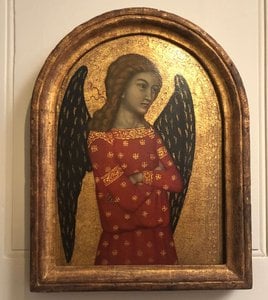
In the golden, sun-drenched landscape of mid-fourteenth-century Siena, a period defined by spiritual fervor and artistic refinement, the name Niccolò di Ser Sozzo resonates as a symbol of the Sienese Gothic zenith. Though his life remains partially veiled by the mists of history—with scholars still debating whether he was the Niccolò di Ser Sozzo di Francesco Tegliacci or the more recently proposed Niccolò di Ser Sozzo di Stefano—his presence in the annals of Italian art is undeniable. Active primarily between 1334 and 1363, Sozzo emerged not merely as a painter, but as a master of light and delicate line, a virtuoso who could breathe life into both monumental panels and the most intimate manuscript leaves.
The foundations of his style were laid within the prestigious workshops of Siena, where the echoes of Simone Martini and the Lorenzetti brothers provided a rich, instructional atmosphere. It is widely believed that Sozzo’s formative years were spent absorbing the stylistic nuances of these pioneers, inheriting their ability to blend profound theological symbolism with an ethereal, almost weightless beauty. His work represents a sophisticated evolution of this tradition, moving toward a more refined, decorative elegance that would define the Sienese school during its most prosperous era.
A Master of the Miniature and the Monumental
Sozzo’s artistic identity was uniquely dualistic, finding equal expression in the grand scale of altarpieces and the microscopic precision of manuscript illumination. His most enduring contribution to the world of art is perhaps the breathtaking frontispiece of the Codex Caleffo, Siena’s historic land registry book. In this monumental depiction of the Assumption of the Virgin, Sozzo demonstrated an unparalleled command over color and composition. The panel, inscribed with his proud signature, serves as a testament to his technical prowess, utilizing gold leaf and vibrant pigments to create a celestial vision that feels both physically present and spiritually transcendent.
Beyond this singular masterpiece, his hand can be found guiding the eyes of the faithful through various religious texts and liturgical works. His skill as a miniaturist allowed him to transform simple parchment into windows to the divine. In his illuminated manuscripts, one observes:
- Intricate Detail: A meticulous attention to the folds of diaphanous drapery and the delicate features of angelic hosts.
- Luminous Color: The use of radiant, saturated hues that capture the flickering light of a cathedral candle.
- Symbolic Depth: An ability to weave complex theological narratives into small, digestible visual motifs.
The Enduring Influence of a Sienese Visionary
The historical significance of Niccolò di Ser Sozzo lies in his role as a bridge between the foundational masters of the early Trecento and the burgeoning complexities of the later Gothic period. His style, characterized by a certain lyrical grace and a preference for delicate, flowing contours, helped solidify Siena's reputation as a center of unparalleled decorative beauty. Even as the artistic tides began to shift toward the more robust naturalism of other regions, Sozzo’s commitment to the Sienese aesthetic—one of elegance, light, and spiritual intimacy—remained a beacon of cultural identity.
Today, when we gaze upon his surviving works, whether in the archives of Siena or within the prestigious collections of international museums, we are not merely looking at relics of the past. We are witnessing the heartbeat of a vanished era. Through his mastery of the Ascension and the Assumption, Sozzo captured the very essence of the medieval soul: a longing for the divine, expressed through the most exquisite earthly materials. His legacy remains etched in gold and pigment, a permanent fragment of the celestial beauty he sought to manifest on earth.



 Pregledaj u prostoru
 Kupi ručno naslikanu sliku
 Pošalji
 Podeli
 Detalji o delu

 Преузми
 Slični predmeti
 Rendgenski snimak
 Slajdovi
 Statistika


 Pročitaj više






































 Opcija sa staklom dostupna je samo za dimenzije manje od 110 cm