Transition: A Reflection of Egyptian Identity Amidst Revolution
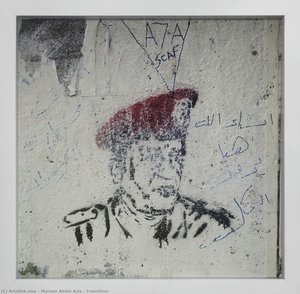
“Transition” by Myriam Abdel Aziz stands as a poignant testament to the transformative moment that gripped Egypt in February 2011 – the ousting of President Mubarak and the subsequent eruption of civil unrest. More than just a depiction of graffiti art on a textured wall, this piece delves into the profound societal fissures exposed during this pivotal period, capturing the volatile dialogue between factions vying for influence.
Abdel Aziz’s artistic vision is rooted in her membership with Rawiya Collective, an initiative dedicated to amplifying Arab women's voices through visual storytelling. This formative experience instilled within her a deep understanding of vulnerability and resilience—elements that consistently permeate her photographic oeuvre and now find expression in “Transition.” Her initial inspiration stemmed from the stylistic approach championed by Pakistani film posters like “Aandhi Shakar,” meticulously recreated as a painting, demonstrating a commitment to dramatic compositions and stylized map designs.
Composition & Technique: Layers of Texture and Color
The artwork’s central focus is a portrait of a man wearing a red hat—a figure embodying authority and arguably representing the military element at play during the revolution. Surrounding him are layers upon layers of graffiti, rendered in Arabic script and punctuated by bold markings. These additions create a deliberately chaotic scene, mirroring the turbulent atmosphere of Cairo during those tumultuous days.
Abdel Aziz skillfully employs spray paint—a technique synonymous with urban expressionism—to achieve remarkable textural depth. The wall itself is heavily textured, providing an ideal canvas for capturing the ephemeral nature of street art. Subtle variations in tone contribute to a sense of immediacy and authenticity, emphasizing the artwork’s raw aesthetic.
Symbolism & Context: Echoes of Resistance
The dominant color palette—primarily monochromatic shades of grey, black, and white—underscores the solemnity of the subject matter. However, the striking red hue of the man's hat serves as a powerful visual anchor, symbolizing perhaps affiliation with a particular group or representing defiance against established power.
The Arabic script interwoven throughout the graffiti adds cultural context, conveying messages that are undoubtedly politically charged. These symbols resonate with the broader narrative of Egyptian society grappling with its identity amidst upheaval—a theme central to Abdel Aziz’s artistic exploration.
Ephemeral Beauty: The Significance of Repetition
Notably, “Transition” reflects the recurring motif of graffiti being systematically painted over by SCAF (Supreme Council of the Armed Forces), highlighting the artwork's inherent temporality. This deliberate erasure underscores its essence as a fleeting snapshot of history—a reminder that artistic expression can capture moments of profound change and ultimately vanish into the continuum of time.
This piece exemplifies Abdel Aziz’s ability to convey emotion through visual storytelling, mirroring the spirit of her artistic endeavors. It's a compelling artwork for collectors who appreciate both stylistic innovation and historical resonance—a celebration of resilience expressed through the vibrant yet transient medium of graffiti art.



 Pregledaj u prostoru
 Pređi na štampu
 Pošalji
 Podeli
 Detalji o delu

 Преузми
 Slični predmeti
 Rendgenski snimak
 Slajdovi
 Statistika


 Pročitaj više






































 Opcija sa staklom dostupna je samo za dimenzije manje od 110 cm