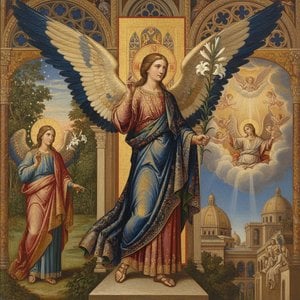
The Annunciation: A Renaissance Echo of Divine Grace
Matthias Grünewald’s “The Annunciation,” painted in 1515, isn't merely a depiction of a biblical moment; it’s a profound meditation on faith, humility, and the unfolding mystery of God’s plan. Housed within the Musée d’Unterlinden in Colmar, France, this masterpiece transcends its historical context to resonate powerfully with viewers centuries later. Grünewald, a pivotal figure bridging the late medieval and early Renaissance periods, deliberately eschewed the prevailing Italian humanist style, instead drawing upon the rich traditions of Northern European art—a lineage characterized by intense emotionality, meticulous detail, and an unwavering focus on religious narrative.
The scene itself is deceptively simple: the Archangel Gabriel stands to Mary’s right, his flowing robes a vibrant crimson that speaks both of divine authority and passionate urgency. He extends his hand, presenting a lily—a potent symbol of purity and virginity, inextricably linked with Mary's role as the Mother of God. Mary, kneeling gracefully on the left, is rendered in shades of serene blue, reflecting her humility and acceptance of this extraordinary destiny. The architectural setting, reminiscent of a Gothic cathedral’s archway, provides a sense of sacred space—a stage for this pivotal encounter.
A Symphony of Color and Light
Grünewald's mastery lies not just in his composition but also in his innovative use of color and light. The palette is deliberately restrained, dominated by the complementary hues of red and blue – a deliberate choice that amplifies their symbolic weight. The strong, directional light source, originating from the upper left corner, dramatically illuminates Mary’s face, emphasizing her vulnerability and receptiveness to the divine message. This carefully orchestrated lighting creates a palpable sense of depth and drama, drawing the viewer's eye directly to the central figures.
Furthermore, Grünewald employs a technique known as *sfumato*, subtly blurring edges and creating atmospheric effects—a hallmark of Renaissance painting that he skillfully adapted to his own style. This adds an ethereal quality to the scene, suggesting the otherworldly nature of the event unfolding before us. The meticulous detail evident in the drapery, the intricate patterns on the clothing, and the subtle modeling of the figures speaks to Grünewald’s exceptional technical skill and unwavering commitment to realism.
Symbolism Woven into Every Detail
Beyond the immediate narrative, “The Annunciation” is rich with symbolic meaning. The dove hovering above Mary represents the Holy Spirit—the divine breath that will bring forth Christ. The architectural setting itself alludes to the sacredness of the event and the importance of God’s presence in human life. Even the positioning of Gabriel and Mary within the archway can be interpreted symbolically, representing harmony and balance – a visual embodiment of the theological concept of *coincidence of opposites*.
The lily held by Gabriel is not merely a floral emblem; it's a potent reminder of Mary’s virginity and her role as the vessel through which Christ will be born. The careful rendering of each element—from the angel’s wings to Mary’s expression—contributes to a complex tapestry of meaning that invites contemplation and interpretation.
A Timeless Masterpiece: Reproductions Available
“The Annunciation” remains a profoundly moving work of art, captivating viewers with its beauty, drama, and spiritual depth. High-quality reproductions are now available through WahooArt, allowing art enthusiasts to bring this iconic masterpiece into their homes or offices. These meticulously crafted oil paintings faithfully capture the essence of Grünewald’s original—a testament to his artistic genius and a timeless reminder of the miracle at the heart of Christian faith. For those seeking to delve deeper into the world of Matthias Grünewald, we encourage you to explore the resources linked below, including detailed images, artist biographies, and related works.
- The Annunciation (detail): /en/art/matthias-grunewald-the-annunciation-detail-8XZGPE-en/
- The Annunciation: /en/art/matthias-grunewald-the-annunciation-8XZGPD-en/
- Matthias Grünewald: /en/artists/matthias-grunewald-en/
- Explore the collection at: https://WahooArt.com
- Learn more about the Musée d’Unterlinden: https://en.wikipedia.org/wiki/Mus%C3%A9e_d%27Unterlinden



 Pregledaj u prostoru
 Pređi na prodaju štampanih primeraka
 Podeli
 Podeli
 Detalji
 Vodič
Vodič

 Preuzmi sliku
 Slični predmeti
 Rendgenski snimak
 Automatska prezentacija
 Statistika


 Pročitaj više






































 Opcija sa staklom dostupna je samo za dimenzije manje od 110 cm