The Genesis of Color and Displacement
Mark Rothko's "Untitled 63" isn’t merely a painting; it’s an immersion. Born in 1903 in Dvinsk, Latvia – a region steeped in historical tension and shifting borders – Rothko’s early life profoundly shaped his artistic vision. His family’s journey from the Pale of Settlement to Portland, Oregon, in 1913 marked a dramatic cultural upheaval, a displacement that resonated deeply within him. The loss of his father at a young age, coupled with the challenges of assimilation and the ever-present anxieties of Jewish life under Tsarist rule, instilled a sensitivity to human suffering – a core theme that would permeate much of his work. This early experience of loss and uncertainty isn’t just biographical; it's woven into the very fabric of the painting, manifesting as an underlying sense of melancholy and yearning.
Rothko’s upbringing was remarkably intellectual. His father, a pharmacist and socialist, fostered a home filled with debate and learning, exposing young Mark to radical ideas and encouraging critical thinking. This environment instilled in him a deep appreciation for knowledge and a questioning spirit – qualities that would later inform his approach to art. The move to the United States wasn’t simply a geographical shift; it was a severing of ties to a familiar past, forcing Rothko to confront new identities and grapple with the complexities of belonging. This foundational experience of displacement is arguably the key to understanding the emotional depth of "Untitled 63" – a painting that speaks volumes about the human condition through its carefully orchestrated fields of color.
Color as Emotion: The Language of Abstract Expressionism
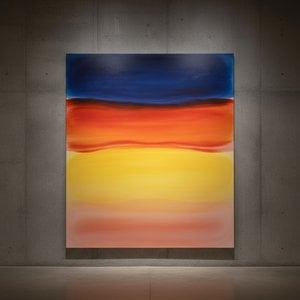
"Untitled 63" exemplifies Rothko’s signature style within Color Field Painting, a movement he helped pioneer. The work eschews traditional representation, instead focusing on the pure emotional impact of color itself. Large, rectangular blocks of deep violet, verdant green, and resonant red dominate the canvas, layered upon one another to create an almost palpable sense of depth and atmosphere. These aren’t simply colors; they are vessels for feeling – evoking a range of emotions from quiet contemplation to profound sorrow. Rothko meticulously applied thin layers of paint, allowing the colors to bleed subtly into each other, creating hazy, luminous effects that seem to vibrate with inner light.
The technique is deceptively simple yet incredibly complex. Rothko’s process involved applying multiple coats of thinned paint, often using a squeegee to create smooth, even surfaces. He avoided brushstrokes, opting instead for a flat, almost sculptural quality that further emphasizes the colors' inherent luminosity. This deliberate flatness invites the viewer to step into the painting, to lose themselves within its chromatic depths and experience it not as an object to be observed, but as a space to be inhabited.
Symbolism and the Search for Meaning
While Rothko vehemently resisted any attempt to interpret his paintings literally, the arrangement of the vases and cups within "Untitled 63" offers intriguing clues. The central vase, holding a single cup, can be seen as a symbol of containment – perhaps representing the human spirit struggling against the weight of existence. The surrounding vases, in varying sizes and positions, suggest a network of interconnectedness, hinting at relationships, memories, and the cyclical nature of life and death. The scattered cups, both near and far from the central composition, could symbolize fleeting moments of joy or sorrow, reminders of past experiences that linger in our consciousness.
However, Rothko’s intention wasn't to provide a concrete narrative. Instead, he sought to create paintings that would evoke a profound emotional response in the viewer – a sense of awe, mystery, and perhaps even transcendence. The ambiguity of the imagery allows for individual interpretation, inviting each observer to project their own experiences and emotions onto the canvas. It’s this very openness that makes "Untitled 63" such a powerful and enduring work of art.
A Legacy of Emotional Resonance
Mark Rothko's “Untitled 63” stands as a testament to the power of color to communicate profound emotions. Reproductions, like those offered by WahooArt.com, allow viewers to experience this emotional depth firsthand, bringing Rothko’s evocative vision into their own spaces. The painting’s enduring appeal lies in its ability to tap into universal human experiences – loss, longing, and the search for meaning – making it a timeless masterpiece that continues to resonate with audiences today.
Pitanja i odgovori
U kom delu doma bi se reprodukcija dela "Untitled 63" lepo uklopila?
„Untitled 63”, Марк Ротко se preporučuje za Living Room. Ovaj predlog je zasnovan na temi, bojama i raspoloženju dela.
Gde se „Untitled 63”, Марк Ротко nalazi u istoriji umetnosti?
„Untitled 63”, Марк Ротко pripada pravcu Color Field Abstraction, unutar perioda Modern. Zajedno, oni delu daju njegovo mesto u istoriji umetnosti.
Kakve boje koristi "Untitled 63"?
„Untitled 63”, Марк Ротко koristi Earthy paletu boja. Ova paleta sažima opšti koloristički karakter dela.



 Pregledaj u prostoru
 Naručite ručno oslikano reprodukciju
 Podeli
 Podeli
 Detalji
 Vodič
Vodič

 Preuzmi sliku
 Slični predmeti
 Rendgenski snimak
 Automatska prezentacija
 Statistika

 Pročitaj više






































 Opcija sa staklom dostupna je samo za dimenzije manje od 110 cm