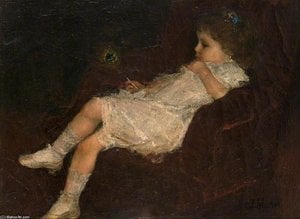
The Transatlantic Vision of Jules Émile Saintin
Born in the quiet French town of Lemé in 1829, Jules Émile Saintin would eventually become a painter whose canvas bridged the refined elegance of European Neoclassicism with the raw, burgeoning spirit of the American frontier. His artistic foundation was laid within the prestigious halls of the École des Beaux-Arts in Paris, where he studied under the masterful guidance of Michel Martin Drolling and François-Édouard Picot. These early years were defined by a rigorous devotion to technique; between 1850 and 1853, Saintin distinguished himself through meticulous pencil portraits that showcased an extraordinary ability to capture the subtle nuances of human character. This period of disciplined training prepared him for a life of profound stylistic evolution.
The trajectory of Saintin’s life changed irrevocably in April 1854 when he embarked on a transformative journey to the United States. This relocation was far more than a mere change of scenery; it was an immersion into a new world of light, scale, and subject matter. In America, the refined French academician found himself captivated by the vastness of the landscape and the compelling narratives of indigenous peoples. His repertoire expanded significantly as he moved beyond the studio to document portraits, sweeping landscapes, and the poignant realities of American life. This era of exploration infused his work with a unique vitality, blending the sophisticated brushwork of his Parisian training with an authentic, rugged appreciation for the New World.
A Legacy of Cultural Synthesis
Upon returning to Paris in 1860, Saintin did not abandon his American inspirations; instead, he integrated them into the heart of the French art scene. He established a dedicated workshop where he produced canvases that brought the imagery of the American frontier to European audiences, alongside delicate genre scenes reflecting the rhythms of everyday life. His ability to navigate these two distinct cultural spheres earned him immense respect within the artistic community. Saintin’s social and professional circles were luminously prestigious, counting among his friends the renowned architect Charles Garnier and the painter Paul Baudry.
The height of his professional recognition arrived during the late 19th century, marked by significant appointments and honors that solidified his historical importance. In 1876, he served as a commissioner for the Centennial Exposition in Philadelphia, a role that underscored his enduring connection to the American spirit. His contributions to the arts were formally recognized by the French state in 1877, when he was appointed a Chevalier (Knight) of the Legion of Honour. Through works such as The Pony Express and various evocative portraits, Saintin left behind a legacy that remains a testament to the power of artistic movement and the beautiful complexity of a life lived between two continents.



 Pregledaj u prostoru
 Pređi na prodaju štampanih primeraka
 Podeli
 Podeli
 Detalji
 Vodič
Vodič

 Preuzmi sliku
 Slični predmeti
 Rendgenski snimak
 Automatska prezentacija
 Statistika

 Pročitaj više






































 Opcija sa staklom dostupna je samo za dimenzije manje od 110 cm