The Fragmented Dawn of Modernity
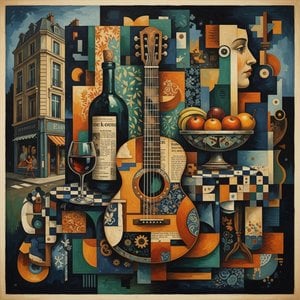
Juan Gris' "Coffee Grinder and Glass," painted in 1920, isn’t merely a still life; it’s a meticulously constructed microcosm of early 20th-century thought. Emerging from the fertile ground of Cubism, this work represents a pivotal moment in art history – a deliberate fracturing of perspective and form that simultaneously embraced abstraction and retained a surprising degree of recognizable subject matter. The painting captures a fleeting domestic scene: a coffee grinder, a glass, a bottle, a book, and a handbag—everyday objects rendered with an almost unsettling detachment. It’s a visual puzzle, inviting the viewer to reconstruct the scene not through traditional representation, but through intellectual engagement and intuitive understanding.
Cubist Deconstruction and Harmonious Reconstruction
Gris' approach during this period – often referred to as “Analytical Cubism” – moved beyond simply depicting objects from multiple viewpoints. Instead, he sought to dissect them into their fundamental geometric components, then reassemble these fragments within a flattened picture plane. The painting exemplifies this process brilliantly. The coffee grinder is not realistically rendered; it’s broken down into angular planes of color and line, suggesting its mechanical function without offering a literal depiction. Similarly, the glass appears fragmented, reflecting light in an almost crystalline manner, while the bottle and handbag are reduced to their essential shapes. Yet, despite this deconstruction, Gris masterfully orchestrates these disparate elements into a remarkably balanced composition. The use of black tones – a hallmark of his style during this time – anchors the painting, providing a grounding counterpoint to the vibrant hues and fractured forms.
A Parisian Palette: Color, Light, and Symbolism
The color palette is deliberately restrained yet intensely evocative. Gris employs a sophisticated interplay of browns, blues, greens, and yellows, creating a sense of depth and luminosity. The strategic use of black not only defines the forms but also adds a layer of melancholy and introspection – reflecting the artist’s own experiences during this period of personal upheaval. The inclusion of seemingly mundane objects—the coffee grinder, the glass, the handbag—holds symbolic weight. They represent the rhythms of daily life in Paris, a city that served as the epicenter of artistic innovation at the time. The presence of the book hints at intellectual pursuits and the pursuit of knowledge, while the bottle suggests indulgence and pleasure. The painting’s title, “Le moulin à café,” further reinforces this connection to Parisian culture.
The Legacy of a Visionary
Juan Gris' "Coffee Grinder and Glass" stands as a testament to his unique artistic vision. It embodies the spirit of Cubism – a radical departure from traditional representation that paved the way for future generations of artists. His ability to synthesize geometric abstraction with recognizable subject matter, coupled with his masterful use of color and composition, cemented his place as one of the most influential figures in 20th-century art. Reproductions of this work offer a captivating glimpse into a world where reality is fragmented, yet harmony can still be achieved through careful observation and artistic ingenuity. It’s a piece that continues to resonate with viewers today, prompting reflection on the nature of perception, representation, and the beauty found in the everyday.
Pitanja i odgovori
Koja je dominantna boja dela „Coffee Grinder”, autor Хуан Грис?
„Coffee Grinder“ teži Green to Violet Spectrum tonu.
O kakvom se delu radi u "Coffee Grinder"?
U katalogu je delo „Coffee Grinder”, autor Хуан Грис klasifikovano kao WallArt. Ova kategorija pomaže u pronalaženju sličnih radova.
Da li je delo „Coffee Grinder”, autor Хуан Грис u javnom vlasništvu?
Što se tiče autorskih prava, delo "Coffee Grinder" je u javnom vlasništvu – autorska prava su istekla.



 Pregledaj u prostoru
 Pređi na štampu
 Pošalji
 Podeli
 Detalji o delu
 Vodič
Vodič

 Preuzmi
 Slični predmeti
 Rendgenski snimak
 Automatska prezentacija
 Q&A
Q&A Statistika


 Pročitaj više






































 Opcija sa staklom dostupna je samo za dimenzije manje od 110 cm