Pregledaj u prostoru AR pregled Kupite ručno oslikano delo Pređi na digitalnu sliku Pošalji
Detalji o delu Vodič Dodaj u omiljene Preuzmi Slični predmeti Rendgenski snimak Automatska prezentacija Q&A Statistika

The Trial

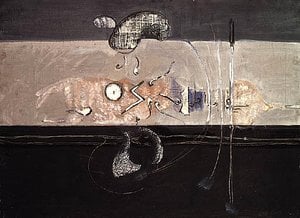
John Samuel Tunnard’s ‘The Trial,’ painted in 1944, delves into psychological exploration with layered perspectives and evocative motifs. Inspired by modernist fabric design and jazz, this artwork reflects a contemplative mood amidst the anxieties of WWII.

Discover John Samuel Tunnard (1900-1971): a key English modernist painter influenced by Surrealism. Explore his landscapes, portraits & textile designs at WahooArt.

Umetničko delo prikazano na ovoj stranici zaštićeno je autorskim pravima, što znači da zakonski nismo u mogućnosti da kreiramo niti prodajemo identičnu reprodukciju. Ova zaštita se sprovodi u skladu sa međunarodnim sporazumima kao što su Bernska konvencija i nacionalnim zakonima, uključujući i one koji su definisani u Američki zakon o autorskom pravu – Naslov 17.

Ovaj metod je u potpunosti usklađen sa regulativama o autorskim pravima jer ne podrazumeva kopiranje ili dupliranje zaštićenih umetničkih dela. Umesto toga, reč je o kreativnoj reinterpretaciji – novom slikarskom delu koje je inspirisano originalom, ali nije identično njemu.

Giclee štampa / Umetnički otisak

Giclée štampa ili print na platnu muzejskog kvaliteta uz brzu izradu i raznovrsne opcije završne obrade. ( Kupite ručno oslikano delo Pređi na digitalnu sliku)

Corner sample of the P118B picture frame: oblikovani polistiren, 5 cm wide and 3 cm thick
P118B дин10
Corner sample of the P118H picture frame: oblikovani polistiren, 5 cm wide and 3 cm thick
P118H дин10
Corner sample of the P118W picture frame: oblikovani polistiren, 5 cm wide and 3 cm thick
P118W дин10
Corner sample of the P438Z picture frame: oblikovani polistiren, 5.5 cm wide and 3.5 cm thick
P438Z дин10
Corner sample of the P508JH picture frame: oblikovani polistiren, 7 cm wide and 3.5 cm thick
P508JH дин12
Corner sample of the P508YH picture frame: oblikovani polistiren, 7 cm wide and 3.5 cm thick
P508YH дин12
Corner sample of the P805H picture frame: oblikovani polistiren, 5 cm wide and 3.5 cm thick
P805H дин10
Corner sample of the P805Z picture frame: oblikovani polistiren, 5 cm wide and 3.5 cm thick
P805Z дин10
Corner sample of the P919BZ picture frame: oblikovani polistiren, 7 cm wide and 3.5 cm thick
P919BZ дин10
Corner sample of the P919G picture frame: oblikovani polistiren, 7 cm wide and 3.5 cm thick
P919G дин10
Corner sample of the P919XJ picture frame: oblikovani polistiren, 7 cm wide and 3.5 cm thick
P919XJ дин10
Corner sample of the P959ZH picture frame: oblikovani polistiren, 5 cm wide and 3 cm thick
P959ZH дин10
Corner sample of the P968JZ picture frame: oblikovani polistiren, 6 cm wide and 4 cm thick
P968JZ дин12
Corner sample of the W106C picture frame: masivno drvo, 5 cm wide and 3 cm thick
W106C дин8
Corner sample of the W218G picture frame: masivno drvo, 5 cm wide and 3 cm thick
W218G дин10
Corner sample of the W218JH picture frame: masivno drvo, 5 cm wide and 3 cm thick
W218JH дин8
Corner sample of the W218Y picture frame: masivno drvo, 5 cm wide and 3 cm thick
W218Y дин10
Corner sample of the W307PJ picture frame: masivno drvo, 6 cm wide and 3 cm thick
W307PJ дин10
Corner sample of the W316G picture frame: masivno drvo, 6 cm wide and 3 cm thick
W316G дин10
Corner sample of the W316PJ picture frame: masivno drvo, 6 cm wide and 3 cm thick
W316PJ дин8
Corner sample of the W316Y picture frame: masivno drvo, 6 cm wide and 3 cm thick
W316Y дин10
Corner sample of the W398PJ picture frame: masivno drvo, 5 cm wide and 3 cm thick
W398PJ дин8
Corner sample of the W4111J picture frame: masivno drvo, 6.5 cm wide and 3.5 cm thick
W4111J дин10
Corner sample of the W500HY picture frame: masivno drvo, 7 cm wide and 5 cm thick
W500HY дин15
Corner sample of the W500JH picture frame: masivno drvo, 7 cm wide and 5 cm thick
W500JH дин15
Corner sample of the W692G picture frame: masivno drvo, 8 cm wide and 4 cm thick
W692G дин12
Corner sample of the W849H picture frame: masivno drvo, 5 cm wide and 3 cm thick
W849H дин8
Corner sample of the W940BG picture frame: masivno drvo, 7.5 cm wide and 4.5 cm thick
W940BG дин15
Corner sample of the W953PJ picture frame: masivno drvo, 6 cm wide and 3.5 cm thick
W953PJ дин8

Standardne dimenzije
po meri
CM
INCH

Izaberite jednu od naših unapred definisanih veličina koje odgovaraju originalnim proporcijama umetničkog dela.

širina
visina

Unesite željenu širinu i visinu kako bi se štampa uklopila u vaš ram ili zid. Štampu je moguće samo iseći, ali nikada povećati iznad dimenzija originalne slike, stoga format sa drugačijim proporcijama uzrokuje gubitak dela slike. Pre početka štampe, poslaćemo vam digitalni prikaz radi potvrde. Slika prikazana na ovoj stranici ne predstavlja stvarni isrez — to pokazuje samo digitalni prikaz.

Dostava širom sveta () za 2 nedelje umesto uobičajenih 4/5 nedelja. (29 октобар)

Besplatna ekspresna dostava širom sveta
Visokokvalitetno laneno platno
Potpuno osiguranje transporta
Garancija povraćaja carine i uvoznih dažbina
Garancija vernosti boja
Politika povraćaja u roku od 100 dana (samo u slučaju nedostataka)
Garancija povrata 100% novca
Popust na više proizvoda

Ukupna cena

дин 7044

The Trial

Giclee štampa / Umetnički otisak

Dimenzije reprodukcije

-

Ukupna cena

дин 7044

Osnovne informacije

  • Artistic style: Modernist
  • Title: The Trial
  • Artist: John Samuel Tunnard
  • Subject or theme: Psychological exploration; Dreamscape.
  • Notable elements or techniques: Perspective play; Void motifs; Ochre-yellow figure.
  • Movement: Surrealism

Kviz o umetnosti

Svako pitanje ima samo jedan tačan odgovor.

Pitanje 1:
What artistic movement is John Tunnard’s painting ‘The Trial’ primarily associated with?
Pitanje 2:
Where was John Tunnard's early career exhibition showcasing his work held?
Pitanje 3:
What is a prominent motif within Tunnard's painting 'The Trial', reflecting his broader artistic interests?
Pitanje 4:
Which influential figure inspired Tunnard’s exploration of perspective and its impact on conveying mood in ‘The Trial’?
Pitanje 5:
What was John Tunnard's role during World War II, contributing to his artistic inspiration?
After studying textile design at the Royal College of Art, John Tunnard began his career as a designer and fabric-buyer for John Lewis in London. In the 1930’s, he moved with his wife to Cornwall, establishing a silk block-printing business. It was while he was in Cornwall that Tunnard turned towards painting. Identified as an English Surrealist, his paintings were shown alongside Yves Tanguy, Paul Nash, Graham Sutherland and John Piper. He was widely regarded and exhibited during his life, with an early career exhibition at Peggy Guggenheim’s ‘Guggenheim Jeune’ gallery in London, (open between 1938-9). He would produce two major works for the 1951 Festival of Britain – a painting, The Return (1951) and a mural for the Regatta Restaurant. Influences on his work include Modern fabric design, an interest in marine life, free-association music (Tunnard was a keen jazz player), and the natural world, (he also collected rare insects for the Natural History Museum while it was still a part of the British Museum).A play on perspective gives this painting its macabre ‘down the rabbit hole’ ambience. This painting leads its viewer into a world of multiple planes, lines and voids. Peering into its visual machine, one’s investigations are quickly interrupted by a disappearing line, or a strike that crosses one’s view or bends one’s vision along a new route. The viewer’s eye experiences a kind of paroxysm while looking at this painting. A darting effect is produced that leaves us confused as to the ‘real’ nature of the pattern itself. Whatever was first understood becomes distorted and we are left with such questions as: where is the front? where is at the back? what indeed, is happening here?A number of motifs within this work are common across Tunnard’s practice at this time. The ochre-yellow figure to the right recurs in the work Ghost painted in the same year, and the sharp base-point of tentatively poised shapes are present in other paintings at this time. Voids, doorways, red colour accents, white scores across the composition and generally a dark, nocturnal palate, are all present throughout a body of work that Tunnard painted across the final years of the Second World War.A conscientious objector, Tunnard spent most of the war as a coastguard on the Cornish coast. In this role, his regular view would have been towards occupied France and across an embattled mass of sky and sea. An active stage of war, this coastal strip was the southernmost ‘front’ of Great Britain. A distorted political space, The Channel, much like this painting, was ideologically abstracted by opposing forces that brawled across it.The sea meets the sky in this painting, which recasts an agitated and sombre character of war. As a critic of The Times was to later write about Tunnard’s work during this period, his:‘imagery seems to spring directly from the war, from a time when deserted airships beneath the moon and skies scored with the smoke-trails of aerial battles brought a sudden anticipatory glimpse of the space-age. Mr Tunnard’s obsession with the dynamics of flight, and his visions of an upper ether patterned and articulated by them were never… documentary records, but more like romantic pictorial science-fiction.’ © Gemma Sharp 20101. Imagery derived from War. Mr John Tunnard’s Paintings’. The Times, 7th December 1959. p14.

Pitanja i odgovori

Na koji način se tema dela "The Trial" odnosi na uobičajene teme umetnika John Samuel Tunnard?

Među upečatljivim temama umetnika John Samuel Tunnard – modern fabric design, jazz player inspiration, british surrealist vision, festival britain mural, cornish landscape motif – delo "The Trial" donosi sopstveni fokus na cornwall, landscape, marine life, perspective, psychological, jazz influence, symbolism.

Gde mogu videti originalno delo „The Trial”, autor John Samuel Tunnard?

Delo „The Trial”, autor John Samuel Tunnard je izloženo u muzeju British Council, London, Ujedinjeno Kraljevstvo. Navod o muzeju odnosi se na originalno delo, a ne na reprodukcije.

Da li je delo "The Trial" autora John Samuel Tunnard u javnom vlasništvu i zašto?

Status autorskih prava za delo "The Trial" - i dalje je zaštićeno autorskim pravima - proizilazi iz godine smrti umetnika, 1971.


Biografija umetnika

John Samuel Tunnard: A Life in Modern British Art

Early Life and Education

John Samuel Tunnard (1900-1971) was an English modernist painter and designer. Born in Sandwich, Kent, he initially studied design at the Royal College of Art from 1919 to 1923. This foundational training would prove crucial throughout his artistic career, influencing both his painting style and his later ventures into textile design.

Early Career & Textile Design

During the 1920s, Tunnard worked in various textile design roles in Manchester. This period provided him with practical experience and an understanding of pattern, color, and form – elements that would later become prominent features of his paintings. In 1926, he married Mary May Robertson, a partnership that would significantly shape both their personal and professional lives.

Artistic Development & Influences

By 1928, Tunnard began to focus seriously on painting. He taught design at the Central School of Arts and Crafts in London from 1929 onwards, further solidifying his engagement with artistic principles and pedagogy. His work during this time demonstrates a growing interest in modernist aesthetics. Tunnard’s style was notably influenced by Surrealism, although he never formally joined the movement. He participated in several surrealist exhibitions throughout the 1930s, including one at the Gordon Fraser Gallery in Cambridge.

Cornwall and a New Artistic Direction

In 1933, Tunnard and his wife moved to Cadgwith, Cornwall. There, they established a business producing printed silks, allowing them to combine their artistic talents with entrepreneurial endeavors. The Cornish landscape profoundly impacted Tunnard’s art, inspiring many of his later landscapes and providing a new source of visual motifs.

Major Works & Artistic Style

Tunnard's oeuvre encompasses both paintings – including notable landscapes and portraits – and textile designs. His painting style is characterized by its lyrical abstraction, dreamlike qualities, and vibrant color palettes. He often blended representational elements with abstract forms, creating a unique visual language that reflects his surrealist leanings.

  • His landscapes frequently depict the Cornish coastline, rendered in bold colors and fluid shapes.
  • His portraits explore psychological depth through expressive brushwork and unconventional compositions.
  • His textile designs showcase innovative patterns and color combinations, demonstrating his versatility as an artist.

Exhibitions & Recognition

Tunnard exhibited widely throughout his career. He showed work at the Royal Academy and with the London Group (which he joined in 1934). His participation in surrealist exhibitions further cemented his position within the British avant-garde.

Legacy & Historical Significance

John Samuel Tunnard is now considered one of the most important English modernist painters. His work represents a unique synthesis of Surrealism, abstraction, and landscape painting. Examples of his art can be found in prominent collections such as the National Galleries of Scotland. He contributed significantly to the development of modern British art, bridging the gap between traditional representation and abstract expression.

John Samuel Tunnard

John Samuel Tunnard

1900 - 1971 , United Kingdom

Osnovne informacije

  • Name: John Samuel Tunnard
  • Movement: Modernism, Surrealism
  • Birth Date: 1900
  • Death Date: 1971
  • Birth Place: Sandwich, United Kingdom
  • Nationality: British
  • Date Of Birth: 1900
  • Date Of Death: 1971
  • Influenced By: Surrealism
  • Notable Works: Landscapes, Portraits, Textile Designs
  • Place Of Birth: Sandwich, United Kingdom