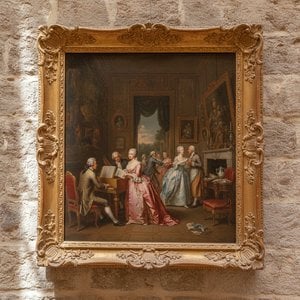
Joaquín Domínguez Bécquer: A Sevillean Chronicle of Daily Life
Born in the heart of Seville in 1817, Joaquín Domínguez Bécquer emerged as a pivotal figure within the vibrant and deeply rooted artistic movement known as Costumbrismo. More than simply a painter, he was a chronicler of his city’s soul – capturing its bustling markets, spirited festivals, and the everyday lives of its inhabitants with an unparalleled sensitivity to detail and color. His work offers a poignant glimpse into 19th-century Spain, revealing both the beauty and the hardships of Sevillian life through a distinctly romantic lens.
Bécquer’s artistic journey began within the walls of the Academia de Bellas Artes in Seville, where he honed his skills under the tutelage of his cousin, José Domínguez Bécquer. This familial connection undoubtedly played a role in shaping his early style, but it was through his own observations and experiences that Bécquer truly developed his unique voice. He quickly established himself as a respected artist, taking on commissions for both private patrons and public institutions, including the royal court itself. His talent wasn’t confined to grand historical scenes; he excelled at portraying intimate moments of daily life – a market vendor haggling with a customer, children playing in the streets, or families gathered around a festive table.
The Influence of Family and Tradition
Bécquer's artistic lineage was deeply intertwined with Seville’s rich cultural heritage. His family, originally from the Spanish Netherlands, brought with them a strong sense of tradition and an appreciation for craftsmanship. This legacy is evident in his meticulous attention to detail – every brushstroke seems deliberate, every color carefully chosen. However, Bécquer wasn't simply replicating tradition; he was interpreting it through his own artistic vision.
The influence of his cousin, José Domínguez Bécquer, was also significant. José’s established style provided a foundation for Joaquín’s development, but Bécquer ultimately forged his own distinct path. He absorbed elements from other notable artists of the time, including Diego Velázquez – whose mastery of light and shadow clearly informed Bécquer's approach to composition. The echoes of Velázquez can be particularly felt in Bécquer’s ability to capture the essence of his subjects with a single glance.
Notable Works: Capturing Seville’s Essence
Among Bécquer’s most celebrated works is “The Seville Fair” (1847), currently housed at the Carmen Thyssen Museum in Málaga. This vibrant oil painting vividly depicts the annual fair, a chaotic yet joyous celebration of trade, music, and high society. It's a masterful example of his ability to capture the energy and excitement of Sevillian festivities – a true testament to his understanding of local culture. The painting’s rich colors and dynamic composition draw the viewer into the heart of the event, transporting them back to a bygone era.
Another significant work is “The Treaty of Wad Ras,” a large-scale historical scene depicting the signing of the treaty following the Battle of Wad Ras. This piece showcases Bécquer’s skill in portraying complex narratives and capturing the solemnity of important events. It's currently displayed at the headquarters of the City Council of Seville, serving as a reminder of his contributions to Sevillian history.
Beyond these iconic works, Bécquer produced a vast body of paintings exploring various facets of Sevillian life – portraits, urban landscapes, and scenes from everyday routines. His work offers a comprehensive portrait of a city and its people, revealing both the beauty and the challenges of their existence.
A Legacy in Private Collections
Despite the passage of time, Bécquer’s legacy endures through the many private collections that house his works. His paintings continue to be admired for their vibrant colors, meticulous detail, and evocative portrayal of Sevillian culture. He remains a revered exponent of Costumbrismo, an artistic style that continues to inspire artists today.
His work is also featured in prominent museums such as the Museo de Bellas Artes in Seville, where visitors can immerse themselves in the rich tapestry of Spanish art from the medieval period onward. Bécquer’s contributions have solidified his place as a significant figure in Spanish artistic history – a chronicler of Seville's soul and a master of Costumbrismo.
Further Exploration
For those seeking to delve deeper into the life and work of Joaquín Domínguez Bécquer, several resources are available. The WahooArt website offers detailed information about his paintings, including “The Seville Fair,” along with high-resolution images. Wikipedia provides a comprehensive biographical overview, while other online sources offer insights into his artistic influences and historical context.



 Pregledaj u prostoru
 Naručite ručno oslikano reprodukciju
 Podeli
 Podeli
 Detalji
 Guide
Guide

 Preuzmi sliku
 Slični predmeti
 Rendgenski snimak
 Automatska prezentacija
 Statistika


 Pročitaj više






































 Opcija sa staklom dostupna je samo za dimenzije manje od 110 cm