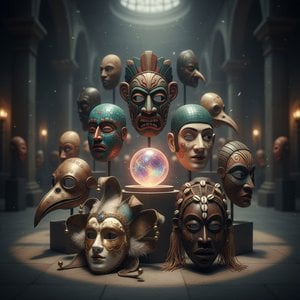
James Ensor: Confronting Death Through Masks
James Ensor’s *Masques Chantants* (Masks Singing) stands as a chilling testament to the artist's preoccupation with mortality and societal anxieties—a cornerstone of his Expressionist vision. Painted in 1888, this monumental canvas captures a scene steeped in theatricality and unsettling symbolism, reflecting Ensor’s fascination with the grotesque and challenging viewers to confront uncomfortable truths about human existence.
- Subject Matter: The painting depicts a group of figures adorned in masks—a motif recurrent throughout Ensor's oeuvre—engaged in an ambiguous ritualistic dance. These masked individuals are positioned against a backdrop of shadowy interiors, amplifying the sense of unease and isolation.
- Style & Technique: Ensor employed oil paints on canvas with meticulous detail, utilizing bold brushstrokes and contrasting colors to convey emotion rather than realistic representation. His technique is characterized by a deliberate disregard for academic conventions, prioritizing psychological impact over visual accuracy.
- Historical Context: Created during the Belle Époque—a period marked by optimism alongside simmering social tensions—*Masques Chantants* speaks to anxieties surrounding death, ritual, and societal hypocrisy. Ensor’s work aligns with the broader Expressionist movement's rejection of Impressionistic aesthetics in favor of conveying inner turmoil.
Symbolism: Masks as Disguises and Representations
The masks themselves are central to the painting’s symbolic significance. They represent not merely concealment but also deception, illusion, and the suppression of identity—themes that resonate throughout Ensor's artistic explorations. The figures’ postures convey a sense of solemnity and apprehension, hinting at an impending doom.
- The Masks: Each mask embodies a distinct character or emotion, ranging from solemn contemplation to defiant resistance. Their exaggerated features heighten the theatrical atmosphere and underscore Ensor's critique of societal norms.
- Color Palette: Ensor’s palette is dominated by muted tones—browns, greys, and blacks—creating an oppressive mood that reinforces the painting’s preoccupation with death and decay. The use of color serves to heighten emotional intensity.
Emotional Impact & Artistic Legacy
*Masques Chantants* is undeniably disturbing yet profoundly evocative. Ensor compels viewers to confront uncomfortable realities about human vulnerability and the inevitability of mortality—a feat achieved through masterful composition, unsettling imagery, and a deliberate rejection of conventional beauty standards. It remains an enduring emblem of Expressionism’s commitment to psychological realism and its unflinching portrayal of the darker aspects of human experience.
This artwork exemplifies Ensor's groundbreaking approach to painting—a bold departure from academic traditions that cemented his place as one of the most influential artists of the late nineteenth century. Its enduring power lies in its ability to provoke contemplation and challenge viewers’ perceptions of life, death, and the human condition.
Pitanja i odgovori
Gde mogu pronaći statistiku o delu „Masques Chantants”, Јемас Енсор?
Postoji Statistika stranica za „Masques Chantants“. Ona prikazuje mesečne posete ovom umetničkom delu i drugim delima ovog umetnika, uz detaljnu analizu po državama i jezicima.
Koji umetnik se pripisuje delu "Masques Chantants"?
Delo "Masques Chantants" je kreirao/la Јемас Енсор. Informacije na ovoj stranici opisuju originalno delo umetnika Јемас Енсор.
Da li je "Masques Chantants" tipično za ono što je Јемас Енсор obično stvarao?
Učestale teme umetnika Јемас Енсор obuhvataju masks confront death, social satire, expressionist vision, symbolic imagery, ensor’s legacy; delo "Masques Chantants" fokusira se na masks, carnival, skeletons, figures, belgium, surrealism, portrait.
Kakve boje koristi "Masques Chantants"?
„Masques Chantants”, Јемас Енсор koristi Neutrals paletu boja. Ova paleta sažima opšti koloristički karakter dela.
Koja tehnika je korišćena za „Masques Chantants”, Јемас Енсор?
Јемас Енсор je koristio/la tehniku Acrylic On Canvas za delo "Masques Chantants". Ova tehnika definiše materijalnu prirodu originalnog dela.
Ko prodaje ručno oslikane kopije dela „Masques Chantants”, Јемас Енсор?
Ručno oslikane kopije dela „Masques Chantants”, Јемас Енсор mogu se kupiti na stranici ovaj veb-sajt: ručno oslikana uljana reprodukcija na lanenom platnu, uz poručivanje putem ova stranica.
Kako mogu da nabavim print dela „Masques Chantants”, Јемас Енсор?
Štampa dela „Masques Chantants”, Јемас Енсор može se naručiti direktno na ova stranica: umetnička štampa na pamučnom platnu ili arhivskom kanvas papiru.



 Pregledaj u prostoru
 Pređi na prodaju štampanih primeraka
 Podeli
 Podeli
 Detalji
 Vodič
Vodič

 Preuzmi sliku
 Slični predmeti
 Rendgenski snimak
 Automatska prezentacija
 Statistika
 Pročitaj više






































 Opcija sa staklom dostupna je samo za dimenzije manje od 110 cm