The Enigmatic Gathering: Exploring L' Arrestation de Pierrot
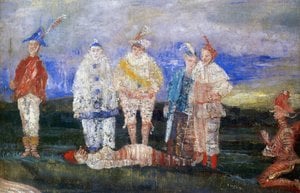
To stand before James Ensor’s L' Arrestation de Pierrot is to step directly into the vibrant, unsettling heart of a carnival dream that has curdled slightly into something more profound—a moment suspended between revelry and revelation. This painting captures not merely three figures in the grass, but an entire tableau steeped in the theatricality and underlying anxieties of human interaction. Ensor, forever fascinated by the masquerade, presents us with characters whose very costumes seem to speak volumes about their inner selves. The gentleman on the left, crowned with a striking red hat and sporting a white beard, contrasts sharply with the central figure draped in what appears to be a luminous white robe beneath a blue hood. To his right, the third individual adds another layer of visual complexity with their checkered attire. These are not simply portraits; they are carefully constructed masks worn by souls caught in an arresting moment.
A Tapestry Woven from Carnival and Shadow
Ensor’s technique here is masterful in its ability to blend the grotesque with the beautiful, a hallmark of his unique vision. While the subject matter—three figures amidst scattered props like tennis rackets and watchful birds—suggests an outdoor gathering, the atmosphere feels intensely staged, almost dreamlike. The inclusion of these seemingly random objects, alongside the two avian presences, adds a layer of symbolic clutter that invites endless interpretation. One senses the energy of the seaside resort town from which Ensor drew so much inspiration; the air itself seems thick with forgotten laughter and whispered secrets. It is a work that demands prolonged contemplation, rewarding the viewer who dares to look beyond the surface gaiety.
Symbolism in the Masquerade
The recurring motif of disguise, central to Ensor’s life and art, permeates this piece. The masks are not just accessories; they are psychological barriers. Pierrot himself, whose name echoes through the title, represents a figure perpetually caught between visibility and anonymity. The varied costuming—the bright red, the ethereal white, the bold checks—suggests different social roles or perhaps different emotional states being played out simultaneously. The tension inherent in their grouping, coupled with the scattered props that suggest interrupted activity, hints at a moment of confrontation or sudden realization, an "arrestation" of spirit rather than just body.
Bringing the Carnival Home: Decorating with Ensor
For the collector or designer seeking to infuse a space with intellectual depth and dramatic flair, this reproduction offers unparalleled character. Imagine this piece anchoring a room—perhaps one with rich textures or historical architectural details. Its vibrant yet melancholic palette prevents it from feeling overly saccharine; instead, it lends an air of sophisticated mystery. It speaks to those who appreciate art that refuses easy categorization, pieces that invite conversation and deep thought over the passing clinking of crystal. Owning a reproduction of L' Arrestation de Pierrot is acquiring not just paint on canvas, but a piece of Belgian artistic history imbued with the restless spirit of the carnival.
Pitanja i odgovori
Kakvu atmosferu donosi „L' Arrestation de Pierrot”, Јемас Енсор u enterijer?
Sa svojim Dramatic raspoloženjem, delo "L' Arrestation de Pierrot" je predloženo za Living Room.
Kako mogu da nabavim print dela „L' Arrestation de Pierrot”, Јемас Енсор?
Štampa dela „L' Arrestation de Pierrot”, Јемас Енсор može se naručiti direktno na njegovoj stranici za Umetski print: umetnička štampa na pamučnom platnu ili arhivskom kanvas papiru.
Koliko su intenzivne boje u delu „L' Arrestation de Pierrot”, Јемас Енсор?
Boje u delu „L' Arrestation de Pierrot”, Јемас Енсор imaju Balanced intenzitet.



 Pregledaj u prostoru
 Naručite ručno oslikano reprodukciju
 Podeli
 Podeli
 Detalji
 Vodič
Vodič

 Preuzmi sliku
 Slični predmeti
 Rendgenski snimak
 Automatska prezentacija
 Statistika

 Pročitaj više






































 Opcija sa staklom dostupna je samo za dimenzije manje od 110 cm