BESPLATNA KONSULTACIJA SA STRUČNJAKOM ZA UMETNOST

x
Kupi štampu Kupi štampuNaručite reprodukciju Naručite reprodukciju PošaljiPošalji
DetaljiDetalji Dodaj u omiljene Dodaj u omiljene ПреузмиПреузми Slični predmetiSlični predmeti Rendgenski snimakRendgenski snimak SlajdoviSlajdovi

Au conservatoire

James Ensor's 'Au Conservatoire' is an Expressionist masterpiece brimming with unsettling figures and satirical humor. Explore the painting’s layered symbolism, masks, and critique of Belgian society through a unique, captivating visual experience.

Откријте Јамес Енсор (1860-1949), белгијског сликар који је био пионер експресионизма и сюрреализма. Истражите његове узнемирујуће сцене маски, карнавала и скелета.

Kupite digitalnu sliku visoke rezolucije i poboljšanog kvaliteta, koja je znatno superiornija od onoga što vidite u online prikazu.

Svaka datoteka je pedantno pripremljena od strane naših stručnjaka koristeći napredne alate i profesionalnu ručnu retušu. Osiguravamo da svaka slika ima izuzetnu oštrinu, preciznu reprodukciju boja i fine detalje.

Konačna datoteka se dostavlja putem e-pošte u roku od 72 sata, optimizovana za neposrednu upotrebu u profesionalnim, izdavačkim i štamparskim okruženjima. To je isti kvalitet kojem veruju vrhunski studiji dizajna, izdavači i galerije.

Digitalna slika

Preuzmite datoteku visoke rezolucije za ličnu upotrebu, štampanje i kreativne projekte.

Ukupna cena

$9.99

Uključeno uz svaku porudžbinu digitalne slike

Profesionalna digitalna isporuka, zagarantovana

Kada odaberete WahooArt.com, ne dobijate samo sliku – vi primate profesionalno unapređeno digitalno umetničko delo, izrađeno sa najvećom preciznošću i uz garanciju zadovoljstva. Evo svega što automatski dolazi uz vašu porudžbinu:

shipping_icon
Brza dostava putem e-pošte

Vaša digitalna slika visoke rezolucije biće vam poslata putem e-pošte u roku od 72 sata od poručivanja – spremna za trenutnu upotrebu.

canvas_icon
Digitalna datoteka unapređena veštačkom inteligencijom

Vaše umetničko delo je profesionalno optimizovano korišćenjem naprednih AI alata i ručne obrade, čime se osiguravaju maksimalni detalji, oštrina i preciznost boja.

insurance_icon
Besplatna ponovna isporuka doživotno

Slučajno ste obrisali ili izgubili svoju datoteku? Ne brinite – poslaćemo vam je ponovo u bilo kom trenutku, potpuno besplatno.

tax_icon
Bez troškova uvoza – zauvek

Uživajte u svojim umetničkim delima trenutno, bez carine, dažbina ili troškova dostave – digitalni download je uvek bez poreza.

color_icon
Garancija vernosti boja

Uz pomoć profesionalnih alata i upravljanja bojama, osiguravamo da vaša digitalna slika što vernije odražava originalne boje.

return_icon
Garancija zadovoljstva u roku od 60 dana

Ako niste zadovoljni svojom digitalnom slikom, revidirat ćemo je ili vratiti 100% novca u roku od 60 dana – bez ikakvih pitanja.

guarantee_icon
100% garancija povrata novca

Niste zadovoljni? Obezbedite pun povrat novca u roku od 60 dana od trenutka kada ste primili svoju digitalnu datoteku – bez suvišnih pitanja.

discount_icon
Popusti na velike porudžbine

Kupite 3 slike, uštedite 10% - Kupite 5 slika, uštedite 15% - Kupite 10+ slika, uštedite 20%. Odlično za kreativne projekte, galerije i agencije.

Osnovne informacije

  • Artistic style: Satirical, grotesque
  • Artist: James Ensor
  • Subject or theme: Conservatoire scene
  • Dimensions: 56 x 71.5 cm
  • Location: Musée d'Orsay, Paris
  • Year: 1902
  • Influences:
    • Wagnerism
    • Carnival

Kviz o umetnosti

Svako pitanje ima samo jedan tačan odgovor.

Pitanje 1:
What artistic movement is most closely associated with James Ensor’s ‘Au Conservatoire’?
Pitanje 2:
The painting 'Au Conservatoire' primarily utilizes what color palette?
Pitanje 3:
What is the significance of the numerous objects depicted in ‘Au Conservatoire’?
Pitanje 4:
Which of the following best describes James Ensor’s style as evident in ‘Au Conservatoire’?
Pitanje 5:
The inclusion of a ‘hareng-saur’ (a type of herring) in the painting is most likely intended to convey:

Opis kolekcionarskog dela

A Window into the Psyche: Unpacking James Ensor’s *Au Conservatoire*

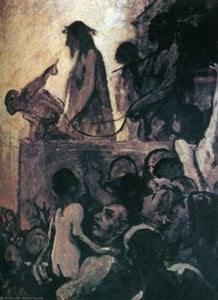
James Ensor's 1902 painting, *Au Conservatoire*, isn’t merely a depiction of a scene; it’s an unsettling plunge into the artist’s uniquely warped perception of reality. This work, housed within the Musée d'Orsay in Paris, stands as a cornerstone of Expressionism – a movement that prioritized raw emotion and subjective experience over objective representation. More than just a portrait or still life, *Au Conservatoire* is a meticulously constructed tableau designed to provoke, to challenge, and ultimately, to reveal the anxieties simmering beneath the surface of Belgian society at the turn of the 20th century.

The painting immediately commands attention with its deliberate lack of harmony. A central figure, seemingly directing our gaze with a pointed stick, dominates the composition, yet his purpose remains ambiguous. Surrounding him is a chaotic collection of individuals – men in ties, a woman holding sheet music, and a scattering of objects: a bowl overflowing with what appears to be a disconcerting assortment of items, a knife and fork resting on a table, a bottle, two cell phones—each element contributing to the painting’s overall sense of unease. The use of sepia tones lends an air of timelessness, reminiscent of old photographs, yet this formality is immediately undermined by the distorted figures and jarring juxtapositions.

The Language of Distortion: Style and Technique

Ensor's masterful manipulation of form and color is central to *Au Conservatoire’s* impact. The figures are rendered with a deliberate lack of detail, their faces often obscured by masks or distorted expressions. This technique isn’t simply stylistic; it serves to strip away any semblance of conventional beauty or social decorum, exposing the underlying anxieties and tensions within the scene. Notice how the perspective is subtly skewed, creating a sense of disorientation and pulling the viewer into the painting's unsettling atmosphere. The artist employs a bold, almost frantic brushstroke, adding to the feeling of agitation and instability.

Furthermore, the inclusion of seemingly random objects – the hareng-saur (a type of herring), a canard (duck), and even a cat—functions as a deliberate disruption. These elements, presented with an almost absurd intensity, suggest a critique of bourgeois values and societal pretensions. The inscription on the back of the painting, “He.Y.HOTO.yo / Ho y Ho Ho / HAUT Y HAUT / TROP HAUT / TROP D’EAU / CONSERVATOIRE / ROYAL,” adds another layer of complexity, hinting at a satirical commentary on the rigid hierarchy and self-importance within the musical establishment.

Contextualizing the Discomfort: Expressionism and Beyond

*Au Conservatoire* is deeply rooted in the context of early 20th-century Expressionism. Artists like Egon Schiele, known for his emotionally charged portraits and unsettling imagery, and Pablo Picasso, whose exploration of form and psychology profoundly influenced the movement, were grappling with similar themes of alienation, anxiety, and the fragmentation of modern life. Ensor’s work shares a kinship with these artists, yet possesses a uniquely Belgian sensibility – a darkly humorous critique of national identity and social conventions.

The painting's influence extends beyond its immediate historical context. The use of masks, grotesque figures, and symbolic objects anticipates later developments in Surrealism and continues to resonate within contemporary art. Reproductions of *Au Conservatoire*, particularly those crafted by WahooArt.com, offer a remarkable opportunity to experience the power and complexity of this seminal work, allowing viewers to engage with Ensor’s vision on a deeper level.

To explore further, consider visiting the Musée d'Orsay in Paris or delving into James Ensor’s extensive body of work. And for a truly immersive experience, we invite you to commission a hand-painted reproduction of *Au Conservatoire* – a timeless piece that will undoubtedly become a captivating centerpiece in your collection.

Srodna umetnička dela


Biografija umetnika

James Ensor: A Pioneer of Expressionism and Surrealism

James Sidney Edouard, Baron Ensor (Ostend, 13 April 1860 – 19 November 1949) was a Belgian painter and printmaker who stands as one of the most influential figures in the development of Expressionism and Surrealism. Born into an English father and Belgian mother amidst the vibrant atmosphere of Ostend’s seaside resort town, Ensor’s upbringing instilled within him a profound fascination with observation and detail—a foundation upon which he would construct his distinctive artistic vision.

Early Influences and Artistic Training

From a young age, Ensor demonstrated an exceptional talent for drawing and painting. Encouraged by his parents' operation of a souvenir shop brimming with curiosities and carnival masks – a veritable cabinet of wonders that ignited his imagination – he pursued formal artistic training at the Académie Royale des Beaux-Arts in Brussels. Despite encountering resistance from the rigid academic conventions of the time, Ensor quickly recognized the necessity of forging his own path, prioritizing experimentation and personal expression above all else.

The Emergence of Grotesque Vision

Around 1886–87, Ensor embarked on a transformative artistic journey, rejecting Impressionistic ideals in favor of a bold embrace of grotesque imagery. Influenced by Rembrandt’s masterful use of chiaroscuro, the unsettling visions of Francisco Goya, and the evocative symbolism of Japanese woodcuts, he developed a highly personal iconography characterized by jarring juxtapositions of color and form.

Major Works and Recurring Themes

Ensor's oeuvre is marked by an unparalleled exploration of psychological complexity and social critique. Paintings like *The Oyster-eater* (1882) exemplify his meticulous attention to detail and his ability to convey profound emotional resonance, while *Christ’s Entry into Brussels* (1888–89), arguably his magnum opus, remains a monumental satire of religious hypocrisy—a painting initially met with vehement disapproval but now universally recognized as a cornerstone of Expressionist art.

Legacy and Influence

James Ensor's uncompromising artistic vision profoundly impacted subsequent generations of artists. His rejection of academic formalism, coupled with his fearless confrontation of taboo subjects and his masterful manipulation of visual language—particularly the use of bold brushstrokes and vibrant hues—established him as a pivotal figure in the genesis of Expressionism and Surrealism. Today, Ensor’s work continues to inspire awe and provoke contemplation, serving as a timeless reminder that art possesses the capacity to unsettle conventions and illuminate the darkest recesses of human consciousness.

Јемас Енсор

Јемас Енсор

1860 - 1949 , Бележија

Kratke činjenice

  • Artistic Movement Or Style: Expressionism, Surrealism
  • Artists Who Influenced This Artist:
    • Bruegel the Elder
    • Francisco Goya
    • Whistler
  • Date Of Birth: April 13, 1860
  • Date Of Death: November 19, 1949
  • Full Name: James Sidney Edouard Ensor
  • Nationality: Belgian
  • Notable Artworks:
    • The Scandalized Masks
    • Skeletons Fighting...
    • Christ's Entry into Brussels
  • Place Of Birth: Ostend, Belgium