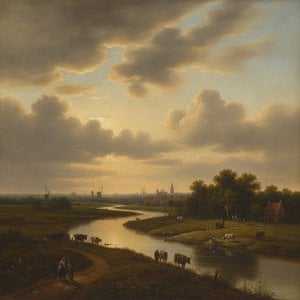
Landscape with Cattle by Jacob van Strij
Jacob van Strij’s “Landscape with Cattle” stands as a quintessential example of Dutch Golden Age landscape painting, embodying the serene beauty and meticulous observation characteristic of this artistic period. Executed in 1785 – 1800, this oil on canvas measuring 80 x 107 cm captures a tranquil rural scene that transcends mere depiction; it’s an invitation to contemplate the harmony between humanity and nature.
Initially dismissed as a Cuyp attribution due to a misleading inscription on the lower right corner—a common occurrence during the time—scholarly research has definitively established Strij's authorship. Comparisons with signed works by Cuyp revealed subtle stylistic differences, bolstering the conviction that this painting represents an independent artistic endeavor.
Style and Technique: Echoes of Baroque Grandeur
Strij’s approach aligns closely with the Baroque tradition yet subtly diverges from its theatrical exuberance. Like many artists of his era, he drew inspiration from the monumental landscapes of Rembrandt and Cuyp, prioritizing atmospheric perspective and tonal modulation to convey depth and realism. However, Strij eschews the dramatic contrasts favored by Cuyp, opting for softer lighting that illuminates the scene with a diffused glow—a technique particularly adept at capturing the ethereal quality of winter mornings.
The artist’s meticulous attention to detail is evident in every brushstroke. The textured surface of the canvas reflects the materiality of the pigments themselves, demonstrating Strij's mastery of oil paint and his ability to render natural forms with remarkable accuracy. Particularly noteworthy are the depictions of the cattle—their fur meticulously brushed to convey a palpable sense of warmth and vitality—and the reflections shimmering on the river’s surface.
Historical Context: A Moment Frozen in Time
"Landscape with Cattle" reflects the broader cultural landscape of the Dutch Republic during the Enlightenment. The painting speaks to an idealized vision of rural life, mirroring the philosophical preoccupation with simplicity and contemplation prevalent at the time. Furthermore, it embodies the fascination for scientific observation—a hallmark of the era—as evidenced by the artist’s careful rendering of geological formations and plant species.
The inclusion of a village nestled along the riverbank adds another layer of significance to the composition. This depiction harkens back to earlier Baroque landscapes that celebrated the grandeur of aristocratic estates, subtly reminding viewers of the social hierarchy inherent in Dutch society. Yet, unlike those monumental works, “Landscape with Cattle” prioritizes intimacy and immediacy—a deliberate choice that underscores Strij’s artistic sensibility.
Symbolism and Emotional Impact
Beyond its aesthetic merits, "Landscape with Cattle" resonates on an emotional level. The tranquil atmosphere conveyed by the painting evokes feelings of peace and contentment—a balm for the anxieties of urban life during the Enlightenment. The presence of livestock symbolizes fertility and prosperity, reinforcing the pastoral ethos that underpinned Dutch artistic culture.
Ultimately, Jacob van Strij’s “Landscape with Cattle” remains a testament to the enduring power of landscape art to inspire contemplation and capture the sublime beauty of the natural world. Its meticulous execution and harmonious composition solidify its place as one of the most celebrated achievements of Dutch Golden Age painting.



 Pregledaj u prostoru
 Kupi ručno naslikanu sliku
 Pošalji
 Podeli
 Detalji o delu

 Преузми
 Slični predmeti
 Rendgenski snimak
 Slajdovi
 Statistika


 Pročitaj više






































 Opcija sa staklom dostupna je samo za dimenzije manje od 110 cm