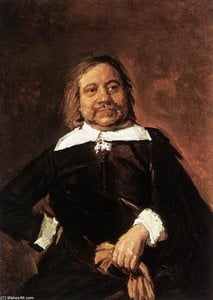
A Portrait of Quiet Dignity: Petrus Scriverius by Frans Hals
Frans Hals’s “Petrus Scriverius,” painted in 1626, isn't merely a likeness; it’s a carefully constructed tableau of intellect, status, and the subtle pleasures of scholarly life. This intimate portrait, rendered in Hals’s signature loose brushwork and vibrant palette, offers a rare glimpse into the world of a Dutch humanist – a man who valued learning, refinement, and the quiet dignity of intellectual pursuits. The painting immediately draws the viewer in with its direct gaze; Scriverius meets the eye with an air of thoughtful composure, his expression hinting at both wisdom and a touch of wry amusement.
Hals’s masterful technique is evident in every detail. Note the remarkable rendering of texture – the heavy velvet of his coat, the intricate weave of his wig, the subtle sheen on his hands resting upon a book. The artist employs a technique known as “stiacciato,” building up layers of paint to create a sense of depth and volume, particularly noticeable in the folds of the fabric. The background is deliberately blurred, directing all attention onto Scriverius himself – a deliberate choice that emphasizes his importance within the composition. Hals’s use of light and shadow further enhances the portrait's realism, creating a three-dimensional effect that invites close inspection.
A Scholar’s World: Context and Symbolism
Painted during the Dutch Golden Age, “Petrus Scriverius” reflects the burgeoning intellectual climate of the time. The Netherlands was experiencing a remarkable cultural renaissance, fueled by trade, exploration, and a renewed interest in classical learning. Humanist ideals – emphasizing reason, ethics, and the study of the humanities – were gaining traction, and figures like Scriverius played a vital role in preserving and disseminating knowledge. The inclusion of the book is paramount; it’s not just an object but a symbol of Scriverius's identity—a scholar immersed in the world of letters.
Beyond the obvious symbolism of learning, subtle details reveal deeper layers of meaning. The gloves he holds are a clear indicator of his social standing and gentlemanly bearing – a marker of respectability within the Dutch society of the era. The carefully arranged setting—a simple, yet elegant interior—suggests a private study, a space dedicated to contemplation and intellectual work. Even the muted colors contribute to the overall mood: they evoke a sense of quiet sophistication and understated elegance.
Marriage Pendant & The Artist’s Signature
This portrait is part of a pair – a marriage pendant – alongside its counterpart depicting Scriverius's wife, Anna van der Aar. Hals frequently created these paired portraits, often presenting them as gifts to commemorate significant milestones in the couple’s lives, particularly their 25th wedding anniversary. This pairing underscores the importance of family and domestic life within the broader context of intellectual pursuits. The composition itself—the figures closely positioned together—suggests a deep connection between husband and wife, further enriching the portrait's narrative.
Interestingly, the painting is monogrammed with “PH,” indicating Frans Hals’s signature. This subtle detail serves as a testament to the artist’s pride in his work and reinforces the importance of this particular commission. The fact that these portraits were retained as family keepsakes speaks volumes about their enduring value and the affection they inspired.
A Timeless Portrait: Emotional Impact & Reproduction
“Petrus Scriverius” transcends a simple likeness; it’s a powerful evocation of intellect, dignity, and quiet contemplation. Hals masterfully captures not just Scriverius's physical appearance but also his inner character—his intelligence, his composure, and perhaps even a hint of melancholy. The painting invites the viewer to step into Scriverius’s world, to share in his intellectual pursuits, and to appreciate the beauty of a life dedicated to learning.
WahooArt offers meticulously crafted reproductions of this iconic masterpiece, allowing you to bring its timeless elegance into your home or office. Our high-quality prints capture the nuances of Hals’s brushwork and color palette with exceptional fidelity, ensuring that you experience the full emotional impact of this remarkable portrait. Whether you are an art enthusiast, a collector, or simply seeking a piece of history to adorn your space, a reproduction of “Petrus Scriverius” is sure to be a treasured addition to your collection.



 Pregledaj u prostoru
 Pređi na prodaju štampanih primeraka
 Podeli
 Podeli
 Detalji
 Vodič
Vodič

 Preuzmi sliku
 Slični predmeti
 Rendgenski snimak
 Automatska prezentacija
 Statistika


 Pročitaj više






































 Opcija sa staklom dostupna je samo za dimenzije manje od 110 cm