The Tranquil Embrace: A Study in Rococo Idyllicism
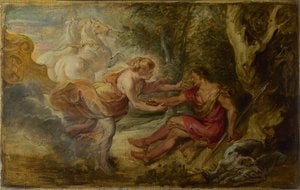
François Boucher’s “Pastoral Scene,” painted in 1745, isn't merely a depiction of a rural landscape; it’s a carefully constructed invitation into an idealized world—a sanctuary of innocence and leisure nestled within the heart of France. The painting immediately draws the viewer in with its soft palette of browns, beiges, and muted greens, evoking a sense of gentle warmth and timeless serenity. Two young figures – a boy and girl – are seated amidst a rocky outcrop, seemingly lost in quiet contemplation as they engage with paper, suggesting an early lesson or perhaps simply a shared moment of innocent amusement. The scene is populated by sheep grazing peacefully nearby, reinforcing the theme of harmonious coexistence between humanity and nature.
Boucher’s masterful command of Rococo style is evident throughout. The composition adheres to classical principles of balance and symmetry, yet it's infused with a distinctly playful spirit. The figures are rendered with exquisite detail – their youthful faces alight with curiosity, their clothing flowing gracefully—while the surrounding landscape is treated with a delicate touch, emphasizing texture through subtle variations in tone and hatching. Notice how Boucher expertly uses light to sculpt form, creating a sense of depth and volume that invites the viewer to step into the scene.
A Masterpiece of Dry Point Technique
The painting’s remarkable detail is achieved using a technique known as dry point etching, a method favored by Boucher during this period. This process involved scratching a copper plate with a needle, creating a textured surface that would then be inked and pressed onto paper. The resulting image possesses a unique tactile quality—a subtle roughness that adds to the painting’s overall sense of intimacy and immediacy. The meticulous hatching and cross-hatching create a rich tapestry of tones, suggesting both the solidity of the rocks and the softness of the sheep's wool. This technique is particularly effective in conveying the texture of drapery and the delicate details of the children’s clothing.
Furthermore, Boucher’s use of color is restrained yet evocative. He avoids bright, saturated hues, opting instead for a muted palette that contributes to the painting's overall sense of tranquility. The browns and beiges create a warm, earthy atmosphere, while the greens suggest the lushness of the surrounding landscape. The subtle variations in tone—from the darkest shadows to the lightest highlights—are expertly rendered, creating a dynamic interplay of light and shadow that brings the scene to life.
Symbolism and the Essence of Pastoral
“Pastoral Scene” is rich in symbolic meaning. The setting itself – a secluded rocky outcrop with grazing sheep – represents the idealized concept of the “locus amoenus,” or beautiful place, a recurring motif in pastoral literature and art. This idyllic landscape embodies notions of harmony, innocence, and escape from the complexities of urban life. The children’s engagement with paper hints at the importance of education and learning, suggesting that this peaceful setting is also a space for intellectual growth. The sheep, traditionally associated with simplicity and humility, further reinforce this theme.
Beyond its immediate visual appeal, “Pastoral Scene” speaks to broader cultural values—the appreciation of nature, the celebration of childhood, and the pursuit of a simpler, more fulfilling way of life. It’s a testament to Boucher's ability to capture not just a scene but also an entire mood—a feeling of quiet contemplation, gentle joy, and profound connection with the natural world. Reproductions of this work offer a window into a bygone era, inviting us to pause, reflect, and rediscover the beauty that can be found in the simplest of moments.



 Pregledaj u prostoru
 Kupi ručno naslikanu sliku
 Pošalji
 Podeli
 Detalji o delu

 Преузми
 Slični predmeti
 Rendgenski snimak
 Slajdovi
 Statistika


 Pročitaj više






































 Opcija sa staklom dostupna je samo za dimenzije manje od 110 cm