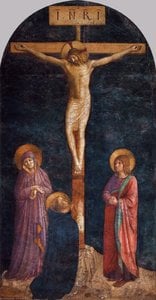
A Symphony of Sorrow: The Ethereal Grief of Fra Angelico
In the quiet, contemplative halls of the Museo Nazionale di San Marco in Florence, there exists a moment frozen in time, a profound meditation on loss and faith known as Lamentation. Painted around 1430, this masterpiece by the Dominican friar Fra Angelico transcends the boundaries of mere religious illustration to become an immersive emotional experience. The scene unfolds within a somber, cave-like space that mirrors the monastic solitude of the artist's own life, drawing the viewer into a sacred circle of mourning. At the heart of this composition lies the lifeless body of Jesus, his arms outstretched in a final gesture of sacrifice, serving as the central axis around which a constellation of grief revolves.
The arrangement of the figures is a masterclass in Early Renaissance balance and proportion. Surrounding the central figure are those who shared in this biblical tragedy: Mary Magdalene, Saint John the Evangel_Evangelist, Nicodemus, and Joseph of Arimathea. Each character is placed with meticulous precision, creating a tableau that feels both structurally stable and emotionally volatile. The artist uses the physical closeness of these figures to evoke a sense of communal suffering, inviting anyone who gazes upon the work to participate in their shared heartache.
The Alchemy of Light and Color
Fra Angelico’s technical brilliance is most evident in his use of color and medium. Utilizing tempera paint—a technique involving the delicate mixing of pigment with egg yolk—the artist achieved a luminous, glaze-like surface that captures and reflects light with an almost supernatural quality. This choice of medium was essential for creating the ethereal glow seen in the wings of the surrounding angels, providing a celestial contrast to the earthly weight of the scene.
The color palette is a deliberate study in contrasts. A restrained selection of cool blues and deep greens dominates the stony, subterranean setting, grounding the scene in a sense of heavy, earthen desolation. However, this coolness is pierced by sudden, vibrant bursts of warmth; the rich reds and shimmering golds adorning Mary’s robes act as visual anchors, drawing the eye toward the most poignant expressions of devotion. This juxtaposition between the coldness of death and the warmth of divine compassion serves to heighten the visual impact, making the Lamentation not just a painting to be seen, but a spiritual encounter to be felt.
A Timeless Legacy for the Discerning Collector
For the art lover or interior designer, a reproduction of this work offers more than mere decoration; it brings a sense of historical depth and spiritual serenity into a contemporary space. The Lamentation is a testament to the power of art to communicate the most complex human emotions—the intersection of agony and hope, of mortality and divinity. Its ability to anchor a room with its profound stillness and balanced composition makes it an incomparable choice for those seeking to curate an environment of reflection and grace.
Pitanja i odgovori
Ko je kreirao "lamentation" i u kojoj godini?
Delo "lamentation" delo je umetnika Фра Анђело iz 1430. godine.
Postoji li informativni list o delu „lamentation”, autor Фра Анђело namenjen studentima?
Vodič za "lamentation" je stranica Vodič za učenike za ovo umetničko delo – štampani informativni list koji prikazuje delo sa njegovim opisom, podacima o autorstvu i identifikacionom tabelom (umetnik, datumi, tehnika, originalna veličina, kolekcija).
Gde i kako se preporučuje postaviti „lamentation”, autor Фра Анђело?
„lamentation”, autor Фра Анђело se preporučuje za Accent, idealno u Living Room. Upotreba i prostor zajedno ukazuju na to gde reprodukcija najbolje pristaje.



 Pregledaj u prostoru
 Kupite ručno oslikano delo
 Pošalji
 Podeli
 Detalji o delu
 Vodič
Vodič

 Preuzmi
 Slični predmeti
 Rendgenski snimak
 Automatska prezentacija
 Q&A
Q&A Statistika

 Pročitaj više






































 Opcija sa staklom dostupna je samo za dimenzije manje od 110 cm