


Umetničko delo prikazano na ovoj stranici zaštićeno je autorskim pravima, što znači da zakonski nismo u mogućnosti da kreiramo niti prodajemo identičnu reprodukciju. Ova zaštita se sprovodi u skladu sa međunarodnim sporazumima kao što su Bernska konvencija i nacionalnim zakonima, uključujući i one koji su definisani u Američki zakon o autorskom pravu – Naslov 17.
Ovaj metod je u potpunosti usklađen sa regulativama o autorskim pravima jer ne podrazumeva kopiranje ili dupliranje zaštićenih umetničkih dela. Umesto toga, reč je o kreativnoj reinterpretaciji – novom slikarskom delu koje je inspirisano originalom, ali nije identično njemu.
Giclée štampa ili print na platnu muzejskog kvaliteta uz brzu izradu i raznovrsne opcije završne obrade. ( Kupite ručno oslikano delo Pređi na digitalnu sliku)
Izaberite jednu od naših unapred definisanih veličina koje odgovaraju originalnim proporcijama umetničkog dela.

Unesite željenu širinu i visinu kako bi se štampa uklopila u vaš ram ili zid. Štampu je moguće samo iseći, ali nikada povećati iznad dimenzija originalne slike, stoga format sa drugačijim proporcijama uzrokuje gubitak dela slike. Pre početka štampe, poslaćemo vam digitalni prikaz radi potvrde. Slika prikazana na ovoj stranici ne predstavlja stvarni isrez — to pokazuje samo digitalni prikaz.
Dostava širom sveta () za 2 nedelje umesto uobičajenih 4/5 nedelja. (8 новембар)
Sans Titre
Dimenzije reprodukcije

Fouad Bellamine, a prominent figure in the Moroccan and international artistic landscape, possesses a practice that transcends mere representation to explore the very architecture of perception. Born in the imperial city of Fez, his early years were steeped in the rich textures of the madina, where watching his grandfather work as a weaver provided a foundational connection to pattern and craft. This deep-rooted cultural heritage, combined with an academic rigor developed at the École des Arts Appulated de Casablanca, allowed him to forge a unique visual language. Bellamine’s work is famously characterized by his philosophical stance on identity, famously asserting that “there is no Moroccan painting, there are only Moroccan painters.” This sentiment underscores his refusal to be confined by nationalistic labels, choosing instead to engage with universal themes of light, space, and the physical act of creation.
His artistic journey took him from the vibrant streets of Morocco to the intellectual hubs of Europe. After traveling through France, Yugoslavia, and Italy in the early 1970s, Bellamine’s exposure to Western art movements profoundly shaped his trajectory. His time in Paris, supported by a governmental scholarship at the Cité des Arts, became a period of intense theoretical and practical development. It was here that he pursued advanced studies in art history and theory at Saint-Denis University - Paris VIII, focusing his doctoral research on the concept of murality in contemporary painting. This academic pursuit of how art interacts with and constructs space became a cornerstone of his mature style.
In the works of Bellamine, the canvas is not merely a surface for pigment but a site of construction. His paintings often revolve around the motifs of arcs, arches, and vaults, elements that evoke both classical architecture and the rhythmic patterns found in Moroccan design. These forms are never static; they are brought to life through a dynamic interplay of light and gesture. For Bellamine, the movement of the body during the act of painting is inseparable from the creation of space itself. He utilizes light as a structural tool, using it to define volumes and reveal the hidden depths within his compositions.
The technique often involves a masterful use of mixed media, where rich textures invite the viewer into a state of contemplation. His palettes frequently employ vibrant tones—such as deep reds and warm oranges—to guide the eye through complex, nonfigurative landscapes. This approach creates a sense of tranquility and "calm silence," inviting an emotional response that is both meditative and profound. The following elements are central to his aesthetic development:
Bellamine’s influence extends far beyond the borders of Morocco, as his work has been integrated into some of the most prestigious collections in the world. His presence in institutions such as the Institut du Monde Arabe in Paris, the Mathaf Museum of Modern Art in Qatar, and the Sharjah Art Museum in the United Arab Emirates speaks to his global significance. In 2020, he achieved a historic milestone as the first Moroccan artist to be honored with a retrospective exhibition at the Mohammed VI Museum of Modern and Contemporary Art in Rabat, titled Entrée en matière.
Living and working between Paris and Rabat, Bellamine continues to bridge the gap between different cultural perspectives. His career, which includes roles as a teacher and lecturer, has allowed him to mentor new generations of artists while maintaining a rigorous personal practice. Through his dedication to nonfigurative painting and his profound inquiry into the nature of space, Fouad Bellamine remains a vital voice in contemporary art, reminding us that the act of painting is an eternal quest for light and meaning.

1940 - , Morocco

Elevate your artistic practice with our expert guide to mastering mixed media art. Discover professional techniques for layering, material integration, and creating structural depth to transform your creative vision into sophisticated, multi-dimensional masterpieces.

Discover the exquisite mastery of pastel and chalk in fine art. Explore how texture, light, and softness create depth in Impressionist masterpieces and learn to curate these velvety textures for sophisticated, luxury interiors with expert guidance.
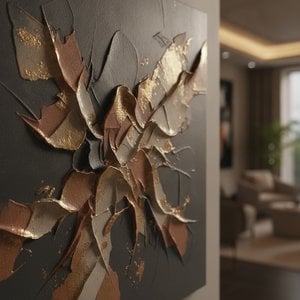
Elevate hospitality interiors with the sculptural depth of plaster and impasto art. Explore how tactile textures and relief techniques create immersive, luxurious environments for modern hotel design through expert curation and bespoke fine art commissions.
 Pregledaj u prostoru
 Pošalji
 Podeli
 Detalji o delu
 Vodič
Vodič

 Preuzmi
 Slični predmeti
 Rendgenski snimak
 Automatska prezentacija
 Pitanja i odgovori
 Statistika


 Pročitaj više






































 Opcija sa staklom dostupna je samo za dimenzije manje od 110 cm


