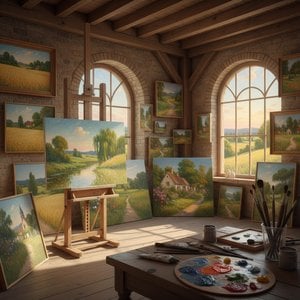
Émile van Marcke de Lummen: A Shepherd of Light and Pastoral Harmony
Born in Sèvres, France, in 1827, Charles Émile van Marcke de Lummen – later simply known as Émile van Marcke – emerged from a lineage steeped in artistic tradition. His grandfather, Charles van Marcke, was himself a Belgian artist specializing in porcelain painting, and his father, Jean-Baptiste, continued this legacy while also venturing into landscape and animal art. This familial connection to the visual arts provided Émile with an unparalleled foundation, immersing him in techniques and sensibilities from a young age. His early years were spent absorbing the atmosphere of Sèvres’ renowned porcelain factory, a place where he encountered the influence of Troyon, one of the most prominent figures of the Barbizon School, who profoundly shaped his artistic approach – specifically, the emphasis on direct observation of nature.
Van Marcke's artistic journey truly began in 1853 when he joined the ranks of the Sèvres factory. However, recognizing a deeper calling, he soon transitioned to independent painting, dedicating himself to capturing the serene beauty of the French countryside. He was particularly drawn to the Normandy region, where he found an abundance of idyllic pastures and contented livestock – subjects that would become the hallmark of his oeuvre. His work wasn’t merely a depiction of rural life; it was a deliberate attempt to evoke a sense of tranquility, harmony, and timelessness. This pursuit led him to purchase a farmhouse in Boutencourt, establishing a studio where he could immerse himself fully in his chosen subject matter.
The Barbizon School and the Influence of Nature
Émile van Marcke’s artistic development is inextricably linked to the Barbizon School, a movement that championed direct observation of nature as paramount. Rejecting the polished finish and idealized forms favored by earlier academic painters, the Barbizon artists sought to capture the essence of the landscape with honesty and immediacy. Van Marcke wholeheartedly embraced this philosophy, spending countless hours outdoors studying light, color, and composition. His paintings are characterized by a remarkable ability to convey atmosphere – the shimmering heat haze over fields, the soft glow of dawn, the dramatic interplay of light and shadow. He skillfully employed loose brushstrokes and muted colors to create a sense of depth and realism, while simultaneously imbuing his scenes with an almost dreamlike quality.
The influence of Troyon is particularly evident in van Marcke’s early work. Like Troyon, he focused on capturing the textures of animal fur and the subtle nuances of light reflecting off water surfaces. However, Van Marcke developed a distinct style – one that prioritized the emotional resonance of his subjects over mere technical accuracy. His cattle paintings are not simply representations of livestock; they are imbued with a sense of dignity, contentment, and connection to the land.
Notable Works and Recognition
Throughout his career, van Marcke produced a substantial body of work, many of which have been celebrated in prestigious museums across France and beyond. His paintings frequently found their way into the collections of prominent figures such as William T. Walters, John Taylor Johnston, Samuel P. Avery, and even the Vanderbilt family. These collectors recognized the unique beauty and emotional depth of his art. Key works include “The Approach of a Storm (Troupeau de Vaches Passant un Gué),” a captivating depiction of cattle crossing a stream under an impending storm; "Early Morning," showcasing a peaceful scene of cows grazing in a sun-drenched valley; and “Grazing Cattle,” which exemplifies his mastery of capturing the essence of rural life. These paintings, along with others, are testaments to his skill and vision.
Legacy and Historical Significance
Émile van Marcke de Lummen died in Hyeres in 1890, leaving behind a legacy as one of France’s most beloved cattle painters. His work represents a pivotal moment in the transition from academic painting to a more modern approach, emphasizing direct observation and emotional expression. He is considered a key figure within the Barbizon School, contributing significantly to its development and influence. His paintings continue to resonate with viewers today, offering a glimpse into a bygone era of rural tranquility and artistic integrity. His art remains exhibited in museums such as The Art Institute of Chicago, The Walters Art Museum, and the Metropolitan Museum of Art, ensuring that his pastoral visions will endure for generations to come.



 Pregledaj u prostoru
 Pređi na prodaju štampanih primeraka
 Podeli
 Podeli
 Detalji
 Vodič
Vodič

 Preuzmi sliku
 Slični predmeti
 Rendgenski snimak
 Automatska prezentacija
 Statistika

 Pročitaj više






































 Opcija sa staklom dostupna je samo za dimenzije manje od 110 cm