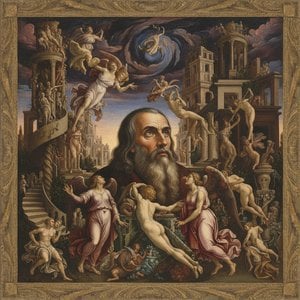
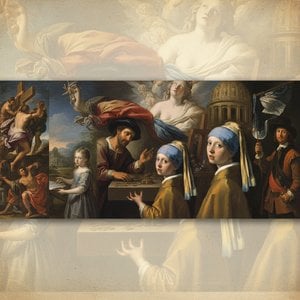
The Annunciation (detail)
Doménikos Theotokópoulos, universally known as El Greco (meaning “the Greek”), stands as one of the most singular figures in the history of Western art. His dramatic and intensely emotional works bridged the gap between the Renaissance and the Baroque periods, while simultaneously forging a distinctly personal style—a style that continues to fascinate scholars and artists alike.
The Annunciation, painted by El Greco in 1597, resides at the Museo Thyssen-Bornemisza in Madrid, Spain. This monumental canvas offers an unparalleled glimpse into the artist’s mastery of Byzantine influences blended with innovative Venetian techniques—a testament to his transformative journey through Europe.
The Composition and Symbolism
At its core, the painting depicts a pivotal biblical scene: the visitation of the Archangel Gabriel to Mary, announcing her divine conception. El Greco meticulously arranges figures within a shallow courtyard setting bathed in diffused light—a characteristic feature of his Venetian period. The angel on the left side holds a book, symbolizing divine knowledge and scripture, while gazing upwards towards Mary. Simultaneously, he gestures with his right hand, conveying reassurance and blessing.
Mary kneels reverently before Gabriel, her gaze fixed upward in contemplation—a gesture laden with spiritual significance. Her posture embodies humility and acceptance of God’s will. The angel’s robe is adorned with intricate drapery folds that contribute to the painting's ethereal atmosphere. Notably, a flaming rose bush sits beneath Mary’s lectern, representing her virginity and symbolizing divine grace.
Artistic Style and Evolution
El Greco’s artistic style underwent considerable evolution throughout his career, profoundly shaped by his formative years in Crete and subsequent explorations of Venice and Toledo. His early works demonstrate a pronounced adherence to Byzantine conventions—precise detail, hierarchical composition, and vibrant color palettes—reflecting the traditions of his homeland.
However, El Greco’s Venetian period witnessed a decisive shift toward Mannerism, characterized by elongated figures, stylized poses, and exaggerated expressions. He skillfully incorporated elements from Titian and Tintoretto's oeuvre, adopting their masterful use of chiaroscuro—the dramatic interplay between light and shadow—to heighten emotional impact.
The Annunciation exemplifies El Greco’s Venetian style, showcasing his ability to synthesize disparate influences into a cohesive visual language. The elongated figures are rendered with remarkable fluidity and dynamism, conveying an inner turmoil that transcends mere representation.
Historical Context and Significance
Painted during the Counter Reformation—a period marked by religious fervor and artistic conservatism—The Annunciation stands as one of El Greco’s “most pleasing” early works. Its composition enhances the painting's otherworldly quality, capturing a moment of profound spiritual revelation.
Acquired by Baron Hans Heinrich Thyssen-Bornemisza in 1975 and subsequently housed at Museo Nacional Thyssen-Bornemisza, The Annunciation continues to inspire admiration for its artistic innovation and emotional depth. Scholars recognize El Greco as a precursor of Expressionism and Cubism—artists who would later revolutionize the visual arts.
Furthermore, numerous paintings on this subject were recorded in El Greco’s inventories drawn up upon his death in 1614 and during the marriage celebration of his son Jorge Manuel—providing invaluable insight into the artist's artistic legacy. The painting’s enduring appeal lies in its ability to convey a timeless message of faith and divine grace.
Conclusion
El Greco’s Annunciation remains an unparalleled masterpiece—a testament to his singular vision and unwavering commitment to artistic excellence. Its significance transcends mere stylistic innovation; it embodies the artist's profound engagement with spiritual themes, cementing its place as a cornerstone of Western art history.



 Pregledaj u prostoru
 Pređi na prodaju štampanih primeraka
 Podeli
 Podeli
 Detalji
 Vodič
Vodič

 Preuzmi sliku
 Slični predmeti
 Rendgenski snimak
 Automatska prezentacija
 Statistika


 Pročitaj više






































 Opcija sa staklom dostupna je samo za dimenzije manje od 110 cm