A Snapshot of Urban Anxiety: Examining Edvard Munch’s Untitled (7439)
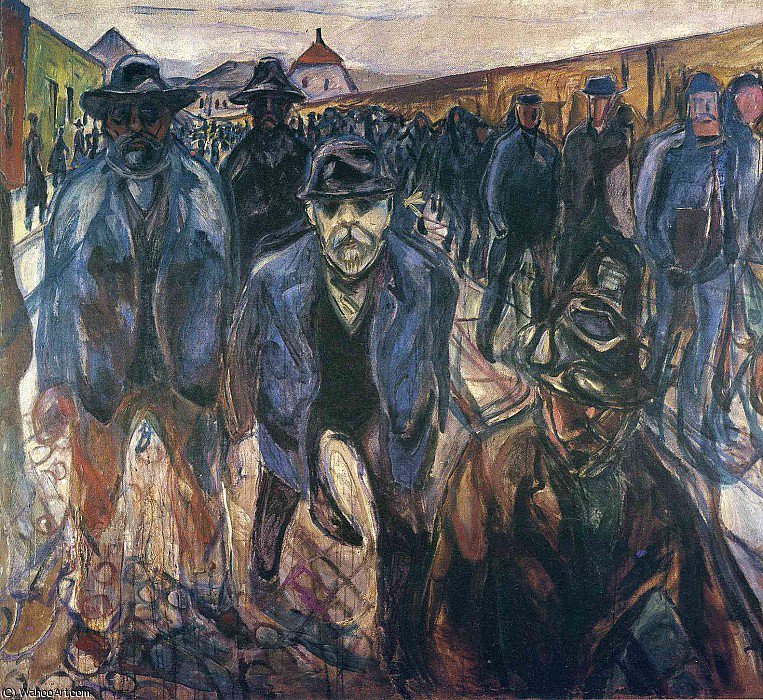
Edvard Munch's *Untitled (7439)*, a deceptively simple black and white photograph depicting a crowd traversing a city street, transcends mere documentation to embody the profound anxieties characteristic of Expressionism—a movement that irrevocably altered the course of modern art. Captured sometime between 1895 and 1902, this artwork isn’t merely a visual record; it's a distillation of Munch’s inner turmoil, projected onto the canvas with masterful restraint. The photograph itself presents a scene familiar to anyone who has navigated the bustling thoroughfares of European capitals—a procession of figures moving purposefully towards an unseen destination amidst buildings and urban infrastructure. Yet, within this commonplace tableau lies a palpable tension, a suggestion of unease that speaks volumes about Munch’s artistic preoccupation with psychological states.
- Subject Matter: The image focuses on the collective experience of urban life—the movement of people in public space—a subject frequently explored by Munch to convey feelings of isolation and dread.
- Style: Munch's stylistic approach aligns perfectly with Expressionism, prioritizing emotional intensity over objective representation. He eschews meticulous detail, opting instead for broad strokes and tonal variations that prioritize conveying mood and atmosphere.
Technique and Composition – Minimalist Mastery
Munch’s technique is remarkably economical, utilizing a monochrome palette to heighten the impact of his compositional choices. The photograph's stark contrast between light and shadow creates dramatic depth, guiding the viewer’s eye across the scene and emphasizing the figures’ postures and movements. Notice how Munch skillfully employs negative space—the areas devoid of pigment—to amplify the sense of isolation felt by each individual amidst the throng. This deliberate simplification underscores Munch’s belief that art should communicate emotion directly, bypassing intellectual analysis in favor of visceral experience. The photograph's perspective is slightly elevated, offering a vantage point that subtly reinforces the feeling of detachment from the crowd below.
Historical Context – Echoes of Fin-de-Siècle Disquiet
*Untitled (7439)* emerged during the Fin-de-Siècle period—a time marked by intellectual ferment, social upheaval, and a pervasive sense of disillusionment following the optimism of the Victorian era. Munch’s artistic endeavors were deeply influenced by philosophical currents questioning traditional beliefs and confronting the darker aspects of human psychology. The photograph reflects anxieties prevalent in European society concerning industrialization, urbanization, and the erosion of spiritual faith—themes central to Expressionist art's exploration of existential dread. It stands as a testament to Munch’s ability to capture not just what he saw but also what he felt—the pervasive unease that characterized the era.
Symbolism – The Silent Scream
Although devoid of color, *Untitled (7439)* is laden with symbolic resonance. The figures themselves represent individuals grappling with internal struggles—their postures conveying a subtle tension and vulnerability. Munch’s masterful use of tonal gradation contributes to the artwork's emotional impact, mirroring the psychological landscape depicted. Consider the implied movement toward an unknown destination; this symbolizes humanity's journey through life fraught with uncertainty and fear. The photograph encapsulates Munch’s core artistic vision—a portrayal of human experience stripped bare, revealing its inherent anxieties and vulnerabilities.
Emotional Impact – Resonance Beyond Representation
Ultimately, *Untitled (7439)* succeeds in conveying a profound emotional response. It invites contemplation on themes of isolation, anxiety, and the inescapable awareness of mortality—subjects that continue to resonate powerfully with audiences today. Like Munch’s other seminal works, this photograph transcends mere visual depiction; it communicates an intangible feeling—a silent scream captured in monochrome—that speaks directly to the viewer's subconscious. It serves as a poignant reminder of Munch’s enduring legacy as one of art history’s most perceptive chroniclers of the human condition.
Pitanja i odgovori
O čemu se radi u delu "untitled (7439)"?
U katalogu je delo „untitled (7439)”, Едвард Мунх klasifikovano kao Photo. Ova kategorija pomaže u pronalaženju sličnih radova.
Da li je „untitled (7439)”, Едвард Мунх svetlo ili tamno umetničko delo?
Zabeležene vrednosti za „untitled (7439)”, Едвард Мунх su: osvetljenost shadow, luminansa Soft Shadow.
Na koji način se tehnika i stil spajaju u delu "untitled (7439)"?
U delu "untitled (7439)", tehnika Black and White Photography susreće pokret Expressionism.


 Naručite ručno oslikano reprodukciju
 Podeli
 Podeli
 Detalji
 Vodič
Vodič

 Preuzmi sliku
 Slični predmeti
 Automatska prezentacija
 Statistika

 Pročitaj više






































 Opcija sa staklom dostupna je samo za dimenzije manje od 110 cm


