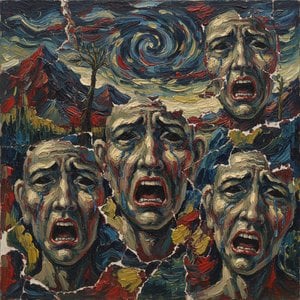
A Portrait of Melancholy: Edvard Munch’s ‘Untitled (2363)’
Edvard Munch's “Untitled (2363)” is not merely a portrait; it’s a distilled essence of late 19th-century anxiety, rendered with the raw intensity that would come to define Expressionism. The painting immediately draws the viewer into a world steeped in shadow and introspection, centered around a man whose gaze holds both weariness and a subtle hint of defiance. He is a figure caught between worlds – perhaps contemplating a past sorrow, wrestling with an unseen burden, or simply observing the unsettling beauty of a darkening evening. The composition itself speaks volumes: the brick wall behind him isn’t just a backdrop; it's a symbol of confinement, of the weight of urban existence pressing down on the individual. The muted palette – dominated by browns, greys, and deep blues – reinforces this sense of melancholy, creating an atmosphere that is both intimate and profoundly unsettling.
The Man and His Companion
At the heart of the painting lies the enigmatic figure holding a cat. The man’s attire—a dark suit and tie—suggests a formal setting, perhaps a social gathering or an evening engagement, yet his posture and expression betray a profound disquiet. The cat, often interpreted as a symbol of both comfort and vulnerability, rests in his hand, its presence adding another layer to the portrait's complexity. Is it a source of solace, a reminder of domesticity amidst the turmoil, or simply an object held for lack of something better to do? The cigarette dangling from his fingers is a potent visual cue—a symbol of habit, perhaps even self-destructive indulgence, further emphasizing the man’s internal struggle. The details are deliberately ambiguous; Munch doesn't offer easy answers, instead inviting the viewer to project their own interpretations onto the scene.
Munch’s Expressionist Vision and the Dawn of Modern Anxiety
Created around 1890-1895, “Untitled (2363)” is firmly rooted in the burgeoning Expressionist movement. Munch, deeply influenced by his personal tragedies – the early deaths of his mother and sister from tuberculosis – sought to depict not just what he *saw*, but what he *felt*. His art was a direct conduit for his inner world, exploring themes of illness, death, love, anxiety, and loneliness with unflinching honesty. This painting exemplifies this approach; it’s less about realistic representation and more about conveying the emotional state of the subject. The loose brushstrokes, distorted forms, and heightened colors—all hallmarks of Expressionism—are employed to amplify the sense of unease and psychological tension. It's a pivotal work in understanding Munch’s exploration of the human condition during a period of rapid social and technological change, reflecting the growing anxieties of modern life.
Symbolism and Emotional Resonance
Beyond its immediate visual impact, “Untitled (2363)” is rich in symbolic meaning. The brick wall represents societal constraints and the isolation of the individual within a larger world. The cat can be seen as a symbol of instinct, vulnerability, or perhaps even a connection to the natural world—a fleeting respite from the man’s internal struggles. The act of smoking – a common motif in Munch's work – often signifies contemplation, but also hints at self-destructive tendencies. Ultimately, the painting’s power lies in its ability to evoke a profound emotional response in the viewer. It’s a portrait that lingers in the mind long after it has been viewed, prompting reflection on themes of mortality, loneliness, and the complexities of human experience. A hand-painted reproduction captures this delicate balance of detail and emotion with unparalleled fidelity, allowing you to bring this evocative masterpiece into your own space.
Pitanja i odgovori
Da li su boje dela „untitled (2363)”, Едвард Мунх živopisne ili prigušene?
Boje dela „untitled (2363)”, Едвард Мунх pokazuju Subtle Color zasićenost uz Monochromatic intenzitet.
Koja veličina i orijentacija se preporučuju za štampu dela „untitled (2363)”, Едвард Мунх?
Za "untitled (2363)", preporučena postavka štampe je dimenzija Large i Portrait orijentacija.
Koja veličina reprodukcije se preporučuje za „untitled (2363)”, Едвард Мунх?
Za „untitled (2363)”, Едвард Мунх preporučuje se reprodukcija u veličini Large. Veličina se može prilagoditi uz zadržavanje proporcija.



 Pregledaj u prostoru
 Naručite ručno oslikano reprodukciju
 Podeli
 Podeli
 Detalji
 Vodič
Vodič

 Preuzmi sliku
 Slični predmeti
 Rendgenski snimak
 Automatska prezentacija
 Statistika

 Pročitaj više






































 Opcija sa staklom dostupna je samo za dimenzije manje od 110 cm