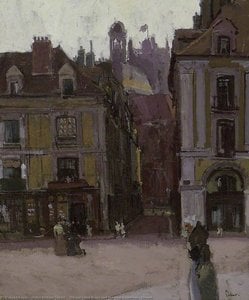
Impressionism
 71.0 x 82.0 cm
Kupite digitalnu sliku visoke rezolucije i poboljšanog kvaliteta, koja je znatno superiornija od onoga što vidite u online prikazu.
Svaka datoteka je pedantno pripremljena od strane naših stručnjaka koristeći napredne alate i profesionalnu ručnu retušu. Osiguravamo da svaka slika ima izuzetnu oštrinu, preciznu reprodukciju boja i fine detalje.
Konačna datoteka se dostavlja putem e-pošte u roku od 72 sata, optimizovana za neposrednu upotrebu u profesionalnim, izdavačkim i štamparskim okruženjima. To je isti kvalitet kojem veruju vrhunski studiji dizajna, izdavači i galerije.
Preuzmite datoteku visoke rezolucije za ličnu upotrebu, štampanje i kreativne projekte. ( Kupi print Kupi ručno naslikanu sliku)
Kada odaberete WahooArt.com, ne dobijate samo sliku – vi primate profesionalno unapređeno digitalno umetničko delo, izrađeno sa najvećom preciznošću i uz garanciju zadovoljstva. Evo svega što automatski dolazi uz vašu porudžbinu:

Vaša digitalna slika visoke rezolucije biće vam poslata putem e-pošte u roku od 72 sata od poručivanja – spremna za trenutnu upotrebu.

Vaše umetničko delo je profesionalno optimizovano korišćenjem naprednih AI alata i ručne obrade, čime se osiguravaju maksimalni detalji, oštrina i preciznost boja.

Slučajno ste obrisali ili izgubili svoju datoteku? Ne brinite – poslaćemo vam je ponovo u bilo kom trenutku, potpuno besplatno.

Uživajte u svojim umetničkim delima trenutno, bez carine, dažbina ili troškova dostave – digitalni download je uvek bez poreza.

Uz pomoć profesionalnih alata i upravljanja bojama, osiguravamo da vaša digitalna slika što vernije odražava originalne boje.

Ako niste zadovoljni svojom digitalnom slikom, izvršićemo reviziju ili ćemo vam vratiti 100% novca u roku od 100 dana – bez ikakvih pitanja.

Niste zadovoljni? Dobijte puni povraćaj novca u roku od 100 dana od prijema digitalne datoteke – bez suvišnih pitanja.

Kupite 3 slike, uštedite 10% - Kupite 5 slika, uštedite 15% - Kupite 10+ slika, uštedite 20%. Odlično za kreativne projekte, galerije i agencije.

Born in the heart of Wandsworth, London, in 1904, Clifford Eric Martin Hall emerged as a painter whose brush captured the shifting textures of twentieth-century urban life and the profound mysteries of the human form. His early years, spent navigating the streets of Richmond and Sheen Avenue, provided the foundational imagery for a career that would oscillate between the gritty realism of London’s bohemian quarters and a deeply introselctive, almost surrealist exploration of identity. Educated through a rigorous classical lineage—from Richmond Hill School to the prestigious Royal Academy Schools under a Landseer scholarship—Hall possessed a technical mastery that allowed him to move seamlessly from the precise demands of portrait commissions to the atmospheric vagueness of street scenes.
The trajectory of Hall’s artistry was profoundly shaped by his time in Paris during the late 1920s. Living and working in the vibrant Montparnasse district, he studied under the influential André Lhote, an experience that infused his British sensibilities with a Continental modernism. This period of international exposure, shared alongside contemporaries like Edwin John, allowed him to absorb the avant-garde spirit of the era. Upon his return to England in the 1930s, Hall became a chronicler of the London zeitgeist, finding inspiration in the bustling, often shadowed corners of Soho. His work during this time reflected the influence of masters such as Walter Sickert and Charles Sims, blending a keen observational eye with a moody, atmospheric approach to light and shadow.
The Second World War brought a somber shift to Hall’s creative output. Serving in a stretcher party near Lots Road, he witnessed firsthand the devastation of the Blitz. This period of upheaval left an indelible mark on his psyche; his drawings from this era, which document the harrowing effects of air raids, are now preserved within the Imperial War Museum, serving as vital historical testimonies to London's resilience. Yet, even amidst the chaos of conflict, Hall’s fascination with the human figure remained a constant, though it would soon undergo a radical and haunting transformation.
In the twilight of his career, specifically from the mid-1960s onwards, Hall achieved his most distinctive and enigmatic stylistic evolution. Moving away from the conventional full-face portraits of his youth, he began to paint women swathed in heavy fabrics, towels, or drapery that obscured their features almost entirely. This late period was characterized by a sense of profound mystery; whether it was a woman facing away from the spectator or a figure hidden behind a veil of cloth, the face—the traditional seat of identity—was intentionally withheld. These works created a powerful tension between presence and absence, inviting the viewer to contemplate what lies beneath the surface.
The legacy of Clifford Hall is defined by this duality: he was both a documentarian of a vanishing London and a pioneer of an introspective, obscured portraiture. His ability to weave together the following elements makes his body of work uniquely significant:
Today, Hall is remembered not merely as a painter of scenes, but as an artist who understood that what is hidden can often be more evocative than what is revealed. His canvases remain windows into a lost era of London life, draped in the beautiful, haunting shadows of his own making.

1904 - 1973 , United Kingdom

 Pregledaj u prostoru
 Pošalji
 Podeli
 Detalji o delu

 Преузми
 Slični predmeti
 Rendgenski snimak
 Slajdovi
 Pročitaj više