The Intimacy of the Ink: A Window into Schoenberg’s Soul
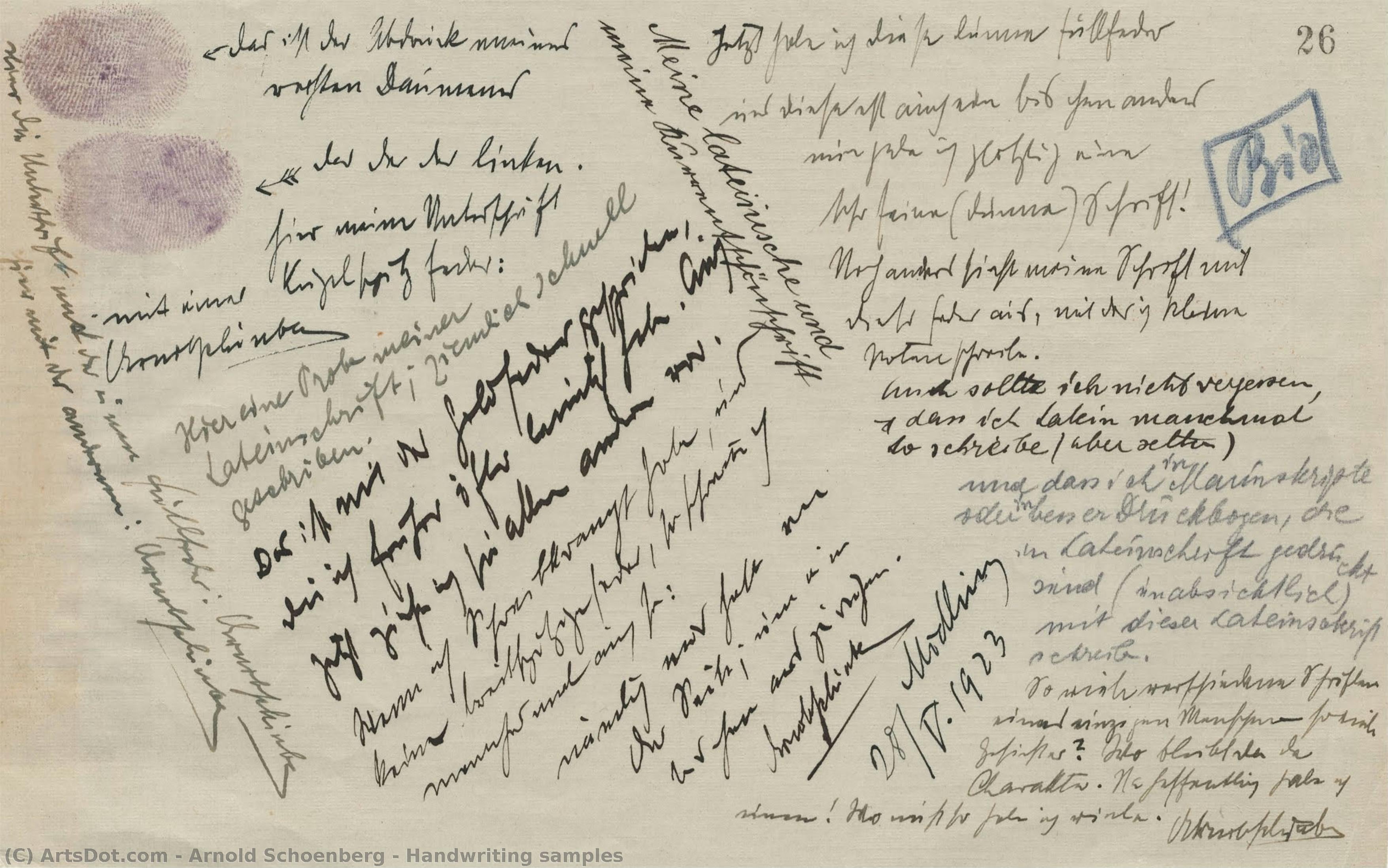
In the quiet, monochromatic expanse of Arnold Schoenberg’s 1923 handwriting samples, we find something far more profound than mere calligraphy; we encounter a raw, unfiltered dialogue between a genius and his tools. This archival photograph captures a moment of deep introspection, where the legendary composer—the architect of atonality—turns his gaze inward to examine the very traces of his physical presence on paper. The document is a dense, beautiful tapestry of script, ranging from the sweeping, confident strokes of a gold-nibbed fountain pen to the hurried, delicate tremors of a fine writing instrument. To look upon these pages is to witness the rhythmic pulse of a mind that was constantly redefining the boundaries of musical and structural expression.
The composition of this piece possesses an organic, almost hypnotic quality. There is no empty space; instead, the parchment is alive with the movement of ink, creating a textured landscape of black and gray tones. The varying weights of the lines—some bold and authoritative, others thin and ghostly—mirror the complexity of Schoenberg’s musical language. For the collector or the lover of historical artifacts, this work offers a rare glimpse into the process of creation. It is not just a record of words, but a visual symphony of pressure, speed, and intent, where each loop and serif serves as a note in a silent, written composition.
A Symphony of Script and Symbolism
Beyond its aesthetic allure, the document serves as a fascinating psychological study. Schoenberg’s accompanying notes act as a guide through his own metamorphosis, as he reflects on how different pens alter his very character. He muses on the "many faces" revealed by his varying scripts, posing a poignant question: "Where is the character? Well hopefully I have one! Where not so I have many." This philosophical inquiry into identity and multiplicity resonates deeply with the modernist spirit of the early 20th century. The handwriting becomes a metaphor for the fragmented yet unified self—a concept that mirrors his revolutionary twelve-tone technique, where individual notes are liberated from traditional hierarchies to form a new, cohesive whole.
For interior designers and curators, this piece offers a sophisticated, minimalist elegance. Its monochromatic palette allows it to integrate seamlessly into modern, academic, or classical settings, providing a focal point of intellectual depth. The texture of the paper and the subtle shadows within the ink strokes provide a tactile quality that invites close inspection. It is an artwork that does not merely decorate a wall; it anchors a room with a sense of history, gravity, and profound human vulnerability.
The Legacy of the Second Viennese School
To possess a reproduction of this work is to hold a fragment of the Second Viennese School’s legacy. Created in May 1923, during a period of immense musical transition, these samples capture Schoenberg at a pivotal moment in his life and career. The document stands as a testament to the era's obsession with breaking tradition and exploring the subconscious. It is an evocative piece for anyone moved by the intersection of fine art, musicology, and the human condition. This archival treasure reminds us that even in the most disciplined masters, there exists a beautiful, wandering spontaneity—a trace of the hand that continues to inspire generations of thinkers and creators.
Pitanja i odgovori
Gde se "Handwriting samples" nalazi među uobičajenim motivima umetnika Arnold Šonberg?
Među zabeleženim temama umetnika Arnold Šonberg – personal identity exploration, self-reflective writing process, documentary archival record, musical composer's personal notes – delo "Handwriting samples" donosi sopstveni fokus na handwriting, document, calligraphy, monochrome, personal notes, archival, script.
Koliko svetlosti se čini da boje dela "Handwriting samples" reflektuju?
„Handwriting samples”, Arnold Šonberg ima luminancu od Luminous. Luminanca opisuje koliko se čini da boje reflektuju svetlosti.
Da li je dostupno preuzimanje "Handwriting samples" u visokoj rezoluciji?
„Handwriting samples“ je dostupan kao preuzimanje digitalne slike visoke rezolucije, uz direktnu kupovinu na njegovoj Digitalna slika stranici.


 Naručite ručno oslikano reprodukciju
 Podeli
 Podeli
 Detalji
 Vodič
Vodič

 Preuzmi sliku
 Slični predmeti
 Automatska prezentacija
 Statistika


 Pročitaj više






































 Opcija sa staklom dostupna je samo za dimenzije manje od 110 cm





