The Industrial Metaphor: The Art of Andreas Golinski
Born in Essen, Germany, Andreas Golinski has developed a profound artistic language that explores the delicate and often turbulent intersection between individual identity and the crushing weight of industrial mechanisms. His work serves as a poignant meditation on the alienation inherent in modern existence, where the boundaries of the self are frequently eroded by the relentless momentum of production and social structures. Through his lens, the artist examines how the contemporary world can strip away cultural roots and personal history, leaving behind a state of precariousness that affects both the individual and the collective.
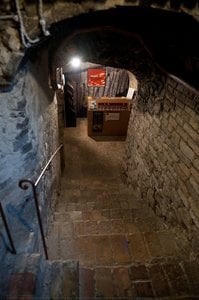
Golinski’s creative process is deeply rooted in observation and a commitment to understanding the relational models of our society. His explorations often draw from direct engagement with the realities of labor and survival. For instance, his project Hochpacker emerged from a period spent in Essen, where he observed the lives of workers navigating the complexities of shared existence within industrial frameworks. This immersion allowed him to translate the sensory experience of production into an articulate, labyrinthine itinerary of claustrophobic corridors. By utilizing materials such as piled-up pallets, he creates a physical manifestation of the sensation of progressive alienation, forcing the spectator to confront the loss of intimacy and specific characteristics that occurs within large-scale social mechanisms.
Themes of Alienation and Coexistence
The core of Golinski’s significance lies in his ability to use metaphor to highlight the compulsive models of cohabitation that define our era. His work delves into the tension between a longing for individuality and the necessity of participating in a flexible, yet often indifferent, collectivity. He addresses the modern struggle of maintaining one's essence amidst:
- The dehumanizing effects of industrial mechanisms that treat individuals as mere components of a larger machine.
- The precarious conditions faced by those on the fringes of society, from abusive laborers to clandestine merchants.
- The loss of cultural and personal identity in an increasingly homogenized and globalized social reality.
In his practice, categorized within Contemporary Realism, Golinski does not merely document these struggles but reconstructs them into a visceral experience. His installations and works act as mirrors to the contemporary condition, reflecting the ways in which man’s most intimate nature is challenged by the structures of modern commerce and industry. Through this evocative approach, he invites viewers to contemplate the enduring relevance of human agency in an age of systemic uncertainty.



 Pregledaj u prostoru
 Kupite ručno oslikano delo
 Pošalji
 Podeli
 Detalji o delu
 Vodič
Vodič

 Preuzmi
 Slični predmeti
 Rendgenski snimak
 Automatska prezentacija
 Q&A
Q&A Statistika


 Pročitaj više






































 Opcija sa staklom dostupna je samo za dimenzije manje od 110 cm