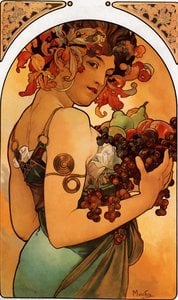
Alphonse Mucha: The Enchanting Vision of Art Nouveau
Alphonse Maria Mucha (1860 – 1939), born in Ivanačice, Moravia, stands as a monumental figure within the Art Nouveau movement—a stylistic revolution that swept across Europe between 1890 and 1910. Rejecting the academic conventions of his time, Mucha forged an utterly original path, prioritizing fluidity, ornamentation, and a profound connection to nature’s rhythms.
His formative years were marked by a rebellious spirit; disillusioned with the rigid formalism of Prague’s Academy of Fine Arts, he abandoned traditional painting for illustration—a decision that proved pivotal in shaping his distinctive aesthetic. Paris beckoned in 1887, offering him not only artistic freedom but also exposure to influential avant-garde circles.
Mucha's style is instantly recognizable: a mesmerizing blend of organic forms and stylized lines reminiscent of flowing drapery and blossoming flowers. Heavily influenced by artists like Pierre-Auguste Renoir and Gustave Moreau, Mucha developed a technique characterized by meticulous watercolor washes layered upon textured paper—a process that captured the ethereal beauty he sought to convey.
His most celebrated works exemplify this approach. “The Slavonic Uprising,” for instance, brilliantly synthesizes Czech folklore with Art Nouveau’s decorative sensibilities. The painting depicts a woman warrior adorned in flowing robes and intricate floral motifs, embodying strength and grace simultaneously. Mucha's masterful use of color—particularly vibrant yellows and oranges—amplifies the emotional resonance of the scene.
Beyond mere decoration, Mucha imbued his images with symbolic meaning. Recurring motifs such as lilies, peacocks, and serpents represent purity, nobility, and primal forces respectively – elements carefully orchestrated to communicate complex narratives within a visually captivating framework. His illustrations for publications like “Salon des Cent” and “Young Farmers Breaking Flax” further cemented his reputation as a visionary artist who transcended stylistic boundaries.
The legacy of Alphonse Mucha extends far beyond the confines of Art Nouveau itself. His influence can be discerned in subsequent artistic endeavors, demonstrating the enduring power of his aesthetic principles. Today, reproductions of Mucha’s paintings continue to inspire interior designers and collectors alike—testament to the timeless beauty and intellectual depth of a singular artistic genius.
Pitanja i odgovori
Koji umetnik i koji stil stoje iza "Topaz"?
Алфонс Муха je kreirao/la "Topaz" u okviru Art Nouveau pokreta.
Pod kojim drugim imenima ili pseudonimima je Алфонс Муха poznat/a?
Алфонс Муха se pojavljuje i pod drugim imenima: Алфонс Марија Муха, Alfons Mucha.
Koliko ljudi posmatra "Topaz"?
Postoji Statistika stranica za „Topaz“. Ona prikazuje mesečne posete ovom umetničkom delu i drugim delima ovog umetnika, uz detaljnu analizu po državama i jezicima.



 Pregledaj u prostoru
 Pređi na prodaju štampanih primeraka
 Podeli
 Podeli
 Detalji
 Vodič
Vodič

 Preuzmi sliku
 Slični predmeti
 Rendgenski snimak
 Automatska prezentacija
 Statistika
 Pročitaj više






































 Opcija sa staklom dostupna je samo za dimenzije manje od 110 cm