Early Life and Artistic Training
Willem Troost entered the world on 14 June 1812 in Arnhem, within the Département Yssel-Supérieur. His early years in the Netherlands would eventually lead him toward the quiet observation of landscapes and the precise hand of a lithographer. The seeds of his vocation were sown in the Dutch soil, where he would develop a keen eye for the light and form that define his later works.
To refine this natural inclination, he traveled to The Hague to study at the Koninklijke Academie van Beeldende Kunsten. It was within these academic walls that his formal education took shape, guided by the hands of established masters. In 1839 and 1840, he sought the instruction of Bartholomeus Johannes van Hove, a man whose influence helped shape the young artist's understanding of composition. This period of study was a time of intense learning, as Troost worked to master the technical demands of his craft.
His training continued under the guidance of Andreas Schelfhout, with whom he studied until 1842. Through these mentors, Troost absorbed the traditions of his predecessors, learning how to translate the natural world onto canvas and stone. This rigorous preparation in The Hague provided the foundation for a life spent capturing the essence of the Dutch landscape and the fleeting moments of daily life.
Residences and Periods of Activity
The life of Willem Troost was marked by a steady movement through the various landscapes of the Netherlands, a wandering that mirrored the changing scenes he sought to capture on canvas. After his formative years in the academies, he found himself in Schiedam, where he remained from 1842 until 1849. This period of stability was followed by a move toward the north, settling in Leeuwarden for seven years between 1855 and 1862. His path then led him through several smaller settlements, reflecting a life lived in close connection to the local terrain and its people.
As the decades progressed, his residence shifted frequently. He spent a brief time in ’s Gravenmoer from 1868 to 1871, followed by a stay in Etten-Leur that lasted until 1874. The years that followed saw him in Hoeven bei Halderberge from 1874 to 1877, and then in Sint-Oedenrode until 1881. These transitions were not merely changes of address but were the rhythms of a man deeply embedded in the geography of his homeland. Even in his later years, his movements remained purposeful, residing in Laren (Gelderland) from 1881 until 1883.
In the final chapter of his life, Troost found a permanent home in Barneveld. He remained there, settled and quiet, until his death at the age of eighty. His long life was a collection of these various stays, each one offering a new perspective on the light and the land of the Dutch provinces.
Artistic Style and Specializations
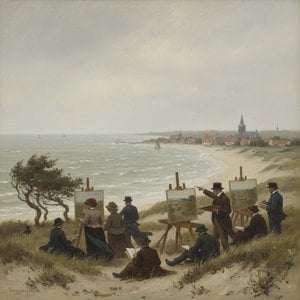
The hand of the master was most often seen in his devotion to the natural world, particularly through his focus on landscapes and the shifting scenes of beach views. In these compositions, one can clearly sense the lingering influence of his teacher, Andreas Schelfhout, whose guidance shaped the way he organized space and light. He possessed a keen eye for the movement of the elements, capturing the essence of the Dutch coast and the quiet dignity of the countryside. While his brush often sought the horizon of the sea, he was equally capable of turning his gaze toward the human element, crafting portraits that captured the likeness of his contemporaries or occasionally sketching the structured lines of a cityscape.
Beyond the canvas, his talent extended into the delicate art of lithography, where he translated his observations into print. These works allowed him to explore social scenes and seasonal activities with a different kind of precision. He found interest in the communal spirit of the people, documenting moments of leisure and industry that defined the era. His prints often depicted the energy of local life, from the excitement of a winter gathering to the organized movement of maritime fleets.
- Eiswettlauf (1855)
- Yachtklub in Leeuwarden (1860)
- Ausfahrt der Heringsflotte
Notable Works and Museum Collections
The hand of Willem Troost captured moments of profound change, particularly through his depictions of the Buitenzorg Palace in Java. He rendered the Rear View of Buitenzorg Palace before the Earthquake of 10 October 1834, presenting the structure in a state of calm before the disaster. This was followed by his depiction of the Front View of Buitenzorg Palace after the Earthquake of 10 October 1834, documenting the aftermath of the seismic event. These works offer a glimpse into a landscape altered by the sudden forces of nature.
Beyond these historical views, Troost turned his attention to the faces of his own era. He produced twenty portraits of contemporaries that were eventually gathered into the collection of the Kupferstichkabinett within the Rijksmuseum Amsterdam. These likenesses provide a window into the people who walked the streets of the Netherlands during his lifetime.
Today, the legacy of his brush and lithograph is preserved in several significant institutions. The Rijksmuseum in Amsterdam, the Netherlands, holds a substantial portion of his output. His works can also be found within the collections of the Groninger Museum and the Kröller-Müller Museum, ensuring that his landscapes and portraits remain available to those who seek them.
Vprašanja in odgovori
Ali obstaja kronološki pregled dela umetnika Willem Troost?
Kronološki pregled dela umetnika Willem Troost si lahko ogledate na njegovi strani Zgodovina umetnosti, kjer se dela prikazujejo v vrstnem redu nastanka, razdeljena v posamezna poglavja.
Koliko umetnin umetnika Willem Troost je na voljo za ogled?
Na strani Vsi umetniški slogi si lahko ogledate 4 umetnin del umetnika Willem Troost.
Katera dela umetnika Willem Troost imajo največ ogledov?
Stran Statistika umetnika Willem Troost prikazuje statistiko, izračunano na podlagi umetnin tega umetnika, ki so navedene na ta spletna stran.