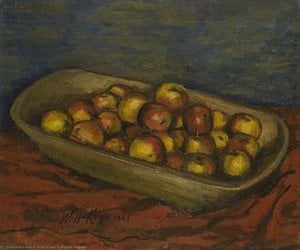
Walt Kuhn: A Pioneer of American Modernism
Early Life and Background
- Born: 1877 in New York City.
- Kuhn’s early life was rooted in a working-class family near the Brooklyn docks, exposing him to vibrant yet rough waterfront experiences.
- Despite a natural inclination towards drawing, his initial career path diverged from art, involving work as a bicycle repair shop owner and a professional bike racer.
- He began selling drawings at age fifteen, adopting the signature “Walt.”
- Formal artistic training commenced in 1893 at the Brooklyn Polytechnic Institute.
European Studies and Artistic Development
- In 1899, Kuhn ventured to California with limited funds, working as an illustrator for WASP Magazine.
- Recognizing the need for broader artistic exposure, he traveled to Paris in 1901.
- He briefly studied at the Académie Colarossi before moving to Munich and studying under Heinrich von Zügel of the Barbizon School.
- His European travels included sketching trips in the Netherlands and visits to museums in Venice, where he encountered Impressionism and Post-Impressionism for the first time.
Return to America and Early Career
- Kuhn returned to New York in 1903, working as an illustrator for local journals.
- He held his first exhibition at the Salmagundi Club in 1905, establishing himself as both a cartoonist and painter.
- His illustrations appeared in Life Magazine, and he created the comic strip “Whisk” (1909-1911) for the New York World.
- He briefly taught at the New York School of Art but disliked the experience.
- Marriage to Vera Spier followed, and they had a daughter, Brenda Kuhn.
The Armory Show and its Impact
- A Defining Moment: Kuhn played a crucial role in organizing the 1913 Armory Show – America’s first large-scale introduction to European Modernism.
- He formed a close friendship with Arthur Bowen Davies, who also significantly impacted American art history.
- Kuhn served as the executive secretary and was tasked with securing participation from European artists. He, Davies, and Walter Pach toured Europe in 1912 to achieve this.
- The Armory Show attracted over 200,000 attendees and generated $44,000 in sales, exceeding all expectations.
- Robert Hughes noted Kuhn’s “talent for promotion” which was instrumental to the show's success.
Later Career and Artistic Style
- Post-Armory Show, Kuhn advised lawyer and collector John Quinn in building his modern art collection.
- He exhibited with the Whitney Studio Club and became a respected artist at the Whitney Museum of American Art.
- His work initially reflected European Modernist influences (e.g., Raoul Dufy, André Derain), but later evolved towards a more representational style while retaining bold colors and textures.
- He taught at the Art Students League of New York after recovering from a serious illness in 1925.
- Kuhn completed a commission for the Union Pacific Railroad, designing the club car “The Little Nugget.”
Historical Significance and Legacy
- Kuhn’s role in the Armory Show was transformative, opening American audiences to new artistic ideas.
- He navigated a complex art world caught between European Modernism and emerging American regionalist movements.
- His paintings – particularly his depictions of circus performers and still lifes – are celebrated for their vibrant color, energetic brushwork, and unique perspective.
- Died: 1949, leaving behind a legacy as a pivotal figure in the development of American Modernism.
Vprašanja in odgovori
V katerem zgodovinskem obdobju je delal/a Walt Kuhn?
Walt Kuhn je deloval v obdobju Modern. To obdobje umetnikovo dejavnost umešča v zgodovinski okvir.
Kje in leta se je rodil/a Walt Kuhn?
Walt Kuhn se je rodil/a v mestu Brooklyn leta 1877.
Ali je na voljo 3D virtualni ogled del Walt Kuhn?
3D galerija umetnosti umetnika Walt Kuhn je stran, ki v virtualni trodimenzionalni galeriji prikazuje umetnikova dela.