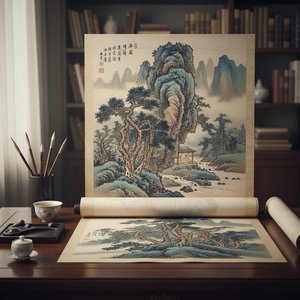
The Ethereal Vision of Fa Ruozhen
In the sweeping transition between the fall of the Ming dynasty and the rise of the Qing, few artists captured the turbulent spirit of an era as profoundly as Fa Ruozhen. A scholar-official by trade but a poet and painter by soul, his life was a delicate dance between the rigid responsibilities of the bureaucracy and the boundless freedom of the natural world. Born in 1613 in Jiaozhou, Shandong Province, Fa Ruozhen emerged as a singular voice within the literati tradition. While many of his contemporaries retreated into silent protest against the new Manchu administration, Fa navigated the complexities of government service—notably serving as a lieutenant governor—while using his art to explore themes of stability, endurance, and the sublime beauty of the untamed landscape.
His artistic identity was deeply rooted in the classical traditions of calligraphy and poetry, disciplines that informed the rhythmic vitality of his brushwork. To look upon a Fa Ruozhen landscape is to witness a dialogue between ink and atmosphere. He was a master of the misty peak, specializing in compositions where mountains do not merely stand, but seem to breathe through layers of translucent cloud. His work often utilized the classic "three distances" technique, yet he possessed a unique ability to flatten forms and compress space, creating a sense of verticality that feels both monumental and dreamlike. This mastery allowed him to transform mere topography into a psychological landscape, where the swirling vapors and rugged outcrops reflect the internal shifts of a scholar living through political upheaval.
Technique, Spirit, and the Painted Atmosphere
The brilliance of Fa Ruozhen lies in his sophisticated manipulation of tonal values. He did not seek to replicate the world with photographic precision; instead, he sought to capture its qi, or vital energy. Through the meticulous layering of ink washes, he achieved luminous gradations that could simulate the heavy dampness of a mountain fog or the crisp, biting clarity of a winter snowfall. His brushwork often oscillated between controlled elegance and a more "disorderly," expressive spontaneity. In his later years, as seen in masterpieces like Snow Coloring the World White, his strokes became even more experimental and emotive, mirroring a lifetime of contemplation and the weathered resilience of the natural world.
Beyond the technical, his work is imbued with deep philosophical resonance. Influenced by Daoist cosmology and Buddhist thought, his paintings serve as meditations on the harmony between humanity and the cosmos. The mountains in his scrolls are rarely empty; they are inhabited by a sense of spiritual presence, where every twisting branch and hidden grove suggests a deeper, unseen order. This connection to the natural rhythm was not merely aesthetic but deeply personal, as his official duties in forestry provided him with direct, intimate encounters with the very terrains he would later immortalize on silk and paper.
Legacy of a Scholar-Artist
The historical significance of Fa Ruozhen extends far beyond the borders of Shandong. He remains a pivotal figure in the Qing dynasty art canon because he bridged the gap between the scholarly ideals of the past and the expressive innovations of his time. While critics of his era occasionally debated his political loyalties due to his service to the Qing administration, his vast body of work—comprising thousands of poems and countless landscapes—demonstrates a man using the brush to affirm Confucian virtues of duty and administrative integrity amidst chaos.
Today, his legacy is preserved in the great collections of the world, from the Metropolitan Museum of Art to the Cleveland Museum of Art. He is remembered not just as a painter of mountains, but as an architect of atmosphere. His ability to render the ephemeral—the passing cloud, the drifting mist, the falling snow—into something permanent and profound ensures that his vision of the "cloudy mountainscape" continues to haunt and inspire the modern imagination.