A Life Painted in Water: The Expressive World of Ernst Schrom
Ernst Schrom, born in Vienna on October 14, 1902, emerged as a quietly powerful voice within the Austrian art scene of the mid-20th century. While not a figure who sought widespread fame, his dedication to expressive watercolor painting earned him recognition as one of Austria’s most compelling artists working in that medium. His life story, though tragically cut short, reflects a commitment to artistic exploration and a unique sensitivity to the emotional possibilities of color and form. Schrom's early education at the Fine Arts Academy in Vienna laid the foundation for his technical skill, but it was after graduation, as a teacher, that he truly began to cultivate his distinctive style. He wasn’t merely imparting knowledge; he was simultaneously refining his own artistic vision, seeking ways to translate the complexities of human experience onto paper with washes of vibrant hue and dynamic composition.
The Development of an Expressive Style
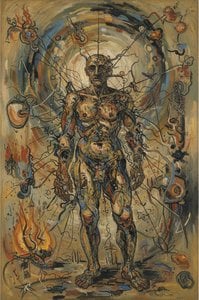
Schrom's work is characterized by a remarkable ability to convey mood and atmosphere through watercolor. He wasn’t interested in precise representation; instead, he embraced abstraction and distortion as tools for emotional expression. His aquarelles often feature landscapes or figures rendered with loose brushstrokes and intense color palettes. These weren’t idyllic scenes but rather reflections of an inner world—a world marked by both beauty and a sense of underlying tension. The influence of Expressionism is palpable in his work, though Schrom developed a style that was distinctly his own. He moved beyond the often-harsh angularity of some Expressionist painters, opting for a more fluid and lyrical approach.
His watercolors possess a captivating energy, drawing viewers into their swirling depths. While he explored other mediums throughout his career, it was watercolor where Schrom truly excelled, mastering its delicate nuances to create works that are both visually striking and emotionally resonant.
Themes and Symbolism in Schrom’s Art
The themes present in Schrom's paintings often revolve around the human condition—loneliness, alienation, and a search for meaning in a rapidly changing world. His landscapes frequently evoke a sense of isolation, with solitary figures dwarfed by vast expanses of nature.
These aren’t simply depictions of places; they are metaphors for the inner lives of individuals grappling with existential questions. While specific symbolism isn't always readily apparent, there is a recurring use of color to convey emotional states—deep blues and purples suggesting melancholy, while vibrant reds and oranges hint at passion or turmoil. Schrom’s art doesn’t offer easy answers; instead, it invites viewers to contemplate their own experiences and interpretations.
Legacy and Historical Significance
Ernst Schrom's untimely death in a car accident on May 8, 1969, brought an abrupt end to a promising career. However, his work continues to be appreciated for its unique expressive power and its contribution to Austrian art history. He stands as a testament to the enduring appeal of watercolor as a medium for conveying complex emotions and ideas.
- Schrom’s influence can be seen in the work of later generations of Austrian artists who embraced abstraction and emotional expression.
- His paintings offer a valuable insight into the cultural climate of post-war Austria, reflecting the anxieties and uncertainties of the era.
- He remains an important figure for those interested in exploring the intersection of Expressionism and watercolor painting.
Though he may not be as widely known as some of his contemporaries, Ernst Schrom’s legacy endures through the evocative beauty and emotional depth of his art. His work serves as a reminder that true artistic power lies not in technical perfection but in the ability to connect with viewers on a deeply human level.