Alphonse Osbert: The Poet Painter of Symbolism
Alphonse Osbert (1857–1939) stands as a singular figure in the annals of French Symbolist art, an artist whose ethereal landscapes and haunting portraits captured the spirit of his time—a period marked by profound intellectual and spiritual questioning. Born in Bordeaux, France, Osbert’s artistic journey began with a fervent admiration for Spanish masters like Jusepe de Ribera, establishing him firmly within the realist tradition before undergoing a transformative embrace of Symbolism's core tenets. This pivotal shift propelled him into the vanguard of avant-garde art movements and cemented his legacy as one of the most distinctive voices of the late nineteenth century.
Early Influences and Academic Training
Osbert’s formative years were shaped by rigorous academic training at the École des Beaux-Arts in Bordeaux, where he honed his skills under luminaries such as Henri Lehmann, Fernand Cormon, and Léon Bonnat. These instructors instilled in him a disciplined approach to artistic technique—a foundation that would prove invaluable as he navigated the complexities of Symbolist aesthetics. Initially drawn to the dramatic realism championed by Ribera, Osbert’s gaze soon turned towards exploring the realm of imagination and emotion, mirroring the broader intellectual currents shaping European culture at the time.
The Embrace of Pointillism and Seurat's Legacy
A defining moment in Osbert’s artistic evolution arrived with his encounter with Georges Seurat, a fellow student who championed the revolutionary technique of Pointillism—a method that meticulously applied tiny dots of color to create luminous surfaces. Inspired by Seurat’s groundbreaking approach, Osbert abandoned traditional brushstrokes in favor of this innovative technique, mirroring the broader Symbolist movement's rejection of naturalistic representation. This stylistic choice underscored his commitment to conveying psychological depth and spiritual resonance through visual abstraction—a hallmark of Symbolist art.
Symbolism: Landscapes of Emotion and Mythical Visions
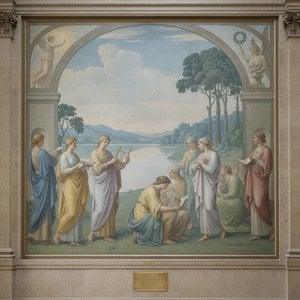
Osbert’s artistic vision was fundamentally rooted in Symbolism, a movement that sought to transcend the limitations of realism by delving into the subconscious mind and exploring universal myths and archetypes. Like Pierre Puvis de Chavannes, Osbert eschewed depicting tangible realities, instead crafting landscapes imbued with an otherworldly luminescence—often dominated by shades of blue—that evoked feelings of melancholy, contemplation, and spiritual yearning. His canvases became vehicles for conveying profound emotional states and philosophical ideas—a testament to his artistic prowess and intellectual curiosity.
Notable Works and Recognition
Osbert’s oeuvre comprises a remarkable collection of paintings that exemplify the Symbolist aesthetic at its finest. Among his most celebrated creations are “Un Paysage Avec Une Femme Nue Agenouillée Au Bord D'un Lac,” “Le Calme Deau,” and “Muses the waterfront”—each piece demonstrating Osbert’s mastery of color, composition, and evocative symbolism. Furthermore, he undertook significant commissions for monumental murals—including at the Centre Thermal des Dômes in Vichy—and contributed to the Church Of Saint-Louis in Vichy, solidifying his reputation as a respected artist within the cultural landscape of his era. His work continues to inspire admiration for its poetic beauty and intellectual depth.
Legacy and Influence
Alphonse Osbert’s contribution to Symbolist art remains largely unrecognized by mainstream audiences today—a poignant reminder of the ephemeral nature of artistic movements and the challenges faced by artists who dared to forge their own distinctive paths. Nevertheless, his pioneering use of Pointillism and his unwavering devotion to Symbolist ideals ensured that he would be remembered as a visionary artist whose canvases captured the essence of a transformative period in European art history. His legacy persists through the enduring fascination with landscapes bathed in ethereal light—a testament to Osbert’s profound artistic vision.