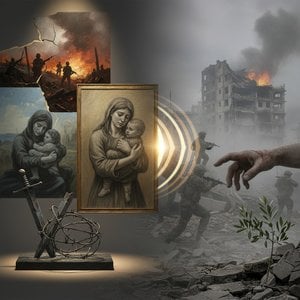
The Discipline of the Brush
Paris, 1857. The 18th arrondissement is a place of movement and noise, where Alexandre Bloch enters the world. He does not drift into art; he is forged by it. Under the watchful eyes of Jean-Léon Gérôme and Jules Bastien-Lepage, his hands learn the rigorous language of academic precision. By 1880, his first appearance at the Salon marks the arrival of a painter who finds his purpose not in the abstract, but in the weight of history and the grit of conflict.
His canvas becomes a theater for the heavy, often violent, chapters of French identity. He moves between the quietude of genre scenes and the high stakes of patriotic drama. He captures the echoes of the Chouannerie and the scars left by the Franco-Prussian War. His work is a study of duty, often rendered through the lens of military struggle.
A Life Defined by Duty
Bloch does not merely observe the soldier; he serves. As a lieutenant of the military reserve in a territorial infantry regiment, his commitment to the nation is a lived reality. This dual existence—as a creator of images and a participant in the defense of his country—culminates in 1911 when he is named a Chevalier of the Légion d'honneur. He was a painter of genre scenes and historical patriotic subjects, often depicting episodes from the Chouannerie and the Franco-Prussian War.
His work documents specific historical episodes:
- The defense of Rochefort-en-Terre in 1885.
- The Chapel of La Madeleine in Malestroit in 1886.
- The death of Henri de La Rochejaquelein in 1889.
- The flooding of Le boulevard Haussmann in 1910.
The Final Record
The end comes in 1919, in the 20th arrondissement of Paris. The man who spent his life documenting the movements of soldiers and the weight of historical episodes dies at the Hôpital Tenon. He leaves behind a legacy that is officially recognized by the state; he is an accredited military artist of the Musée de l'Armée. His paintings remain as records of a specific era, frozen in the precise, academic style he mastered in the studios of his teachers.
Vprašanja in odgovori
Ali obstaja kronološki pregled dela umetnika Alexandre Bloch?
Kronološki pregled dela umetnika Alexandre Bloch si lahko ogledate na njegovi strani Zgodovina umetnosti, kjer se dela prikazujejo v vrstnem redu nastanka, razdeljena v posamezna poglavja.
Koliko umetnin umetnika Alexandre Bloch je na voljo za ogled?
Na strani Vsi umetniški slogi si lahko ogledate 3 umetnin del umetnika Alexandre Bloch.
Ali lahko dela umetnika Alexandre Bloch raziskujem po ključnih besedah?
Za iskanje del umetnika Alexandre Bloch na določeno temo uporabite stran Po ključnih besedah, ki dela razvršča po ključnih besedah.
Katere barve je Alexandre Bloch najpogosteje uporabljal/a?
Barvni profil del opusov umetnika Alexandre Bloch je prikazan na njegovi strani Genom palete.