BREZPLAČNO POSVETOVANJE O UMETNOSTI
x
Oljna barva
Stenska umetnost
Synthetic Cubism
1913
Moderna doba
52.0 x 30.0 cmRočno slikano olje na platnu v vaši izbiri velikosti in okvirja, izdelano po naročilu naših umetnikov.
Izberite eno od naših vnaprej določenih velikosti, ki ustrezajo prvotnim proporcijam umetničkega dela.
Svoje dimenzije lahko vnesete tako, da se prilagodite določenemu okvirju ali prostoru. Če izbrana velikost ne ustreza razmerjem originalne slike, bomo umetniško delo obrezali ali sliko dopolnili z dodatnimi ročno naslikanimi elementi. Pred začetkom proizvodnje vam bo poslan digitalni osnutek v odobritev.
Upoštevajte, da predogled na zaslonu ne odraža dejanskega obrezovanja ali podaljšanja. Le osnutek bo natančno prikazal končno kompozicijo.
Čeprav so na voljo velikosti po meri, priporočamo izbiro dimenzije s preddefiniranega seznama, da ohranimo originalne razmere.
Svetska dostava () za 3/4 nedelje umesto uobičajenih 5 nedelja. (1 julij). Bez kompromisa po pitanju kvaliteta.
Violin
Velikost reprodukcije
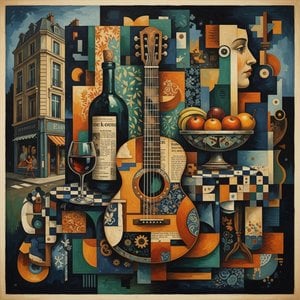
Pablo Picasso's 'Violin,' painted in 1913 during his pivotal Synthetic Cubist period, isn’t merely a depiction of an instrument; it’s a radical exploration of perception and representation. This work, rendered primarily with charcoal on cardboard—a surprising choice that contributes significantly to its textured surface—demands attention not just for its subject matter but for the innovative techniques Picasso employs to dismantle and reassemble reality onto the canvas. It's a piece brimming with intellectual curiosity and a bold rejection of traditional artistic conventions, firmly establishing Picasso as a key figure in the birth of modern art.
The painting immediately captivates with its fragmented composition. The violin itself is not presented as a unified form but rather as a collection of geometric shards—a series of interlocking planes and angles that suggest both its structural integrity and inherent instability. This deliberate fracturing, characteristic of Synthetic Cubism, moves beyond the analytical deconstruction of earlier Cubist works, opting instead to reassemble these fragments into a recognizable subject while simultaneously disrupting our ability to perceive it as a whole. Surrounding the violin are carefully placed elements: two birds, rendered with similar geometric simplification, and three books—each contributing to the overall sense of controlled chaos and layered perspectives. These additions aren’t merely decorative; they serve to heighten the painting's complexity, inviting the viewer to actively engage in deciphering the scene.
‘Violin’ exemplifies Synthetic Cubism’s shift from the analytical approach that preceded it. While Analytical Cubism focused on breaking down objects into their fundamental geometric components and presenting them simultaneously from multiple viewpoints, Synthetic Cubism sought to reintegrate these fragmented forms into more recognizable images. Picasso achieves this through a clever use of collage—incorporating elements like newspaper clippings and cardboard—to create a textured surface that adds depth and visual interest. The painting’s flatness is deliberate; it rejects the illusionistic space of traditional painting in favor of a flattened, graphic style reminiscent of printmaking. This flattening wasn't simply an aesthetic choice but a reflection of Picasso’s growing interest in exploring the possibilities of two-dimensional art.
Picasso’s experimentation during this period was deeply intertwined with his collaboration with Georges Braque, another pivotal figure in Cubism. Together, they pushed the boundaries of representation, challenging established notions of perspective and form. ‘Violin’ stands alongside other works from this era—including “Woman with guitar” and “Bottle, glass, violin”—forming a cohesive body of work that showcases their shared exploration of Synthetic Cubist techniques. The influence of Crystal Cubism is also evident here; the use of cardboard and the emphasis on surface texture echo the experiments conducted by artists like Juan Gris, who sought to create paintings that resembled stained-glass windows or mosaics.
'Violin' isn’t just a beautiful painting; it’s a testament to Picasso’s relentless pursuit of innovation and his profound impact on the development of modern art. It represents a radical departure from traditional representation, embracing abstraction, fragmentation, and experimentation. The work’s enduring appeal lies in its ability to simultaneously challenge and engage the viewer, prompting us to reconsider our own perceptions of reality. It's a powerful reminder that art can be both intellectually stimulating and emotionally resonant—a legacy that continues to inspire artists and collectors alike.
WahooArt.com offers high-quality, handmade oil painting reproductions of famous artworks like Picasso’s ‘Violin’. These reproductions are crafted with meticulous attention to detail, ensuring that the essence of the original piece is preserved.
1881 - 1973 , Španija
Povejte nam o svojem projektu in naši strokovnjaki za umetnost vam bodo pripravili 3 prilagojene predloge umetniških del.
Naj vam izberemo 3 možnosti – popolnoma brezplačno!