The Allure of Still Life: Picasso’s Fruit Basket
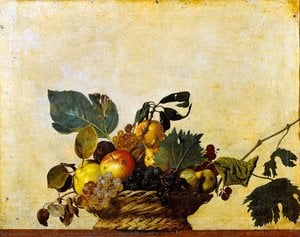
Pablo Picasso's “Fruit Basket,” a seemingly simple depiction of a humble basket overflowing with ripe produce, is anything but straightforward. Created around 1593 (though often attributed to Caravaggio), this painting transcends the ordinary still life genre, becoming a profound exploration of form, light, and human interaction—a testament to the artist’s masterful manipulation of space and his keen observation of the natural world. It's a work that invites prolonged contemplation, revealing layers of meaning beneath its vibrant surface.
The scene itself is deceptively uncomplicated: a wooden basket rests on a table, laden with apples, oranges, pears, grapes, and bananas. However, Picasso—or rather, the artist who created this earlier version—doesn’t merely present these objects; he dissects them, reassembling them in a way that challenges our perception of reality. The arrangement isn't dictated by conventional rules of composition but by an internal logic, driven by the interplay of light and shadow, volume and flatness. The artist’s focus is not on photographic realism, but rather on capturing the essence of each fruit—its texture, its weight, its inherent beauty—through a carefully orchestrated visual vocabulary.
Caravaggio's Influence: A Dialogue Across Time
While often associated with Picasso, it’s crucial to acknowledge the significant influence of Caravaggio on this particular work. The painting shares a remarkable kinship with Caravaggio’s “Boy with a Basket of Fruit,” created around the same period and employing strikingly similar techniques. Both artists masterfully utilize chiaroscuro—the dramatic contrast between light and dark—to sculpt form and create a sense of depth. The strong directional lighting, originating from an unseen window, dramatically illuminates the fruit basket, casting deep shadows that emphasize its three-dimensionality. This technique, borrowed from Northern European painting traditions, was revolutionary for its time, injecting drama and realism into the still life genre.
However, Picasso’s approach diverges subtly. Unlike Caravaggio's meticulous rendering of individual objects, Picasso employs a more fragmented style, breaking down forms into geometric shapes and planes. This foreshadows his later development of Cubism, where he would further deconstruct reality and present multiple viewpoints simultaneously. The painting is not simply a representation of fruit; it’s an exploration of how we *see* fruit—a visual puzzle that invites the viewer to actively engage with the artwork.
Symbolic Resonance: Beyond the Bounty
The seemingly straightforward subject matter of “Fruit Basket” carries symbolic weight. The abundance of fruit can be interpreted as a representation of fertility, prosperity, and the bounty of nature—themes frequently explored in Renaissance art. However, Picasso’s use of muted colors – predominantly browns, grays, and ochres – tempers this celebratory mood, suggesting a sense of melancholy or quiet contemplation. The young seller, positioned centrally within the composition, embodies vulnerability and perhaps even loneliness. He is not actively engaged with the fruit; rather, he seems lost in thought, his gaze directed towards an unseen horizon.
Furthermore, the painting’s composition echoes the principles of *xenia*, a Roman custom of offering gifts of fruits and vegetables to guests. This gesture of hospitality subtly elevates the scene, suggesting a connection between the artist, the model, and the viewer—a shared appreciation for beauty and abundance. The careful arrangement of the fruit, almost like a still life sculpture, invites us to pause and consider the simple pleasures of everyday life.
A Legacy of Innovation: Picasso’s Early Masterpiece
“Fruit Basket” stands as a pivotal work in Picasso's artistic development—a bridge between his early training in naturalistic representation and his later revolutionary explorations of form and space. It demonstrates his remarkable ability to synthesize diverse influences, blending Caravaggio’s dramatic chiaroscuro with the emerging principles of Cubism. This painting is not merely a depiction of fruit; it’s a meditation on perception, symbolism, and the enduring power of art to capture the essence of human experience. Reproductions of this captivating artwork offer a unique opportunity to appreciate Picasso's genius and his profound understanding of the visual world.
Vprašanja in odgovori
Kakšno vzdušje in čustvo se prepletata v "Fruit basket"?
V "Fruit basket" spremlja Calm vzdušje in Melancholic čustvo.
Katera barva prevladuje v kompoziciji dela "Fruit basket" avtorja Pablo Picasso?
Prevladujoča barva dela "Fruit basket" avtorja Pablo Picasso je Walnut (#756021).
Ali so barve dela "Fruit basket" avtorja Pablo Picasso nasičene ali utemeljene?
Barve dela "Fruit basket" avtorja Pablo Picasso imajo Clear Color Presence zasičenost. Zasičenost opisuje, kako živahne ali utišane so barve.



 Preverite v realnem okolju
 Naročite ročno slikano reprodukcijo
 Pošlji kot čestitko
 Deli
Deli
 Podrobnosti
 Priročnik

 Prenesi
 Podobni artefakti
 Rentgenski posnetek
 Predvajaj diaporama
 Statistika

 Preberi več






































 Možnost stekla je na voljo le za velikosti pod 110 cm