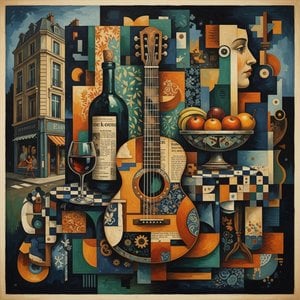
Pablo Picasso: A Revolutionary Artist
Pablo Ruiz y Picasso, born October 25, 1881, in Málaga, Spain, demonstrated artistic talent from a very young age. His father, José Ruiz y Blasco, was an art teacher who provided his son with early training. It’s said Picasso's first words were “piz, piz” – attempting to say ‘pencil’. Picasso quickly surpassed his father’s abilities, showing remarkable skill in naturalistic depictions. The family moved to A Coruña and later Barcelona after the tragic loss of Picasso’s sister. In Barcelona, he attended the School of Fine Arts but often clashed with traditional academic instruction. He briefly studied at the Royal Academy of San Fernando in Madrid, finding it stifling and preferring to study masters like Velázquez and Goya independently.
The Blue Period (1901-1906)
Picasso’s early artistic output was marked by a profound emotional intensity, primarily expressed through the Blue Period. Characterized by somber hues—deep blues, indigoes, and blacks—this period reflected Picasso's preoccupation with themes of poverty, despair, and loneliness. Influenced by artists like Edvard Munch and Rembrandt, he sought to convey human suffering with uncompromising honesty.
The Rose Period (1904-1906)
Following the Blue Period’s melancholic introspection, Picasso transitioned into the Rose Period, embracing warmer tones—rose pinks, ochres, and reds. This stylistic shift coincided with his marriage to Olga Khokhlova and signaled a move toward optimism and tenderness. Subjects like musicians, acrobats, and bullfighters became prominent in his canvases, capturing moments of grace and vitality.
Synthetic Cubism (1907-1913)
The pinnacle of Picasso’s artistic innovation arrived with Synthetic Cubism, commencing around 1907. Collaborating closely with Georges Braque, Picasso dismantled traditional perspective and representation, fracturing objects into geometric planes—cubes, cylinders, and spheres—and reconstructing them simultaneously from multiple viewpoints. This revolutionary technique aimed to capture the essence of an object rather than its literal appearance.
Clarinet and Violin
Clarinet and Violin by Pablo Picasso is a seminal work of Synthetic Cubism, created in 1913. This black and white piece features a man playing the violin, standing in front of a piano, with two chairs visible in the scene. The overall composition suggests a representation of a musician's practice or performance space. As seen on WahooArt.com, this painting is a testament to Picasso’s innovative style.
Artistic Style and Influences
Picasso's work, including Clarinet and Violin, was influenced by his contemporaries, such as Henri Matisse. The Fauvist movement, led by Matisse, motivated Picasso to explore more radical styles. This rivalry between the two artists drove the development of modern art.
Key Features and Symbolism
The painting features a clock on the wall above the man playing the violin, adding a sense of time and rhythm to the scene. The use of black and white creates a sense of harmony and balance, while the geometric shapes and fragmented forms are characteristic of Synthetic Cubism. This style, pioneered by Picasso, emphasizes the composition of an image from multiple viewpoints.
For more information on Pablo Picasso and his artistic movements, visit Wikipedia's page.
- The painting measures 55 x 33 cm, making it an intimate and detailed work.
- The use of Synthetic Cubism creates a sense of depth and visual interest.
- The inclusion of everyday objects, such as the clock and chairs, adds a sense of familiarity to the scene.
Handmade oil painting reproductions of Clarinet and Violin are available on WahooArt.com, allowing art enthusiasts to own a piece of history.
The Museo Thyssen-Bornemisza in Madrid, Spain, is also a must-visit destination for art lovers, featuring an impressive collection of European paintings and sculptures, as seen on WahooArt.com's guide.
The painting Clarinet and Violin is a significant work in the history of modern art, showcasing Picasso’s innovative style and artistic genius.
As a masterpiece of Synthetic Cubism, it continues to inspire and influence artists today.
Vprašanja in odgovori
Kdaj je bilo ustvarjeno "Clarinet and Violin"?
"Clarinet and Violin" izvira iz 1913. Ta datum delo situira v okvir Pablo Picassoove kariere in obdobja, v katerem je nastalo.
Kako lahko dobim digitalno datoteko dela "Clarinet and Violin" avtorja Pablo Picasso?
"Clarinet and Violin" je na voljo kot prenos digitalne slike visoke ločljivosti, ki ga lahko kupite neposredno na njegovi strani Digitalna slika.
Kako lahko dobim tiskano kopijo dela "Clarinet and Violin" avtorja Pablo Picasso?
Tisk dela "Clarinet and Violin" avtorja Pablo Picasso lahko naročite neposredno na njegovi strani Kakovostna tiskanina: umjetnička grafika na bombažnem platnu ali arhivskem papirju za platno.



 Preverite v realnem okolju
 Naročite ročno slikano reprodukcijo
 Pošlji kot čestitko
 Deli
Deli
 Podrobnosti
 Priročnik

 Prenesi
 Podobni artefakti
 Rentgenski posnetek
 Predvajaj diaporama
 Statistika


 Preberi več






































 Možnost stekla je na voljo le za velikosti pod 110 cm