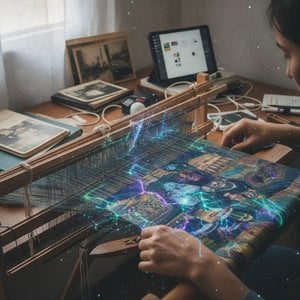
Nilbar Güreş: Weaving Identity in a Global Tapestry
Born in the vibrant, layered city of Istanbul in 1977, Nilbar Güreş’s artistic journey is inextricably linked to her Turkish and Kurdish heritage. Her work, now celebrated internationally from Vienna to Sydney, isn't merely about depicting scenes; it’s a deeply considered exploration of female identity within the complex interplay of cultural traditions, public spaces, and private realms. Güreş’s practice defies easy categorization, seamlessly blending photography, video, performance, textile art, and mixed media collage – each element contributing to a rich tapestry of meaning.
Güreş's early life in Istanbul profoundly shaped her artistic vision. Studying at Mimar Sinan University of Fine Arts and later the Academy of Fine Arts in Vienna provided her with a rigorous grounding in traditional painting techniques while simultaneously exposing her to European avant-garde approaches. This dual influence is evident throughout her work, creating a unique dialogue between Eastern and Western aesthetics. Her decision to settle in Vienna has been crucial, offering a space for reflection and experimentation within a multicultural environment that continues to inform her creative process.
The Language of Textiles and the Female Gaze
A defining characteristic of Güreş’s art is her masterful use of textiles. She doesn't simply employ fabric as a medium; she imbues it with layers of symbolism, referencing traditional Turkish and Kurdish crafts while simultaneously challenging their conventional roles. Quilts, carpets, and embroidered pieces become vehicles for exploring themes of domesticity, memory, and the often-overlooked experiences of women within these cultural contexts. Her work frequently subverts expectations, presenting familiar motifs in unexpected ways – a seemingly simple tablecloth might conceal a powerful commentary on social injustice or gender dynamics.
Güreş’s photographic works are equally compelling. She often employs staged portraits that blur the lines between documentary and fiction, inviting viewers to question their assumptions about identity and representation. Her use of color is deliberate and evocative, ranging from muted earth tones to bold, saturated hues, each carefully chosen to enhance the emotional impact of her images. The recurring motif of the female figure – frequently depicted in moments of quiet contemplation or engaged in everyday activities – speaks to a desire to elevate the experiences of women within both personal and societal narratives.
Major Exhibitions and Critical Recognition
Güreş’s work has garnered significant international recognition, culminating in participation in prestigious events such as the 20th Biennale of Sydney (2016), the SeMa Biennale Mediacity Seoul (2014), and the Berlin Biennial (2010). These platforms have provided crucial visibility for her unique artistic vision. Her work has been exhibited at venues including the Van Abbemuseum in Eindhoven, the ARTER gallery in Istanbul, and numerous museums and galleries across Europe and North America.
Notable solo exhibitions include “Open Phone Booth” (2023), a striking textile diptych exploring identity and social injustice through intricate embroidery; "Wilde Belästigung" (2021), a surreal oil painting blending natural and abstract elements, and “Unknown Sports” (2009), which powerfully depicted women engaged in unconventional activities within domestic settings. These exhibitions consistently demonstrate her ability to create works that are both visually arresting and intellectually stimulating.
Themes of Identity, Culture, and the Contemporary Woman
At the heart of Güreş’s artistic practice lies a persistent interrogation of identity – particularly as it intersects with gender, culture, and location. Her work frequently addresses the experiences of Muslim women in Europe, navigating issues of representation, belonging, and social expectations. She doesn't offer simplistic narratives; instead, she presents nuanced portraits that reveal the complexities of lived experience. Her exploration extends to the relationship between women and their homes, public spaces, and the broader cultural landscape, prompting viewers to consider how these environments shape individual identities.
Güreş’s work is not merely a reflection of her own experiences but also a critical engagement with broader social and political issues. Through her art, she challenges conventional notions of femininity, questions established power structures, and advocates for greater visibility and understanding of marginalized voices. Her ongoing commitment to exploring these themes ensures that her work remains relevant and impactful in the contemporary art world.



 Predogled v realnem okolju
 Preklop na tiskanine
 Pošlji
 Deli
Deli
 Podrobnosti o delu
 Priročnik

 Prenesi sliko
 Podobni izdelki
 Rentgenski posnetek
 Predvajaj diaporama
 Q&A
Q&A Statistika


 Preberi več






































 Možnost stekla je na voljo le za velikosti pod 110 cm