Preverite v realnem okolju Predogled v AR Preklop na tiskanine Preklop na digitalno sliko Pošlji kot čestitko
Podrobnosti Priročnik Dodaj v priljubljene Prenesi Podobni artefakti Rentgenski posnetek Predvajaj diaporama Statistika

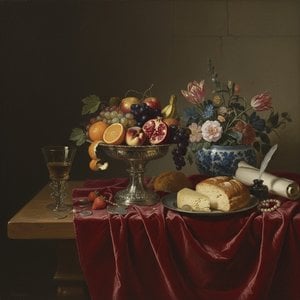
Vegetables on the Table

A vibrant still life of nature's bounty featuring colorful fruits and flowers by Japanese modernist pioneer Narashige Koide, offering a timeless glimpse into 1927 avant-garde beauty for your collection.

Discover Narashige Koide (1887-1931), a pioneer of Hanshinkan Modernism in Japanese yōga painting. Explore evocative portraits, striking nudes & his innovative approach bridging Nihonga tradition and Western styles.

Ročno izdelana oljna reprodukcija

Ročno slikano olje na platnu v vaši izbiri velikosti in okvirja, izdelano po naročilu naših umetnikov. ( Preklop na tiskanine Preklop na digitalno sliko)

Corner sample of the P118B picture frame: izoblit polistiren, 5 cm wide and 3 cm thick
P118B €10
Corner sample of the P118H picture frame: izoblit polistiren, 5 cm wide and 3 cm thick
P118H €10
Corner sample of the P118W picture frame: izoblit polistiren, 5 cm wide and 3 cm thick
P118W €10
Corner sample of the P438Z picture frame: izoblit polistiren, 5.5 cm wide and 3.5 cm thick
P438Z €10
Corner sample of the P508JH picture frame: izoblit polistiren, 7 cm wide and 3.5 cm thick
P508JH €12
Corner sample of the P508YH picture frame: izoblit polistiren, 7 cm wide and 3.5 cm thick
P508YH €12
Corner sample of the P805H picture frame: izoblit polistiren, 5 cm wide and 3.5 cm thick
P805H €10
Corner sample of the P805Z picture frame: izoblit polistiren, 5 cm wide and 3.5 cm thick
P805Z €10
Corner sample of the P919BZ picture frame: izoblit polistiren, 7 cm wide and 3.5 cm thick
P919BZ €10
Corner sample of the P919G picture frame: izoblit polistiren, 7 cm wide and 3.5 cm thick
P919G €10
Corner sample of the P919XJ picture frame: izoblit polistiren, 7 cm wide and 3.5 cm thick
P919XJ €10
Corner sample of the P959ZH picture frame: izoblit polistiren, 5 cm wide and 3 cm thick
P959ZH €10
Corner sample of the P968JZ picture frame: izoblit polistiren, 6 cm wide and 4 cm thick
P968JZ €12
Corner sample of the W106C picture frame: masivno drevo, 5 cm wide and 3 cm thick
W106C €8
Corner sample of the W218G picture frame: masivno drevo, 5 cm wide and 3 cm thick
W218G €10
Corner sample of the W218JH picture frame: masivno drevo, 5 cm wide and 3 cm thick
W218JH €8
Corner sample of the W218Y picture frame: masivno drevo, 5 cm wide and 3 cm thick
W218Y €10
Corner sample of the W307PJ picture frame: masivno drevo, 6 cm wide and 3 cm thick
W307PJ €10
Corner sample of the W316G picture frame: masivno drevo, 6 cm wide and 3 cm thick
W316G €10
Corner sample of the W316PJ picture frame: masivno drevo, 6 cm wide and 3 cm thick
W316PJ €8
Corner sample of the W316Y picture frame: masivno drevo, 6 cm wide and 3 cm thick
W316Y €10
Corner sample of the W398PJ picture frame: masivno drevo, 5 cm wide and 3 cm thick
W398PJ €8
Corner sample of the W4111J picture frame: masivno drevo, 6.5 cm wide and 3.5 cm thick
W4111J €10
Corner sample of the W500HY picture frame: masivno drevo, 7 cm wide and 5 cm thick
W500HY €15
Corner sample of the W500JH picture frame: masivno drevo, 7 cm wide and 5 cm thick
W500JH €15
Corner sample of the W692G picture frame: masivno drevo, 8 cm wide and 4 cm thick
W692G €12
Corner sample of the W849H picture frame: masivno drevo, 5 cm wide and 3 cm thick
W849H €8
Corner sample of the W940BG picture frame: masivno drevo, 7.5 cm wide and 4.5 cm thick
W940BG €15
Corner sample of the W953PJ picture frame: masivno drevo, 6 cm wide and 3.5 cm thick
W953PJ €8

Standardna velikost
po meri
CM
INCH

Izberite eno od naših vnaprej določenih velikosti, ki ustrezajo prvotnim proporcijam umetničkega dela.

širina
višina

Vnesite širino in višino, ki jih potrebujete, da se slika prilega vašemu okviru ali steni. Ker je delo ročno slikano, lahko umetnik pri različnih oblikih slik pri robovih doda malo več barve ali pa jih malo odreže — izberite sami. Pred začetkom slikanja vam pošljemo digitalni predogled za potrditev. Slika, prikazana na tej strani, ni končni rezultat — le predogled prikazuje dejansko podobo.

Primeri možnih sprememb: Zamenjava obraza s fotografijo stranke; Dodajanje hišnega ljubljenčka (npr. zamenjava mačke s psom); Vključitev skritega sporočila v ozadje; Sprememba pokrajine ali elementov v ozadju.
Po oddaji naročila bo ekipa WahooArt.com stranki po e-pošti poslala navodila in predogled digitalnega predogleda.

Mednarodna dostava () v 3/4 tednih namesto običajnih 5 tednov. (24 oktober). Brez kompromisov pri kakovosti.

Brezplačna ekspresna dostava po vsem svetu
Visokokakovostno laneno platno
Popolno zavarovanje pošiljke
Garancija povračila carine in uvoznih davkov
Garancija popolnega barvnega ujemanja
Politika vračila v 100 dneh (le v primeru okvar)
Garancija 100% povračila denarja
Popust pri večjem naročilu

Skupna cena

€ 239

Vegetables on the Table

Tehnika reprodukcije

Velikost reprodukcije

-

Skupna cena

€ 239

Hitri podatki

  • Artist: Narashige Koide
  • Subject or theme: Still life with fruits and vegetables

A Symphony of Stillness: The Bounty of Narashige Koide

In the quiet corners of early 20th-century modernism, few works capture the humble elegance of daily life as poignantly as Narashige Koide’s 1927 masterpiece, Vegetables on the Table. This evocative still life serves as a profound meditation on texture, color, and the simple abundance of nature. At first glance, the viewer is greeted by a vibrant arrangement of life: the sun-kissed curves of oranges and apples, the elongated grace of bananas, and a central vase of flowers that acts as the composition's beating heart. Set against a deep, atmospheric blue background, the subjects do not merely sit upon the table; they emerge from the shadows with a sculptural presence that commands the room.

The brilliance of this piece lies in Koide’s ability to bridge the gap between the delicate sensibilities of Nihonga—the traditional Japanese style he studied in his youth—and the bold, structural experimentation of Western Yōga painting. There is a rhythmic balance at play here, where the placement of two humble bowls and a solitary cup creates a sense of domestic harmony. For the discerning collector or interior designer, this painting offers more than just visual interest; it provides a focal point of stability and warmth. The interplay between the cool, receding blue backdrop and the warm, tactile fruits creates a chromatic tension that breathes life into any sophisticated space.

Beyond its aesthetic charm, Vegetables on the Table carries a deeper symbolic weight, reflecting the era's fascination with finding beauty in the mundane. During a period of intense cultural transition in Japan, Koide utilized the still life genre to explore form and light, stripping away the unnecessary to focus on the essential. The arrangement feels both spontaneous and meticulously curated, suggesting that even in the most ordinary objects, there exists an eternal, artistic truth. Each brushstroke contributes to a sense of weight and volume, inviting the viewer to reach out and touch the velvety skin of a peach or the smooth surface of a ceramic bowl.

For those seeking to infuse their homes with a sense of historical depth and quiet luxury, a high-quality reproduction of this work offers an unparalleled opportunity. It is a piece that transcends mere decoration, acting as a window into the soul of Japanese modernism. Whether placed in a sunlit dining room to echo its themes of nourishment or in a contemporary study to provide a classical counterpoint to modern furniture, Koide’s vision remains timeless. To possess this image is to hold a fragment of 1927—a moment of stillness captured forever in a dance of color and light.

Vprašanja in odgovori

V katero fazo razvoja Narashige Koide pripada delo "Vegetables on the Table"?

V okviru kariere umetnika Narashige Koide velja, da delo "Vegetables on the Table" pripada obdobju Mature Period. Ta faza omogoča primerjavo z ostalimi umetnikovimi deli.

Ali je delo "Vegetables on the Table" avtorja Narashige Koide v javni lastini in zakaj?

Del "Vegetables on the Table" avtorja Narashige Koide je v v javni domeni – njegova avtorska pravica je zastarela. Avtorske pravice se izračunajo od smrti umetnika, Narashige Koide pa je umrl leta 1931.

Ali so barve dela "Vegetables on the Table" avtorja Narashige Koide nasičene ali utemeljene?

Paleta dela "Vegetables on the Table" ima Subtle Color zasičenost.


Biografija umetnika

A Pioneer of Modern Japanese Painting: The Life and Art of Narashige Koide

Narashige Koide, born in Osaka in 1887, emerged as a pivotal figure in the evolution of early 20th-century Japanese art. His brief but intensely productive career bridged the traditions of Nihonga – traditional Japanese painting – with the burgeoning influence of Western artistic styles, particularly in portraiture and the daring exploration of the nude form. Koide’s story is one of a restless innovator, constantly seeking to define a uniquely Japanese modernism, grappling with both aesthetic heritage and the allure of European avant-garde movements.

From his youth, an inclination towards art was evident, leading him to study Nihonga during his elementary and middle school years. However, Koide harbored a deep fascination with Western painting techniques, a desire that initially led to rejection from the Western Arts department of the Tokyo School of Fine Art in 1907. Accepted into the Nihonga program instead, he continued to pursue oil painting independently, recognizing its potential for expressing modern sensibilities. This duality – a grounding in Japanese artistic principles coupled with an ambition to master Western methods – would become a defining characteristic of his oeuvre.

The Rise of Hanshinkan Modernism and Early Success

After graduating from the Tokyo School of Fine Art in 1914, Koide returned to Osaka, immersing himself in the artistic ferment of the Kansai region. This period saw the emergence of what would become known as Hanshinkan Modernism – a movement characterized by its embrace of Western styles while retaining a distinctly Japanese aesthetic sensibility. Koide quickly became a leading voice within this burgeoning scene. His breakthrough came with “N’s Family” (1919), a yōga-style portrait that garnered significant attention and ultimately won the prestigious Chōgyū Prize at the Sixth Nikakai Exhibition. This work, now recognized as an Important Cultural Property of Japan, showcased Koide's ability to synthesize Western compositional techniques with Japanese themes and emotional depth.

The success of “N’s Family” propelled Koide into the spotlight, securing commissions and allowing him further artistic exploration. His subsequent works, such as "Boy with a Lamp" (1923), displayed a growing mastery of light and shadow, influenced by Impressionism and Post-Impressionism, yet imbued with a uniquely Japanese sensitivity to form and atmosphere. He wasn’t merely imitating Western styles; he was adapting them, filtering them through his own cultural lens.

Experimentation and the Pursuit of Form

Koide's artistic curiosity extended beyond traditional painting mediums. He experimented with various techniques, including painting on glass, demonstrating a willingness to push boundaries and challenge conventional norms. A trip to France from 1921-1922 further broadened his horizons, exposing him to the latest developments in European art. Upon his return, he established an atelier in Osaka in 1924, fostering a creative environment that attracted other artists and contributed to the vibrant artistic community of the region.

However, it was in his later years, particularly after moving to Ashiya in 1926, that Koide truly distinguished himself. He became renowned for his depictions of the female nude – a subject considered daringly modern for its time in Japan. Paintings like “Nude with White Cloth” (1929) and “Nude on a Bed” (1930) were not simply exercises in anatomical study; they were explorations of form, light, and emotion, imbued with a subtle sensuality that set them apart from their Western counterparts. He earned the nickname "Rafu no Narashige" – Narashige of the Nudes – reflecting his prominence in this genre.

Legacy and Lasting Influence

Tragically, Narashige Koide’s life was cut short by illness in 1931 at the age of just 43. Despite his relatively brief career, he left an indelible mark on Japanese art history. He played a crucial role in establishing Hanshinkan Modernism as a significant force and paved the way for future generations of artists to explore Western styles while remaining rooted in their own cultural heritage.

Koide’s work continues to resonate today, captivating viewers with its blend of technical skill, emotional depth, and innovative spirit. His paintings are held in prestigious collections such as the National Museum of Modern Art, Tokyo, and the Ohara Museum of Art, ensuring that his legacy will endure for years to come. He remains a testament to the power of artistic vision and the enduring quest to forge a uniquely modern Japanese aesthetic.

Notable Works

  • N’s Family (1919), Ohara Art Museum, National Important Cultural Property
  • Boy with a Lamp (1923), National Museum of Modern Art, Tokyo, Japan
  • Nude with White Cloth (1929), National Museum of Modern Art, Tokyo, Japan
  • Nude on a Bed (1930), Ohara Museum of Art, Tokyo, Japan

Narashige Koide

Narashige Koide

1887 - 1931 , Japan

Ključne informacije

  • Full Name: Narashige Koide
  • Nationality: Japanese
  • Date Of Birth: 1887
  • Date Of Death: 1931
  • Place Of Birth: None, Japan
  • Notable Artworks:
    • N’s Family
    • Boy with a Lamp
    • Nude with white cloth
    • Nude on a bed
  • Artistic Movement Or Style: Hanshinkan Modernism, Yōga
  • Artists Or Movements Influenced By This Artist: Japanese Modern Art