


Kupite digitalno sliko visoke ločljivosti z izboljšano kakovostjo, ki je precej boljša od spletnega predogleda.
Vsaka datoteka je pod natančnim nadzorom naših strokovnjakov, ki uporabljajo napredna orodja in strokovno ročno obdelavo. Zagotovimo, da ima vsaka slika izjemno jasnost, natančnost barv in fine podrobnosti.
Končna datoteka je po e-pošti dostavljena v 72 urah, optimizirana za takojšnjo uporabo v profesionalnem, uredniškem in tiskarskem okolju. To je kakovost, ki ji zaupajo vrhunska oblikovalna studia, založniki in galerije.
Prenesite datoteko visoke ločljivosti za osebno uporabo, tiskanje in kreativne projekte. ( Kupi tisk Kupi ročno naslikano sliko)
Ko izberete WahooArt.com, ne prejmete le slike – prejmete digitalno umetniško delo, ki je profesionalno urejeno, izdelano z natančnostostjo in zavestno zagotovljeno z garancijo za zadovoljstvo. Tukaj je vse, kar samodejno prejmete z vašim naročilom:

Vaša digitalna slika visoke ločljivosti bo na vaš e-naslov poslana v roku 72 ur od zaklopa naročila – pripravljena za takojšnjo uporabo.

Vaše umetniško delo je strokovno optimizirano z uporabo naprednih orodij umetne inteligence in ročne obdelave, kar zagotavlja največjo stopnjo podrobnosti, jasnosti in barvne natančnosti.

Ste zaradi nespremietne napake izgubili ali izbrisali svojo datoteko? Ni težav – vam jo bomo ponovno poslali kadar koli in brezplačno.

Uživajte v svojem umetniškem delu takoj, brez carin, davkov ali stroškov dostave – digitalni prenosi so vedno brezdavčni.

Z uporabo profesionalnih orodij in upravljanja barv zagotavljamo, da vaša digitalna slika čim bolj natančno odraža prvotne barve.

Če niste zadovoljni s svojo digitalno sliko, jo bomo uredili ali vam v 100 dneh povrnili 100% denarja – brez kakršnih koli vprašanj.

Niste zadovoljni? Zagovрите popoln povračilo sredstev v 100 dneh po prejemu digitalne datoteke – brez kakršnih koli vprašanj.

Kupite 3 slike, prihranite 10% - Kupite 5 slik, prihranite 15% - Kupite 10+ slik, prihranite 20%. Odlično za kreativne projekte, galerije in agencije.

In the golden age of Victorian landscape painting, few artists captured the ephemeral dance of light and atmosphere with as much soul as Matthew Ridley Corbet. Born on May 20, 1850, in the quiet village of South Willingham, Lincolnshire, Corbet’s origins were rooted in a world of classical scholarship and religious tradition. As the son of the Reverend Andrew Corbet, his early life was shaped by the disciplined intellect of Cheltenham College, yet his heart was destined for the vibrant, sun-drenched vistas of the Mediterranean. This tension between his structured English upbringing and his burgeoning passion for the natural world would eventually define his unique contribution to the nineteenth-century art canon.
Corbet’s formal artistic journey began within the prestigious halls of the Slade School of Art, where he studied under Alexander Davis Cooper, and later at the Royal Academy Schools under the legendary Frederic Leighton. These institutions provided him with a rigorous foundation in neoclassical technique, yet it was his departure for Italy in 1880 that truly ignited his creative spirit. In the warmth of the Italian sun, Corbet moved beyond the rigid boundaries of academic realism to embrace a more fluid, expressive way of seeing. It was during this transformative period that he formed a profound and lasting bond with the painter Giovanni Costa. This partnership became a cornerstone of his development, as together they explored the rugged beauty of Tuscany and Umbria, seeking to capture the very essence of the landscape.
The true metamorphosis of Corbet’s style occurred through his immersion in the Macchiaioli movement. Often referred to as the "splashed" painters, this group of Italian innovators sought to reject the stale conventions of academic painting in favor of direct observation and the emotive power of light. Influenced by Costa, Corbet began to master the art of the macchia—the use of distinct patches or "spots" of color to define form and atmosphere. His brushwork grew looser and more spontaneous, allowing him to render the fleeting moments of a sunset or the hazy shimmer of heat over an Italian valley with unprecedented vitality.
His canvases became windows into a world of luminous color palettes and soft, atmospheric textures. This evolution is perhaps most evident in his ability to blend Romanticism with a burgeoning Impressionistic sensibility. While his compositions often retained a sense of classical grandeur and structural integrity, the surface of his paintings pulsed with life. He did not merely paint a mountain or a field; he painted the way light clung to the stone and the way shadows stretched across the grass at dusk. This mastery of light allowed him to evoke deep emotional responses, transporting the viewer from the grey skies of England to the idyllic, sun-soaked landscapes of the Mediterranean.
Throughout his career, Corbet exhibited extensively across Europe, earning a reputation as a premier chronicler of the Italian countryside. His oeuvre contains several landmarks of Victorian landscape art that continue to captivate collectors and historians alike:
Though his life was tragically short, ending in 1902, Matthew Ridley Corbet left an indelible mark on the trajectory of landscape painting. He served as a vital bridge between the structured traditions of the Royal Academy and the experimental freedom of the modern era. By integrating the classical training of his English heritage with the revolutionary light-centric techniques of the Italian Macchiaioli, he created a body of work that remains a testament to the enduring power of nature and the transformative beauty of light.
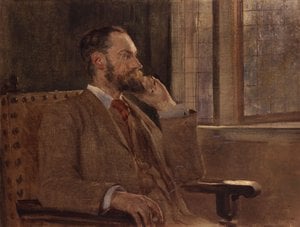
1850 - 1902

 Predogled
 Pošlji
 Deli
Deli
 Podrobnosti o delu

 Prenesi
 Podobni izdelki
 Rentgenski posnetek
 Predvajaj diaporama
 Razviljaj več


