A Dreamscape of Faith: Unpacking Marc Chagall’s “Paradise (13)”
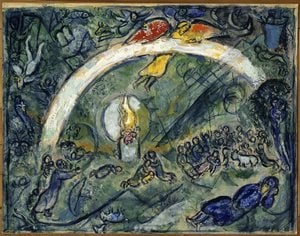
Marc Chagall's "Paradise (13)," painted in 1961, isn’t merely a depiction of an idyllic garden; it’s a vibrant, deeply personal tapestry woven from the threads of memory, faith, and the artist’s unique vision. This surrealistic masterpiece transcends simple representation, inviting us into a world where figures dance with animals, time seems to dissolve, and the familiar becomes imbued with profound symbolism. Born Moishe Shagal in Vitebsk, Belarus, Chagall carried within him the echoes of his Hasidic upbringing – a rich tradition of folklore, storytelling, and an unwavering belief in the power of dreams—and this is powerfully evident in every brushstroke.
The painting immediately captivates with its riotous color palette. Chagall eschews naturalistic hues, instead employing bold, luminous shades of blue, yellow, red, and green to create an atmosphere that’s both joyous and slightly unsettling. These aren't colors meant to simply describe; they are emotional conduits, conveying a sense of ecstatic wonder and spiritual yearning. The composition itself is deliberately dreamlike – figures float, animals mingle with humans, and the landscape bends according to Chagall’s imagination rather than strict perspective. This deliberate distortion reflects his intention: not to depict reality, but to capture the essence of a remembered paradise, filtered through the lens of memory and faith.
Central Figures and Symbolic Resonance
At the heart of “Paradise (13)” sits a woman seated in a chair, radiating an aura of serenity and maternal grace. This figure is often interpreted as representing Eve, though Chagall himself resisted definitive interpretations, preferring to let viewers find their own meaning within the work. Beside her stand two men, likely Adam and God, engaged in a gesture of blessing or perhaps even gentle rebuke. The presence of these figures anchors the painting within the biblical narrative of creation and expulsion from Eden, yet they are rendered with Chagall’s characteristic dreamlike quality – their forms elongated, their features softened, suggesting a realm beyond earthly constraints.
Scattered throughout the scene are a host of symbolic elements. A dog, often associated with loyalty and fidelity, sits close to the woman, while a horse—a symbol of strength and nobility—dominates the upper right corner. Birds flit across the canvas, representing freedom and spiritual aspiration. A prominent figure is a musician playing a violin, evoking themes of joy, celebration, and the divine presence in earthly life. Even seemingly simple objects – a table laden with fruit, a scattering of flowers – carry layers of meaning, hinting at abundance, fertility, and the promise of eternal life.
Contextualizing “Paradise (13)” within Chagall’s Oeuvre
Painted in 1961, "Paradise (13)" represents a pivotal moment in Chagall's artistic journey. Following his emigration to France and the United States during World War II, he returned to a renewed sense of purpose and a deepening engagement with religious themes. This period saw him increasingly explore the rich tapestry of Jewish folklore and biblical narratives, often blending them with personal memories and emotional experiences. “Paradise (13)” is part of a larger series of works inspired by the Book of Genesis, reflecting his lifelong fascination with creation, redemption, and the human condition.
Interestingly, this painting shares thematic resonances with Chagall’s earlier work, particularly "Adam and Eve Expelled from Paradise" (1962). Both pieces depict a similar scene of expulsion, but “Paradise (13)” offers a more hopeful vision—a glimpse of an idealized Edenic realm where figures are bathed in light and surrounded by symbols of abundance. The Musée Marc Chagall in Nice houses a significant collection of his biblical works, providing invaluable context for understanding the evolution of his artistic vision.
A Reproduction to Cherish: Bringing “Paradise (13)” into Your Space
WahooArt offers meticulously hand-painted reproductions of Marc Chagall’s "Paradise (13)" that capture the essence of this iconic artwork. Our skilled artisans replicate Chagall's vibrant colors, dreamlike composition, and evocative symbolism with exceptional detail and fidelity. Whether you choose a large-scale canvas for a statement wall or a smaller print to adorn your study, our reproductions provide an authentic and beautiful way to bring this masterpiece into your home or office. More than just a decorative piece, “Paradise (13)” is a portal to Chagall’s world—a world of faith, memory, and boundless imagination.
Vprašanja in odgovori
Kakšna vrsta dela je "Paradise (13)"?
"Paradise (13)" avtorja Mark Šagal je razvrščeno v kategorijo WallArt. Ta kategorija opisuje vrsto umetniškega dela, da je original.
Kaj pojasnjuje avtorsko stanje za "Paradise (13)" avtorja Mark Šagal?
"Paradise (13)" avtorja Mark Šagal je v še vedno pod avtorsko pravico. Avtorske pravice veljajo od smrti umetnika, ki je umrl leta 1985.
Kakšna je svetlobnost dela "Paradise (13)" avtorja Mark Šagal?
"Paradise (13)" avtorja Mark Šagal ima Gentle Luminance luminanco. Luminanca opisuje, koliko svetlobe se zdi, da barve odražajo.



 Preverite v realnem okolju
 Preklop na tiskanine
 Pošlji kot čestitko
 Deli
Deli
 Podrobnosti
 Priročnik

 Prenesi
 Podobni artefakti
 Rentgenski posnetek
 Predvajaj diaporama
 Statistika


 Preberi več






































 Možnost stekla je na voljo le za velikosti pod 110 cm