

Giclée ali platnati odtis muzejske kakovosti z hitro proizvodnjo in prilagodljivimi možnostmi končne obdelave. ( Kupite ročno slikano delo Preklop na digitalno sliko)





























Izberite eno od naših vnaprej določenih velikosti, ki ustrezajo prvotnim proporcijam umetničkega dela.

Vnesite širino in višino, ki jih potrebujete za svoj okvir ali steno. Tiskanje se lahko le odreže, vendar ga ni mogoče narediti večjega od slike, zato format z drugačno obliko pomeni izgubo dela slike. Pred tiskanjem vam pošljemo digitalni predogled za potrditev. Slika, prikazana na tej strani, ne prikazuje dejanskega izrezka — le predogled to omogoča.
Globalna dostava () v 2 tednih namesto standardnih 4/5 tednov. (8 november)
The Dice
Velikost reprodukcije
In the quiet, intellectual atmosphere of 1922, Juan Gris orchestrated a visual revolution that would forever alter our perception of the mundane. His masterpiece, The Dice, is far more than a mere arrangement of tabletop objects; it is a profound meditation on the architecture of sight. At first glance, the viewer encounters a familiar collection of elements—a book, dice, a glass, and an apple—yet these items are stripped of their traditional, naturalistic weight. Instead, they are reborn through the lens of Synthetic Cubism, where the boundaries between object and space begin to dissolve. Gris invites us into a world where reality is not something to be merely observed, but something to be reconstructed from the very essence of form and geometry.
The brilliance of this composition lies in its masterful deconstruction. Eschewing the soft, fleeting light of the Impressionists, Gris employs a rigorous, analytical approach inspired by the structural legacies of Cézanne. The artwork is a complex tapestry of overlapping planes, where sharp, angular lines and intersecting rectangles create a rhythmic, almost musical, tension. Each shape—be it a circle, triangle, or cube—is presented from multiple viewpoints simultaneously, challenging the eye to navigate a flattened yet deeply layered perspective. This technique does not merely depict objects; it captures their structural soul, presenting a multidimensional experience on a two-dimensional canvas.
Beyond its technical prowess, The Dice breathes with a hidden symbolic life that resonates deeply with the contemplative viewer. The inclusion of dice introduces an element of chance and fate, suggesting the unpredictable nature of existence, while the apple serves as a timeless emblem of knowledge or temptation. These elements are woven into a muted, sophisticated color palette that emphasizes intellectual clarity over emotional excess. The interplay of light and shadow is used not to create realistic volume, but to define the edges of these geometric fragments, casting strong, directional shadows that anchor the composition within its own constructed reality.
For the discerning collector or interior designer, this piece offers an unparalleled sense of structural elegance and modern sophistication. The artwork’s restrained palette and disciplined form allow it to serve as a powerful focal point in any contemporary setting, providing a sense of historical depth and avant-garde prestige. To possess a high-quality reproduction of The Dice is to bring a piece of the Parisian avant-garde into one's personal sanctuary—a constant reminder of the beauty found in fragmentation and the enduring power of the analytical mind. It is an invitation to look closer, to find order within chaos, and to appreciate the profound artistry hidden within the simplest of arrangements.
"The Dice" je na voljo kot ročno slikana oljna reprodukcija na lnenem platnu. Naročilo lahko oddate na njegovi strani Ročno slikana reprodukcija, kjer lahko izbirate med različnimi velikostmi.
Barvna identiteta dela "The Dice" avtorja Juan Gris: paleta Earthy, ki prevladuje z barvo Espresso (#615b54).
Digitalno sliko dela "The Dice" avtorja Juan Gris lahko prenesete na strani za prenos umetninine Prenos digitalne slike: prenos digitalne slike visoke ločljivosti.


1887 - 1927 , Španija

Explore the profound evolution of Cubist still life, from Cézanne's structural foundations to the fragmented brilliance of Braque and Léger. Discover how geometric abstraction redefined reality through a sophisticated lens of form, color, and modern artistic mastery.
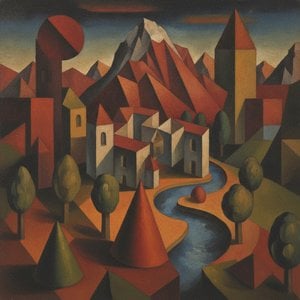
Explore the profound evolution of Cubist landscapes. Discover how masters like Braque and Picasso redefined perspective through geometric mastery, transforming nature into an intellectual mosaic of form and light for the discerning modern art collector.

Explore the profound depth of Cubist Expression. From the deconstructed forms of Picasso to Braque’s geometric mastery, discover how shattering reality through abstraction redefined modern art and continues to inspire sophisticated collectors worldwide.
 Predogled v realnem okolju
 Pošlji
 Deli
Deli
 Podrobnosti o delu
 Priročnik

 Prenesi sliko
 Podobni izdelki
 Rentgenski posnetek
 Predvajaj diaporama
 Vprašanja in odgovori
 Statistika


 Preberi več









 Možnost stekla je na voljo le za velikosti pod 110 cm


