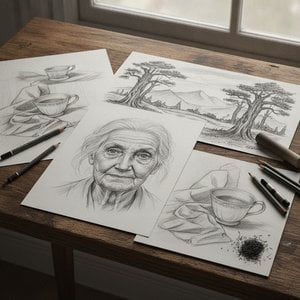
Joseph Beraton: A Spanish Painter Caught Between Tradition and Modernity
Born in Zaragoza, Spain, in 1747, Joseph Beraton’s life unfolded during a pivotal period of artistic transition – the waning years of the Baroque era and the burgeoning rise of Neoclassicism. His early training under José Luzán, a prominent Aragonese painter, laid the foundation for his technical skill, yet it was his time in Madrid, studying with Francisco Bayeu and ultimately the Royal Academy of Fine Arts, that truly shaped his artistic trajectory. Beraton’s career wasn't marked by grand commissions or widespread fame during his lifetime; instead, he primarily served as a chamber painter, meticulously crafting portraits and landscapes for aristocratic patrons, a role that afforded him a degree of stability but also limited exposure to the broader art world.
Beraton’s artistic style is often described as a nuanced blend of influences. Initially rooted in the academic traditions instilled by Bayeu – characterized by precise draftsmanship, balanced compositions, and a restrained palette – his work gradually absorbed elements of Neoclassicism while retaining a distinctly Spanish sensibility. He demonstrated a remarkable ability to capture subtle nuances of expression, particularly in his portraits, imbuing his subjects with an air of dignified reserve. His landscapes, though less frequently exhibited, reveal a keen eye for detail and a sensitivity to the natural world, often depicting scenes of rural Spain bathed in soft light.
- Key Influences: Francisco Bayeu (composition & technique), Goya (emotional depth & dramatic lighting – although this influence is more subtle), and the Neoclassical ideals promoted at the Royal Academy.
- Technique: Masterful draftsmanship, meticulous attention to anatomical detail, skillful use of hatching and shading to create volume and texture.
- Subject Matter: Primarily portraits (aristocrats, dignitaries) and landscapes of Spain.
The World of a Chamber Painter
Beraton’s life as a chamber painter offered both opportunities and constraints. He worked primarily on commission, producing works tailored to the specific tastes and requirements of his patrons. This demanded versatility – he was expected to adapt his style and subject matter to suit diverse requests. His correspondence reveals a pragmatic approach to his profession, navigating the complexities of courtly life and managing his finances with careful precision. The documents unearthed by Jesús López Ortega in Badajoz provide invaluable insights into the daily routines and social interactions of an artist operating within the confines of a royal household.
The archival materials shed light on Beraton’s family life, including his marriage to Manuela Marcelina Sánchez de Ahumada and the birth of their two children. His will, meticulously detailing his assets and bequeathing them to his heirs, underscores the importance of familial stability within his world. The meticulous record-keeping reveals a man deeply invested in securing his family’s future, a testament to the social realities of 18th-century Spain.
Lithography and the Royal Portraits
While primarily known for his oil paintings, Beraton's contribution to the field of lithography is noteworthy. He collaborated with José de Madrazo on the ambitious “Views of the Royal Sites,” a series of over 300 prints documenting the palaces, gardens, and landscapes associated with the Spanish monarchy. This project showcased Beraton’s technical proficiency in printmaking and provided him with a wider audience for his work. The meticulous detail evident in these lithographs reflects his dedication to accuracy and his understanding of the medium's potential.
Furthermore, Beraton produced drawings for the *Retratos de los españoles ilustres* series, commissioned by the Calcografía Nacional. His skillful rendering of figures like Juan José de Austria demonstrates his ability to capture likenesses with remarkable precision and a subtle awareness of character. These engravings served as important visual representations of Spain’s elite during a period of significant political and social change.
Legacy and Historical Significance
Despite not achieving widespread fame during his lifetime, Joseph Beraton's work holds considerable historical significance. He represents a crucial link between the Baroque and Neoclassical traditions in Spanish art, embodying the stylistic shifts that characterized the late 18th century. His meticulous draftsmanship, nuanced portraits, and contributions to lithography offer valuable insights into the artistic practices of his time. The recent research conducted by Jesús López Ortega has brought renewed attention to Beraton’s oeuvre, solidifying his place as a significant, albeit often overlooked, figure in Spanish art history.
His work serves as a reminder that artistic success is not always measured by immediate recognition but can be found in the quiet dedication and skillful execution of one's craft. Beraton’s legacy lies not only in his individual paintings and prints but also in his representation of a specific social milieu – the world of a chamber painter navigating the complexities of courtly life and artistic patronage.



 Predogled
 Kupi ročno naslikano sliko
 Pošlji
 Deli
Deli
 Podrobnosti o delu

 Prenesi
 Podobni izdelki
 Rentgenski posnetek
 Predvajaj diaporama


 Razviljaj več






































 Možnost stekla je na voljo le za velikosti pod 110 cm