A Realm of Solitude: Unveiling Gustave Moreau’s “Polyphème”
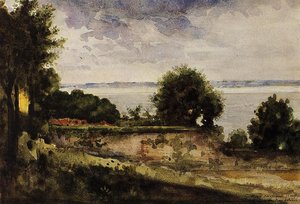
Gustave Moreau's “Polyphème” is not simply a depiction of the one-eyed giant from Homer’s *Odyssey*; it is an immersive journey into the heart of Symbolist aesthetics, a profound meditation on isolation, and a testament to the power of subjective experience. Painted during a period where artists were actively rebelling against the constraints of Realism and Naturalism, Moreau crafts a scene that transcends mere illustration, instead offering a deeply psychological portrait of a mythological figure reimagined as a symbol of human introspection.
The Weight of Thought and the Majesty of Nature
Moreau deliberately departs from traditional portrayals of Polyphème as a brutish antagonist. Here, the Cyclops is not engaged in conflict but lost in quiet contemplation, seated upon a rugged outcrop overlooking a dramatic waterfall. This shift in narrative focus reframes the giant—a figure typically associated with monstrous strength—as a melancholic being burdened by thought and circumstance. The sheer scale of the natural world surrounding him emphasizes his solitude; he is dwarfed by the cascading water and imposing rocks, utterly alone with his inner turmoil. The composition itself reinforces this sense of dramatic isolation, utilizing a strong vertical orientation that accentuates both Polyphème’s stature and the overwhelming power of nature. The loose, gestural brushstrokes contribute to a feeling of movement and instability, mirroring the turbulent emotions suggested by the scene.
A Masterful Technique: Impasto and Subdued Tones
Moreau's technical prowess is evident in his masterful use of oil paint. He employs an impasto technique—layering thick textures onto the canvas—creating a rough, uneven surface that enhances the painting’s visual richness and invites the viewer to engage with its tactile qualities. This isn’t a smooth, polished depiction; it's a visceral experience. The color palette is deliberately subdued, relying on tonal variations to create depth and atmosphere. Strategically placed shadows emphasize Polyphème’s form, drawing attention to his imposing physique while simultaneously hinting at the darkness within. This careful manipulation of light and shadow contributes significantly to the painting’s overall mood of melancholy and contemplation.
Symbolism and Legacy: Echoes of Mythology
The symbolism woven throughout “Polyphème” is rich and multi-layered. The waterfall, a central element of the composition, can be interpreted as representing both the life-giving force of nature and its destructive potential—a constant flow embodying the relentless passage of time and the cyclical nature of existence. Polyphème himself embodies introspection, perhaps even regret. He isn’t presented as a threat but as a figure weighed down by thought. Moreau frequently drew inspiration from mythology, not to simply retell ancient stories, but to explore universal themes of human psychology and spirituality. As a leading figure in the Symbolist movement, Moreau profoundly influenced later generations of artists, including Henri Matisse and Georges Rouault, solidifying his place as one of the most important painters of his time. His museum in Paris stands as a testament to his unique artistic vision, offering an immersive experience into his captivating world.
An Emotional Resonance for Contemporary Spaces
“Polyphème” evokes a powerful emotional response—a sense of melancholy, contemplation, and awe. Its dramatic composition and evocative imagery make it a compelling focal point for any interior space. The subdued color palette lends itself well to both traditional and contemporary settings, adding depth and sophistication. This artwork is particularly suited for libraries or studies, fostering an atmosphere of quiet reflection. It complements interiors with rich textures and muted tones, adding a touch of intellectual gravitas and artistic refinement. More than just a visual experience, “Polyphème” invites viewers to delve into the depths of human emotion and the mysteries of the imagination.
Vprašanja in odgovori
Kako lahko dobim digitalno datoteko dela "Polyphème" avtorja Gustav Moreua?
Digitalno sliko dela "Polyphème" avtorja Gustav Moreua lahko kupite na njegovi strani Digitalna slika: prenos digitalne slike visoke ločljivosti.
Katero tehniko in slog značilni "Polyphème" avtorja Gustav Moreua?
V delu "Polyphème" se tehnika Acrylic On Canvas srečuje z gibanjem Symbolism.
Kdaj je "Polyphème" pripisano kateremu umetniku?
Avtor dela "Polyphème" je Gustav Moreua. Del je katalogiran pod imenom Gustav Moreua.



 Preverite v realnem okolju
 Preklop na tiskanine
 Pošlji kot čestitko
 Deli
Deli
 Podrobnosti
 Priročnik

 Prenesi
 Podobni artefakti
 Rentgenski posnetek
 Predvajaj diaporama
 Statistika
 Preberi več