Biografija umetnika
A Life Immersed in Victorian Narrative: George Bernard O'Neill
George Bernard O’Neill, born in Dublin on July 17th, 1828, was a painter who dedicated his life to capturing the essence of Victorian society and rural life with remarkable detail and warmth. He wasn’t a revolutionary figure challenging artistic conventions; rather, he was a master storyteller, translating everyday moments into charming and evocative scenes that resonated deeply with the sensibilities of his time. O'Neill came from a large family – one of fifteen children born to an Ordnance clerk in Dublin – and arrived in England with his family in 1837, receiving early schooling in Woolwich before gaining acceptance into the prestigious Royal Academy Schools in 1845. This formal training provided him with a solid foundation in technique and composition, setting the stage for a prolific career that spanned over four decades.
Early Success and Artistic Influences
O’Neill quickly established himself as a promising talent, exhibiting regularly at the Royal Academy from 1847 onwards. His early works demonstrated an awareness of Old Master painters, particularly Dutch genre scenes, which heavily influenced his preference for intimate settings and balanced compositions. He wasn't merely copying styles; he was absorbing them, blending them with a distinctly Irish sensibility and a growing fascination with narrative detail. The Foundling, exhibited in 1852, is an excellent example of this early period – a touching depiction of an orphaned child that showcased his ability to evoke emotion through careful observation and skillful brushwork. His style also bore the clear mark of David Wilkie, whose humorous scenes of childhood and everyday life provided a significant model for O’Neill's own developing aesthetic. This focus on relatable subjects, imbued with both sentimentality and gentle humor, quickly garnered him recognition among collectors.
The Cranbrook Colony: A Creative Hub
A pivotal moment in O’Neill’s career came in 1859 when he joined the Cranbrook Colony, a group of artists who had established a creative community in the small Kentish town of Cranbrook. This wasn't an isolated artistic movement with a strict manifesto; it was more a gathering of like-minded painters – including Thomas Webster and the Hardy brothers – who shared similar aesthetic values and a passion for depicting rural life. In 1860, O’Neill leased Old Wilsley House near Cranbrook, establishing a summer home and studio that became central to his artistic practice. The idyllic countryside provided endless inspiration, becoming the backdrop for many of his most beloved works. This period saw him painting scenes of virtuous innocence, often with a touch of comical charm, perfectly tailored to appeal to the tastes of the burgeoning middle class.
Themes and Techniques: Capturing Victorian Life
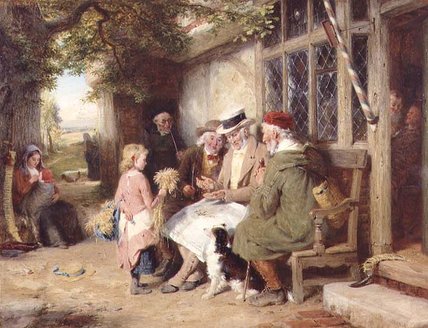
O’Neill's paintings are characterized by their meticulous attention to detail, balanced compositions, and warm color palettes. He excelled at capturing the textures of everyday life – the worn fabric of clothing, the rustic furnishings of a cottage interior, the vibrant colors of a harvest scene. His subjects often revolved around domesticity, rural labor, and social gatherings, offering glimpses into the lives of ordinary people. Public Opinion, exhibited in 1863, is particularly noteworthy as it reflects his keen observation of Victorian society and its evolving dynamics. He frequently depicted scenes with multiple figures, creating lively group portraits that captured a sense of community and interaction. His technique was refined but not overly ostentatious; he prioritized clarity and narrative over dramatic brushwork or experimental approaches. He worked on a small domestic scale, making his paintings accessible and inviting to a wide audience.
Legacy and Historical Significance
George Bernard O’Neill died in 1917, leaving behind a substantial body of work that continues to be admired for its charm, detail, and insightful portrayal of Victorian life. While he may not be as widely recognized as some of his contemporaries, his paintings offer a valuable window into the social values, customs, and aesthetics of the 19th century. He was a successful artist in his own time, eagerly collected by industrialists and entrepreneurs who appreciated his ability to capture the essence of their world. Today, his works are found in museums and private collections around the globe, serving as enduring reminders of a bygone era and the power of art to tell compelling stories about the human experience.



 Kupi tiskanino
 Pošlji
 Deli
Deli
 Podrobnosti o delu

 Prenesi
 Podobni izdelki
 Rentgenski posnetek
 Predvajaj diaporama
 Razviljaj več





