Preverite v realnem okolju Predogled v AR Naročite ročno slikano reprodukcijo Preklop na digitalno sliko Pošlji kot čestitko
Podrobnosti Priročnik Dodaj v priljubljene Prenesi Podobni artefakti Rentgenski posnetek Predvajaj diaporama Statistika

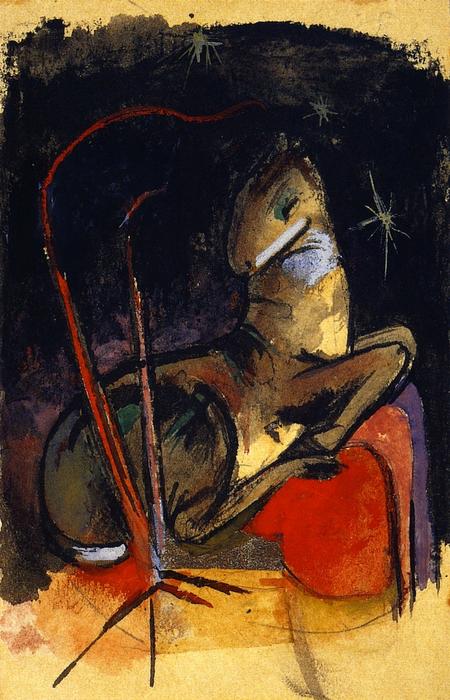
Resting Animal

Franz Marc’s 'Resting Animal' (1913) is a poignant Expressionist watercolor capturing introspective sadness through loose brushstrokes & muted tones. Explore this evocative piece, reflecting vulnerability and a timeless mood.

Raziskujte Franza Marca (1880–1916), voditelja nemške ekspresionistične umetnosti in soustanovitelja Der Blaue Reiterja! Odkrijte njegove ikonične slike živali, živahne barve ter duhovno pomembnost. Naučite se več o njegovem dedišču!

Giclée tisk / Umetniški tisk

Giclée ali platnati odtis muzejske kakovosti z hitro proizvodnjo in prilagodljivimi možnostmi končne obdelave. ( Naročite ročno slikano reprodukcijo Preklop na digitalno sliko)

Corner sample of the P118B picture frame: izoblit polistiren, 5 cm wide and 3 cm thick
P118B €10
Corner sample of the P118H picture frame: izoblit polistiren, 5 cm wide and 3 cm thick
P118H €10
Corner sample of the P118W picture frame: izoblit polistiren, 5 cm wide and 3 cm thick
P118W €10
Corner sample of the P438Z picture frame: izoblit polistiren, 5.5 cm wide and 3.5 cm thick
P438Z €10
Corner sample of the P508JH picture frame: izoblit polistiren, 7 cm wide and 3.5 cm thick
P508JH €12
Corner sample of the P508YH picture frame: izoblit polistiren, 7 cm wide and 3.5 cm thick
P508YH €12
Corner sample of the P805H picture frame: izoblit polistiren, 5 cm wide and 3.5 cm thick
P805H €10
Corner sample of the P805Z picture frame: izoblit polistiren, 5 cm wide and 3.5 cm thick
P805Z €10
Corner sample of the P919BZ picture frame: izoblit polistiren, 7 cm wide and 3.5 cm thick
P919BZ €10
Corner sample of the P919G picture frame: izoblit polistiren, 7 cm wide and 3.5 cm thick
P919G €10
Corner sample of the P919XJ picture frame: izoblit polistiren, 7 cm wide and 3.5 cm thick
P919XJ €10
Corner sample of the P959ZH picture frame: izoblit polistiren, 5 cm wide and 3 cm thick
P959ZH €10
Corner sample of the P968JZ picture frame: izoblit polistiren, 6 cm wide and 4 cm thick
P968JZ €12
Corner sample of the W106C picture frame: masivno drevo, 5 cm wide and 3 cm thick
W106C €8
Corner sample of the W218G picture frame: masivno drevo, 5 cm wide and 3 cm thick
W218G €10
Corner sample of the W218JH picture frame: masivno drevo, 5 cm wide and 3 cm thick
W218JH €8
Corner sample of the W218Y picture frame: masivno drevo, 5 cm wide and 3 cm thick
W218Y €10
Corner sample of the W307PJ picture frame: masivno drevo, 6 cm wide and 3 cm thick
W307PJ €10
Corner sample of the W316G picture frame: masivno drevo, 6 cm wide and 3 cm thick
W316G €10
Corner sample of the W316PJ picture frame: masivno drevo, 6 cm wide and 3 cm thick
W316PJ €8
Corner sample of the W316Y picture frame: masivno drevo, 6 cm wide and 3 cm thick
W316Y €10
Corner sample of the W398PJ picture frame: masivno drevo, 5 cm wide and 3 cm thick
W398PJ €8
Corner sample of the W4111J picture frame: masivno drevo, 6.5 cm wide and 3.5 cm thick
W4111J €10
Corner sample of the W500HY picture frame: masivno drevo, 7 cm wide and 5 cm thick
W500HY €15
Corner sample of the W500JH picture frame: masivno drevo, 7 cm wide and 5 cm thick
W500JH €15
Corner sample of the W692G picture frame: masivno drevo, 8 cm wide and 4 cm thick
W692G €12
Corner sample of the W849H picture frame: masivno drevo, 5 cm wide and 3 cm thick
W849H €8
Corner sample of the W940BG picture frame: masivno drevo, 7.5 cm wide and 4.5 cm thick
W940BG €15
Corner sample of the W953PJ picture frame: masivno drevo, 6 cm wide and 3.5 cm thick
W953PJ €8

Standardna velikost
po meri
CM
INCH

Izberite eno od naših vnaprej določenih velikosti, ki ustrezajo prvotnim proporcijam umetničkega dela.

širina
višina

Vnesite širino in višino, ki jih potrebujete za svoj okvir ali steno. Tiskanje se lahko le odreže, vendar ga ni mogoče narediti večjega od slike, zato format z drugačno obliko pomeni izgubo dela slike. Pred tiskanjem vam pošljemo digitalni predogled za potrditev. Slika, prikazana na tej strani, ne prikazuje dejanskega izrezkov — le predogled to omogoča.

Globalna dostava () v 2 tednih namesto standardnih 4/5 tednov. (25 oktober)

Brezplačna ekspresna dostava po vsem svetu
Visokokakovostno laneno platno
Popolno zavarovanje pošiljke
Garancija povračila carine in uvoznih davkov
Garancija popolnega barvnega ujemanja
Politika vračila v 100 dneh (le v primeru okvar)
Garancija 100% povračila denarja
Popust pri večjem naročilu

Skupna cena

€ 60

Resting Animal

Giclée tisk / Umetniški tisk

Velikost reprodukcije

-

Skupna cena

€ 60

Hitri podatki

  • influences: Vincent van Gogh
  • medium: Watercolor on paper
  • movement: Expressionism
  • style: Expressionism

Kviz o umetnosti

Pri vsakem vprašanju je na voljo le eden pravilen odgovor.

Vprašanje 1:
To which art movement does Franz Marc's 'Resting Animal' (1913) most closely belong?
Vprašanje 2:
What is a prominent characteristic of the technique used in 'Resting Animal'?
Vprašanje 3:
The description notes the composition is dominated by what type of lines?
Vprašanje 4:
What overall mood or feeling does the artwork evoke, according to the description?

A Moment of Quietude: Exploring Franz Marc’s ‘Resting Animal’ (1913)

Franz Marc's *Resting Animal*, painted in 1913, is a captivating watercolor that embodies the core tenets of early Expressionism. More than just a depiction of an animal at rest, it’s a poignant exploration of inner life, vulnerability, and the search for spiritual connection with nature – themes central to Marc's artistic vision.

Subject & Style: Beyond Realistic Representation

The artwork presents a somewhat abstracted figure, likely a deer or similar ungulate, enveloped in a mood of quiet contemplation. While not explicitly detailed, the form is recognizable enough to evoke empathy and invite projection. Marc deliberately moves away from strict realism, favoring instead an expressive style characterized by loose brushstrokes and simplified forms. This isn’t about *what* is depicted, but *how* it feels. The diagonal composition contributes to a sense of unease or inward focus, mirroring the animal's introspective state. Marc wasn’t interested in portraying animals as simply biological creatures; he saw them as possessing an inherent spirituality and purity lacking in human society.

Technique & Materials: Watercolor’s Emotional Range

Executed in watercolor on paper, *Resting Animal* showcases Marc's masterful handling of the medium. The wet-on-wet technique creates soft edges and blended colors, enhancing the dreamlike quality of the scene. The layering of washes builds texture and depth despite the flattened perspective. This approach allows for a fluidity that perfectly complements the subject’s relaxed posture and the overall melancholic mood. The muted tones – grays, browns, and subtle blues – further contribute to this somber atmosphere, while still allowing light to subtly permeate the composition.

Historical Context: Der Blaue Reiter & A World on the Brink

1913 was a pivotal year for Marc, deeply involved with the *Der Blaue Reiter* (The Blue Rider) group alongside Wassily Kandinsky and other avant-garde artists. This collective sought to move beyond purely representational art, exploring spirituality, symbolism, and emotional expression through abstraction and bold color. The looming shadow of World War I also casts a subtle weight over this work; a sense of premonition and fragility permeates many artworks created in the years leading up to the conflict. Marc’s focus on the natural world can be interpreted as a yearning for peace and harmony amidst growing societal tensions.

Symbolism & Emotional Impact: A Universal Language

The symbolism within *Resting Animal* is deliberately understated, allowing for multiple interpretations. The animal's posture – leaning forward, head lowered – suggests vulnerability, introspection, and perhaps even a sense of weariness. It’s an image that resonates with the human condition, inviting viewers to contemplate their own moments of solitude and reflection. The painting isn’t about sadness itself, but about acknowledging and accepting it as part of life's spectrum. The dark background emphasizes this feeling of isolation, while also serving to highlight the animal’s form. Marc believed animals were closer to a primal spiritual truth than humans, and this work invites us to reconnect with that innate sense of peace and belonging.

For Collectors & Designers: Bringing Expressionism into Your Space

*Resting Animal* is an exceptional example of Franz Marc’s unique artistic voice. Its subdued palette and evocative imagery make it a versatile piece for interior design, lending itself well to both modern and traditional settings. A high-quality reproduction would serve as a striking focal point in a study, living room, or bedroom – offering a touch of contemplative beauty and intellectual depth. Its enduring appeal lies in its ability to transcend time and culture, speaking directly to the universal human experience.

Vprašanja in odgovori

V katero obdobje Franc Markoove kariere spada "Resting Animal", glede na datum njegove powstale?

"Resting Animal", ustvarjeno leta 1913, pripada Early Period v karieri umetnika Franc Marko.

Priporočena velikost in orientacija za tiskanje dela "Resting Animal" – kakšna velikost, kakšna orientacija?

Za tiskanje dela "Resting Animal" avtorja Franc Marko priporočamo velikost Large v Portrait orientaciji.

Katera tehnika je bila uporabljena za "Resting Animal" avtorja Franc Marko?

Tehnika za delo "Resting Animal" avtorja Franc Marko je Acrylic On Canvas. Različice imajo za namen natančno prikazati videz te tehnike.


Biografija umetnika

Franz Marc – Cromer Artspace

Der Blaue Reiter

Franz Marc, nemški slikar, risar in grafik, * 8. februar 1880, München, Nemško cesarstvo (zdaj Nemčija), † 4. marec 1916, Braquis, Francija.

Velja za enega najpomembnejših ekspresionističnih slikarjev v Nemčiji. Ob Vasiliju Kandinskim je bil soustanovitelj uredniške skupine Der Blaue Reiter, ki je svojo prvo razstavo odprla v Münchnu 18. decembra 1911. Blaue Reiter je nastal iz Novega münchenskega združenja umetnikov, katerega član je bil Marc kratek čas.

Marc je imel zamisel o študiju klasične filologije ali teologije kot njegov starejši brat Paul - kot je v pismu leta 1897 povedal pastorju Ottu Schlierju, katerega tečaji birme so nanj naredili trajen vtis.

Marc je študiral umetnostno-teoretične spise za almanah Der Blaue Reiter in druge publikacije.

Early Life

Franz Marc se je rodil 8. februarja 1880 kot drugi sin družine Marc na Schillerstrasse 35 v Münchnu. Njegov oče Wilhelm Marc, ki je sprva končal pravo, preden je študiral slikarstvo na Akademiji za likovno umetnost v Münchnu, je bil krajinski in žanrski slikar.

Izhajal iz bavarske uradniške družine. Njegova mati Sophie, rojena Maurice, je prišla iz Alzacije in je otroštvo preživela v francosko govoreči Švici, kjer je obiskovala strogi kalvinistički internat.

Njegovi predniki bili aristokrati, z prijatelji med umetniki kot tudi ljudmi znanstvenimi.

Influences and Artistic Development

Marc je študiral literaturo in filozofijo, zlasti delo Thomasa Carlyla in Friedricha Nietzscheja. Zaradi težav v mladosti je bila njegova vera zelo kritična do Münchnega mladostnega gibanja in mesta življenja.

Njegov brat Paul je študiral klasično filologijo kot njegov starejši brat Paul - kot je v pismu leta 1897 povedal pastorju Ottu Schlierju, katerega tečaji birme so nanj naredili trajen vtis.

Njegova zgodnja dela še v naturalističnem slogu akademizma, vendar se po obisku Pariza leta 1907 pod vplivom Gauguina in van Gogha posvetil postimpresionizmu. Marc je študiral umetnostno-teoretične spise za almanah Der Blaue Reiter in druge publikacije.

Der Blaue Reiter and Artistic Vision

Marc je ustanovni član skupine Der Blaue Reiter (Modri ​​jezdec) v Münchnu leta 1911. Blaue Reiter je nastal iz Novega münchenskega združenja umetnikov, katerega član je bil Marc kratek čas.

Marc je ustvarjal umetnostno-teoretične spise za almanah Der Blaue Reiter in druge publikacije.

Major Achievements and Legacy

Marc je ustvarjal umetnostno-teoretične spise za almanah Der Blaue Reiter in druge publikacije.

Marc je umrl 4. marca 1916, v času Prve svetovne vojne, kar je bila tragedija za svet umetnosti.

Njegovo delo še vedno resonira danes, zavzdihnjuje generacije umetnikov in očarati občinstvo z globoko emotivnostjo in duhovno vrednostjo. Marc je znan kot pionir nemške ekspresionistične umetnosti.

Franc Marko

Franc Marko

1880 - 1916 , Nemčija

Ključne informacije

  • Artistic Movement Or Style: Nemška ekspresionistična umetnost
  • Artists Who Influenced This Artist:
    • Vincent van Gogh
    • Robert Delaunay
  • Date Of Birth: 8. februar 1880
  • Date Of Death: 4. marec 1916
  • Full Name: Franz Moritz Wilhelm Marc
  • Nationality: Nemški
  • Notable Artworks:
    • The Tiger
    • Red Deer
    • Tower of Blue Horses
  • Place Of Birth: Münich, Nemčija
Raziščite umetniška dela, razvrščena po temah, slogih in značilnostih.