


Ročno slikano olje na platnu v vaši izbiri velikosti in okvirja, izdelano po naročilu naših umetnikov. ( Kupi tisk Kupi digitalno sliko)





























Izberite eno od naših vnaprej določenih velikosti, ki ustrezajo prvotnim proporcijam umetničkega dela.

Svoje dimenzije lahko vnesete tako, da se prilagodite določenemu okvirju ali prostoru. Če izbrana velikost ne ustreza razmerjem originalne slike, bomo umetniško delo obrezali ali sliko dopolnili z dodatnimi ročno naslikanimi elementi. Pred začetkom proizvodnje vam bo poslan digitalni osnutek v odobritev.
Upoštevajte, da predogled na zaslonu ne odraža dejanskega obrezovanja ali podaljšanja. Le osnutek bo natančno prikazal končno kompozicijo.
Čeprav so na voljo velikosti po meri, priporočamo izbiro dimenzije s preddefiniranega seznama, da ohranimo originalne razmere.
Svetska dostava () za 3/4 nedelje umesto uobičajenih 5 nedelja. (6 september). Bez kompromisa po pitanju kvaliteta.


Leda Y El Cisne
Velikost reprodukcije

The history of the Spanish Baroque is often told through the lens of its most famous titans, yet the tapestry of this era is woven with the threads of masters like Eugenio Cajes. Born in Madrid around 1575, Cajes was a painter whose very identity was a bridge between cultures. Though his life was rooted in the Spanish capital, his artistic soul was deeply shaped by a Florentine lineage. As the son of Patricio Cajés—a talented artist recruited to Spain by the ambassador Luis de Requesens—Eugenio inherited a legacy steeped in the refined traditions of Italy. This dual heritage allowed him to infuse the grandeur of the Spanish court with the sophisticated elegance of the Florentine school, creating a style that was both locally resonant and internationally informed.
The evolution of Cajes’s technique is a journey through the most transformative artistic movements of his time. His early years were marked by the classical influences of his father, a disciple of Alessandro Allori, which instilled in him a respect for balanced composition and anatomical precision. However, the true metamorphosis occurred around 1595, when Cajes traveled to Rome. Immersed in the vibrant, turbulent atmosphere of the Eternal City, he witnessed the dawn of Caravaggio’s naturalism. This exposure to the dramatic use of chiaroscuro—the interplay of profound shadow and piercing light—would become a hallmark of his mature work, lending an emotional intensity and a palpable sense of drama to his religious and historical narratives.
Cajes’s professional ascent was inextricably linked to the highest echelons of Spanish power. His talent earned him a prestigious position within the royal courts of King Philip II and Philip III, eventually being appointed as a Painter to the King in August 1612. This role granted him access to the most significant architectural and religious projects of the age. One of his most breathtaking achievements was the decoration of the royal audience chamber in Madrid, where he executed a monumental depiction of Solomon’s Judgment upon the vault. Such works required not only technical skill but an ability to manage vast, complex compositions that could command the attention of a monarch.
Beyond the palace walls, Cajes left an indelible mark on Spain's sacred spaces. His collaborative spirit was evident in his work with Vincenzo Carducci, particularly in the decoration of the chapel of Our Lady del Sagrario in Toledo. He also contributed significant canvases to the retablo mayor of the Monastery of Guadalupe, demonstrating a versatility that allowed him to move seamlessly between intimate devotional pieces and massive, multi-figure altarpieces. His ability to weave together biblical storytelling with the opulent textures of the Baroque era made him a preferred hand for the most important ecclesiastical commissions in the kingdom.
The enduring significance of Eugenio Cajes lies in his ability to synthesize disparate influences into a cohesive, emotive language. Whether he was depicting the mythic allure of Leda and the Swan or the profound solemnity of The Adoration of the Magi, his work always sought to capture the divine within the human. In his religious paintings, the figures are not merely icons; they are characters imbued with a sense of weight, breath, and spiritual yearning. His mastery of detail—the shimmer of silk, the glint of gold, and the soft glow of skin—served to ground his grand narratives in a reality that felt both miraculous and immediate.
Though some of his most ambitious works, such as his large-scale historical canvas on the History of Agamemnon, have been lost to the passage of time, the remnants of his oeuvre continue to fascinate scholars and art lovers alike. Cajes remains a vital figure for understanding the complexity of the Spanish Baroque, representing a moment when the traditions of Italy and the ambitions of Spain converged to create something truly transcendent. His life and work stand as a testament to the power of artistic lineage and the transformative impact of cultural exchange.

1575 - 1634 , Spain

Embark on a sophisticated journey through the eternal allure of mythological art. Discover how master painters breathe life into ancient legends, from Greek deities to Baroque masterpieces, and learn to curate these timeless narratives within your own exquisite art collection.
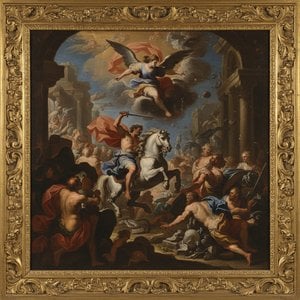
Explore the breathtaking power of Baroque art. Delve into the dramatic interplay of light, shadow, and motion through the works of masters like Caravaggio. Discover how the era's intense emotional realism continues to inspire collectors and connoisseurs of classical grandeur.

 Predogled
 Pošlji
 Deli
Deli
 Podrobnosti o delu

 Prenesi
 Podobni izdelki
 Rentgenski posnetek
 Predvajaj diaporama
 Razviljaj več







 Možnost stekla je na voljo le za velikosti pod 110 cm


