Biografija umetnika
Early Life and Artistic Awakening
Romain de Tirtoff, universally recognized as Erté, was born into a world of aristocratic heritage in Saint Petersburg, Russia, on November 23rd, 1892. His lineage traced back centuries to Tatar khans—a noble pedigree that instilled within him an inherent appreciation for tradition and grandeur. His father, Admiral Vladimir Petrovich Tirtoff, served with distinction in the Imperial Russian Navy, shaping young Romain’s understanding of discipline and ambition. Yet, despite these expectations to follow a naval path, Romain possessed an irresistible passion for artistic expression—a fascination ignited by his mother, Maria Nikolaevna Polenova, who nurtured his talent with unwavering devotion. Legend recounts that at just five years old, Romain sketched an evening gown for his mother, a feat of prodigious skill that astonished seamstresses and foreshadowed his lifelong dedication to visual art.
This internal conflict—the desire for artistic freedom versus familial obligations—propelled him toward adopting the pseudonym “Erté”—a clever adaptation of his initials—to safeguard his family’s reputation as he pursued a career they might not wholeheartedly endorse. In 1910, at eighteen, Romain bravely severed ties with Russia and embarked on an audacious journey to Paris—the undisputed epicenter of artistic innovation and fashion—transforming his destiny irrevocably.
Parisian Flourishing and the Birth of an Art Deco Icon
Arriving in Paris armed only with his innate talent and unwavering determination, Erté swiftly immersed himself within the vibrant Parisian art scene. Initially employed as a draughtsman, he rapidly ascended beyond mere technical proficiency, driven by aspirations that soared far above conventional roles. A pivotal encounter occurred when he presented his portfolio to Paul Poiret—the celebrated “King of Fashion”—who immediately discerned Romain’s exceptional gift for design and propelled him into the heart of haute couture. This collaboration proved invaluable, providing Erté with firsthand experience in costume and accessory creation—a formative period that solidified his position as a rising star within Parisian fashion circles.
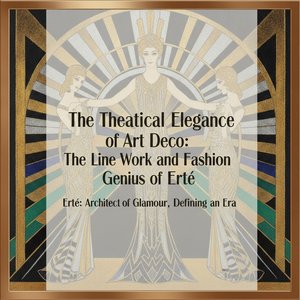
However, it was his association with Harper's Bazaar that truly cemented Erté’s artistic legacy. From 1915 to 1936, he graced over two hundred covers with breathtaking illustrations—a remarkable testament to consistency and creativity—transforming magazine pages into canvases of opulent beauty. These weren’t merely fashion plates; they were masterful works of art—elongated figures draped in lavish costumes against stylized backgrounds—capturing the spirit of Art Deco's glamorous aesthetic. Erté didn’t simply depict fashion; he defined it, embodying an era characterized by sophistication and modernity. His distinctive style—characterized by bold lines, geometric shapes, and luxurious color palettes—became synonymous with the movement itself.
Beyond Fashion: Theater, Hollywood, and Artistic Evolution
Erté's artistic versatility extended far beyond the realm of fashion illustration. He demonstrated a remarkable aptitude for theatrical design, crafting costumes and sets for numerous productions at prestigious venues like Folies-Bergère and Ziegfeld Follies—transforming stage spaces into immersive experiences that captivated audiences. His designs weren’t merely garments; they were transformative creations—bringing characters to life and amplifying the dramatic impact of each performance—reflecting his profound understanding of visual storytelling. This foray into theater allowed him to explore his creativity on a grand scale, experimenting with color, texture, and form in ways that further refined his artistic vision.
In 1925, Erté ventured westward, accepting a lucrative contract with Metro-Goldwyn-Mayer Studios in Hollywood—a pivotal moment that broadened his horizons and exposed him to a new audience. While his time in film was relatively brief, it nonetheless enriched his artistic repertoire—allowing him to collaborate on projects that showcased his versatility and cemented his reputation as a celebrated designer. Throughout this period, Erté’s style underwent subtle yet significant evolution—shifting from Art Nouveau's flowing lines toward Art Deco's geometric precision—reflecting the dynamic artistic currents of the time.
Legacy and Enduring Influence
Erté’s influence reverberates throughout art history—recognized as a pioneer of Art Deco, shaping its visual language and inspiring generations of artists and designers. His designs have permeated fashion trends, interior design aesthetics, and graphic arts—continuing to captivate contemporary creatives with their elegance and sophistication. Erté received numerous accolades in recognition of his contributions to the arts—including Chevalier du Mérite Artistique et Culturel from the French government—a testament to his unwavering dedication to artistic excellence. He passed away peacefully in Paris on April 21st, 1990, at the age of ninety-seven—leaving behind a legacy that transcends time and continues to inspire awe and admiration. His work remains an enduring symbol of beauty, innovation, and the transformative power of artistic vision.



 Predogled
 Preklop na tiskanine
 Pošlji
 Deli
Deli
 Podrobnosti o delu

 Prenesi
 Podobni izdelki
 Rentgenski posnetek
 Predvajaj diaporama
 Statistika
 Razviljaj več






































 Možnost stekla je na voljo le za velikosti pod 110 cm