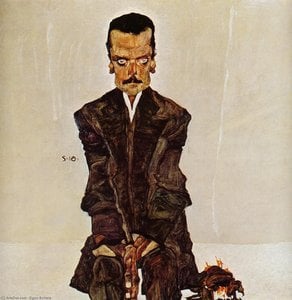
Ročno slikano olje na platnu v vaši izbiri velikosti in okvirja, izdelano po naročilu naših umetnikov. ( Preklop na tiskanine
Preklop na digitalno sliko)
Izberite eno od naših vnaprej določenih velikosti, ki ustrezajo prvotnim proporcijam umetničkega dela.
Svoje dimenzije lahko vnesete tako, da se prilagodite določenemu okvirju ali prostoru. Če izbrana velikost ne ustreza razmerjem originalne slike, bomo umetniško delo obrezali ali sliko dopolnili z dodatnimi ročno naslikanimi elementi. Pred začetkom proizvodnje vam bo poslan digitalni osnutek v odobritev.
Upoštevajte, da predogled na zaslonu ne odraža dejanskega obrezovanja ali podaljšanja. Le osnutek bo natančno prikazal končno kompozicijo.
Čeprav so na voljo velikosti po meri, priporočamo izbiro dimenzije s preddefiniranega seznama, da ohranimo originalne razmere.
Mednarodna dostava () v 3/4 tednih namesto običajnih 5 tednov. (26 september). Brez kompromisov pri kakovosti.
Seated Woman, Back View
Velikost reprodukcije
Egon Schiele's “Seated Woman, Back View,” painted in 1917, is not merely a portrait; it’s a distilled essence of anxiety, vulnerability, and the unsettling beauty found within human form. Created during a turbulent period in Schiele’s life – a time marked by illness, loss, and an increasingly fraught relationship with his wife, Edith Harms – this watercolor on paper offers a poignant glimpse into the artist's intensely personal world. The work immediately arrests the eye with its muted palette of blues and yellows, colors that simultaneously evoke both melancholy and a subtle, almost feverish energy. Schiele’s signature, delicately placed in the lower right corner, serves as a quiet marker of ownership over this deeply felt image, a testament to his singular vision.
What immediately draws attention is the woman's posture – seated, yet profoundly withdrawn. Her back is turned to the viewer, creating an immediate sense of intimacy and exclusion. This deliberate choice forces us to confront her presence not through direct gaze but through suggestion, a technique Schiele frequently employed to amplify emotional impact. The figure’s limbs are drawn upwards, almost as if seeking support or attempting to shield herself from something unseen. The striped shirt and dress, rendered in a restrained palette of blues and yellows, hint at a conventional appearance – a respectable lady – yet the positioning of her lower body, clad in a stark white lace slip and dark stockings, introduces an element of unsettling contrast. This juxtaposition speaks volumes about Schiele’s complex and often contradictory perceptions of femininity, hinting at both admiration and a certain degree of unease.
Schiele was a pivotal figure in the development of Expressionism, an artistic movement characterized by its subjective emotional expression rather than objective representation. In “Seated Woman, Back View,” this is powerfully evident. The loose brushstrokes, the distorted proportions, and the intense color choices all contribute to a sense of psychological turmoil. The painting isn’t concerned with capturing a realistic likeness; instead, it aims to convey an internal state – a feeling of isolation, perhaps even despair. Schiele's use of watercolor lends itself particularly well to this expressive intent, allowing for delicate gradations of tone and the creation of atmospheric effects that heighten the sense of mood.
Considering Schiele’s personal life at the time of painting – his father's death from syphilis, the loss of his sister Elvira, and the growing strain within his marriage – it’s not surprising that “Seated Woman, Back View” is imbued with a sense of profound sadness. The woman’s averted gaze can be interpreted as a shield against an unbearable reality. The contrast between her upper body, suggesting respectability, and her lower body, hinting at vulnerability and perhaps even shame, mirrors the complexities of Schiele's own emotional landscape. Some art historians have suggested that the figure represents Edith Harms, reflecting Schiele’s ambivalent feelings towards his wife – a woman he both loved deeply and struggled to fully understand. The painting becomes a visual embodiment of this internal conflict, a poignant meditation on love, loss, and the fragility of human existence.
WahooArt offers meticulously crafted hand-painted reproductions of Egon Schiele’s “Seated Woman, Back View,” allowing you to bring this powerfully evocative artwork into your home or office. Each reproduction is created by skilled artists using traditional techniques, ensuring a faithful and stunning representation of Schiele's original vision. Explore our collection today and experience the raw emotion and enduring beauty of this masterpiece.

Austrian art has since acquired legendary status in interdisciplinary cultural studies. Histories of modern Austrian art generally begin with the architectural boom that swept Vienna in the second half of the nineteenth century. During this period of strong economic growth, the Emperor Franz Josef constructed a necklace of public edifices along the broad Ringstrasse that encircles Vienna’s inner city, prompting artists to flock to the capital from all over to compete for decorative mural commissions. The most renowned painter of the era was Hans Makart, but the young Gustav Klimt also earned his reputation executing commissions on the interior walls of structures such as theaters and museums. The favored style combined a sort of blowsy eroticism with a firm grip on classical and historical allegory. Starting from his masterpiece *The Kiss*, Klimt gradually moved away from the accepted formula, however, evolving a personal symbolism that was less conventionally readable as well as more overtly sexual. This combination proved devastating so far as the tasted of staid Vienna were concerned: Klimt was banished from the ranks of public muralists, and henceforth had to seek support solely from well-heeled private patrons.
Egon Schiele was born in Tulln an der Donau – a picturesque region with vineyards, onion-domed towers and Baroque monasteries. Yet this idyllic setting is hardly reflected in his work.
Instead, many of his landscapes appear melancholic, sometimes sombre. Perhaps he was processing the early death of his father from syphilis and the subsequent loss of his sister Elvira.
Raised initially by his mother and then under the somewhat controlling guardianship of his uncle Leopold Czihaczek, Schiele’s childhood lacked conventional stability but fostered a fiercely independent spirit. Even as a boy, he displayed an intense fascination with trains—a motif that subtly reappeared in later paintings—and a burgeoning talent for drawing, though this was initially met with disapproval from his father who saw it as a distraction from more practical pursuits. The early death of his sister Elvira also cast a long shadow over the young artist’s psyche. These formative experiences instilled within him a sensitivity and an emotional rawness that would become hallmarks of his artistic expression, a constant grappling with themes of life, death, and the human condition.
Schiele's formal artistic training began at the Kunstgewerbeschule (School of Arts and Crafts) in Vienna, but he quickly found itself stifled by its conservative approach. He transferred to the Akademie der bildenden Künste (Academy of Fine Arts), only to become further disillusioned with its rigid academic traditions. This dissatisfaction led him to abandon formal training altogether, choosing instead to forge his own path, a testament to his unwavering artistic conviction.
The influence of Gustav Klimt was pivotal during these early years; Schiele admired Klimt’s decorative style and exploration of symbolism, even receiving mentorship from the established artist.
He co-founded the Neues Wiener Kunstgruppe (New Viennese Art Group) in 1909, aligning himself with other progressive artists who challenged the prevailing artistic norms. His distinctive style features elongated figures, contorted poses, and expressive lines that convey a sense of unease and emotional intensity.
Schiele’s art is immediately recognizable for its raw honesty and psychological depth.
He fearlessly confronted themes often considered taboo – sexuality, death, anxiety, isolation – with an unflinching gaze.
His distinctive style features elongated figures, contorted poses, and expressive lines that convey a sense of unease and emotional intensity. The human form, particularly the nude, became his primary subject, not as an object of idealized beauty but as a vessel for exploring the complexities of human experience.
Schiele didn’t shy away from depicting himself in unflattering or vulnerable poses, revealing a profound level of self-awareness and introspection.
Despite facing censorship and legal challenges – including a brief imprisonment for allegedly corrupting minors with his art – Schiele gained recognition within Vienna’s avant-garde circles.
His work challenged the conventions of the time, provoking both admiration and outrage.
By the time of his untimely death during the Spanish flu pandemic in 1918 at the age of twenty-eight, he had established himself as a leading figure in Austrian Expressionism. Significant works such as *Self-Portrait with Physalis*, *Couple Embracing*, and *Field Landscape (Kreuzberg near Krumau)* stand as testaments to his artistic genius.
His influence on subsequent generations of artists is undeniable, particularly those interested in exploring psychological themes and challenging conventional artistic norms.
1890 - 1918 , Avstrija